
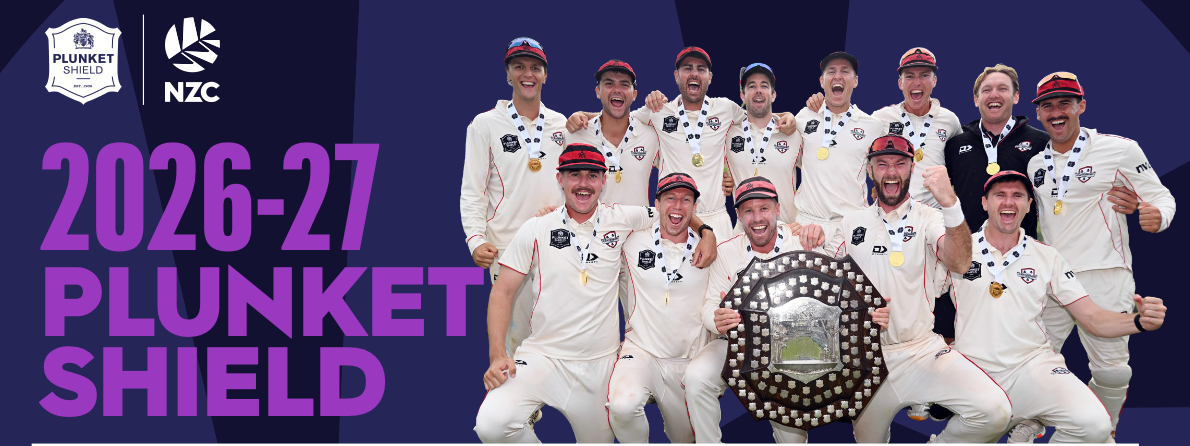
New Zealand’s domestic cricket calendar is about to swing firmly back towards the longest form of the game, with the full 2026-27 Plunket Shield schedule now confirmed and 24 first-class matches set to be played across nine venues around Aotearoa.
The competition returns for its 101st season, placing one of New Zealand sport’s oldest trophies back at the centre of a summer packed with red-ball cricket.
Alongside the Plunket Shield, the BLACKCAPS are set for Test cricket against India and Sri Lanka at home and Australia away, while New Zealand A will host India A for three four-day matches in Christchurch from 24 October.
For established domestic players and those trying to push towards international selection, the timing creates an unusually clear pathway.
Perform for New Zealand A.
Carry that form into the Plunket Shield.
And a BLACKCAPS opportunity may not be far away.
2026-27 Plunket Shield at a glance
| Detail | 2026-27 season |
|---|---|
| Competition season | 101st |
| Teams | 6 |
| Rounds | 8 |
| Matches | 24 |
| Venues | 9 |
| Opening round | 19 November 2026 |
| First block | November-December 2026 |
| Mid-season break | Super Smash and Ford Trophy |
| Competition resumes | 1 March 2027 |
| Final round begins | 26 March 2027 |
| Defending champions | Canterbury |
| Entry | Free |
| Online coverage | Live scoring and NZC YouTube streaming |
The eight-round structure remains unchanged.
Rounds one to four will be played across November and December before the competition pauses for the Super Smash and Ford Trophy.
The Plunket Shield then returns in March for another four rounds to determine the 2026-27 champion.
Full 2026-27 Plunket Shield schedule
For supporters planning to get along to a match, here is the complete schedule released by New Zealand Cricket.
Round 1: 19-22 November 2026
| Match | Venue |
|---|---|
| Northern Districts v Auckland Aces | Seddon Park, Hamilton |
| Central Stags v Wellington Firebirds | Fitzherbert Park, Palmerston North |
| Otago v Canterbury | University of Otago Oval, Dunedin |
Round one immediately provides one of the most interesting fixtures of the opening month.
Defending champions Canterbury travel to Dunedin to face Otago, last season’s runners-up.
Otago came agonisingly close to taking the title and will have an early opportunity to make a statement against the team that finished above them.
Round 2: 27 November-1 December 2026
| Dates | Match | Venue |
|---|---|---|
| 27-30 November | Northern Districts v Central Stags | Bay Oval, Tauranga |
| 27-30 November | Otago v Wellington Firebirds | University of Otago Oval, Dunedin |
| 28 November-1 December | Auckland Aces v Canterbury | Kennards Hire Community Oval, Auckland |
The slightly staggered second round will also give Auckland supporters their first home Plunket Shield fixture of the season.
Canterbury’s title defence will already be taking them from Dunedin to Auckland within their first two matches.
Round 3: 7-10 December 2026
| Match | Venue |
|---|---|
| Auckland Aces v Wellington Firebirds | Kennards Hire Community Oval, Auckland |
| Northern Districts v Canterbury | Seddon Park, Hamilton |
| Central Stags v Otago | McLean Park, Napier |
By round three, teams will begin to get a clearer idea of where they sit.
With only eight rounds in the competition, there is little room for an extended poor run.
A couple of wins can quickly create separation near the top of the table, while consecutive defeats can leave a team chasing the competition before Christmas.
Round 4: 15-18 December 2026
| Match | Venue |
|---|---|
| Central Stags v Auckland Aces | McLean Park, Napier |
| Canterbury v Wellington Firebirds | Hagley Oval, Christchurch |
| Otago v Northern Districts | University of Otago Oval, Dunedin |
Round four completes the first half of the Plunket Shield.
After these matches, the red ball goes away temporarily as attention shifts towards New Zealand’s domestic white-ball competitions.
That break creates an unusual challenge.
Teams will have to carry whatever championship position they establish in December through several months before the first-class competition resumes.
Plunket Shield returns in March
The second half begins on 1 March 2027, with four rounds packed into the final month of the domestic summer.
That should create an intense championship run-in.
Round 5: 1-4 March 2027
| Match | Venue |
|---|---|
| Central Stags v Northern Districts | McLean Park, Napier |
| Wellington Firebirds v Canterbury | Cello Basin Reserve, Wellington |
| Otago v Auckland Aces | University of Otago Oval, Dunedin |
The competition’s return after the white-ball break could be particularly significant for player availability.
Some cricketers may return from international commitments, while injuries, BLACKCAPS selection and workload management could alter team combinations from those seen before Christmas.
Round 6: 10-13 March 2027
| Match | Venue |
|---|---|
| Auckland Aces v Central Stags | Colin Maiden Park, Auckland |
| Wellington Firebirds v Otago | Cello Basin Reserve, Wellington |
| Canterbury v Northern Districts | Hagley Oval, Christchurch |
This round brings one of the notable venue developments of the season.
Plunket Shield cricket returns to Colin Maiden Park for the first time since 2023.
The revamped Auckland venue will host the Aces against Central Stags before returning for the final round later in March.
Round 7: 18-21 March 2027
| Match | Venue |
|---|---|
| Northern Districts v Otago | Seddon Park, Hamilton |
| Wellington Firebirds v Central Stags | Cello Basin Reserve, Wellington |
| Canterbury v Auckland Aces | Hagley Oval, Christchurch |
By round seven, championship calculations should become much clearer.
Bonus points, outright victories and even individual sessions could become critical depending on how tightly packed the standings are.
Round 8: 26-29 March 2027
| Match | Venue |
|---|---|
| Auckland Aces v Otago | Colin Maiden Park, Auckland |
| Wellington Firebirds v Northern Districts | Cello Basin Reserve, Wellington |
| Canterbury v Central Stags | Hagley Oval, Christchurch |
The championship will be decided across Auckland, Wellington and Christchurch.
There is no separate grand final.
The Plunket Shield rewards performance across the entire first-class season, meaning every innings, bowling spell and bonus point accumulated from November onwards can ultimately contribute to deciding the champion.
If the table remains close heading into the final round, all three matches could become part of the title equation.
Nine venues, from Dunedin to Auckland
The schedule spreads first-class cricket across the country.
The nine grounds hosting matches are:
Seddon Park, Hamilton
Fitzherbert Park, Palmerston North
University of Otago Oval, Dunedin
Bay Oval, Tauranga
Kennards Hire Community Oval, Auckland
McLean Park, Napier
Hagley Oval, Christchurch
Cello Basin Reserve, Wellington
Colin Maiden Park, Auckland
That geographic spread is important for a domestic competition that does not depend on massive stadium crowds.
Plunket Shield cricket works particularly well at intimate grounds where spectators can sit close to the action and follow the rhythm of a four-day match.
Red-ball cricket will be unusually prominent
NZC Chief Cricket Operations Officer Catherine Campbell said the schedule adds another layer to what is shaping up as a significant summer for the longer form.
“This schedule adds to what’s already building as a huge summer of red ball cricket, alongside the BLACKCAPS’ Test series against India, Australia and Sri Lanka,” Campbell said.
“Running through November and December alongside the India Tests, and then wrapping up in March off the back of the Sri Lanka series, it means red ball cricket is front and centre for a large chunk of the summer.”
That alignment matters.
Domestic cricket will not be operating separately from the international game.
Selectors will have first-class performances unfolding while Test cricket is being played around them.
A big century or five-wicket haul could therefore attract more immediate attention than it might during a quieter international period.
New Zealand A versus India A adds another selection pathway
Before the Plunket Shield begins, New Zealand A will host India A for three four-day matches in Christchurch starting 24 October.
That series could become particularly important for players hovering just below BLACKCAPS level.
A-team cricket gives selectors an opportunity to see domestic players against strong international opposition under conditions much closer to Test cricket than a white-ball competition can provide.
The sequence could work particularly well for an emerging player.
Perform against India A in October.
Start strongly in the Plunket Shield in November.
And suddenly a player who began the summer outside the Test conversation may find themselves much closer to it.
Canterbury begin as the team everyone wants to beat
Canterbury enter the season carrying the shield after winning the previous campaign.
But they will immediately face Otago, the side that came closest to stopping them.
That should give the opening round added significance.
Otago will have had an entire off-season to reflect on narrowly missing the championship.
Canterbury, meanwhile, now face the different pressure that comes with being defending champions.
Every opponent knows where the benchmark sits.
Why the Plunket Shield still matters
Modern cricket is increasingly dominated by shorter formats.
T20 leagues bring television audiences, sponsorship and substantial player salaries.
One-day cricket still occupies an important position internationally.
But neither format can replace what a first-class competition teaches.
Four-day cricket asks completely different questions.
Can a batter survive the difficult first hour and then bat for another four?
Can a bowler maintain discipline through a third or fourth spell?
Can a spinner create pressure when a pitch offers little assistance?
Can a captain decide when to attack, when to defend and when to declare?
Can a team take 20 wickets?
These are the skills required for Test cricket.
And they are developed through competitions such as the Plunket Shield.
First-class cricket remains New Zealand's Test laboratory
New Zealand’s international success has often been built on players who spent years learning their craft domestically before becoming established BLACKCAPS.
The Plunket Shield remains where selectors can see whether a batter has the technique and concentration required for longer innings.
It is where bowlers demonstrate whether they can repeatedly dismiss quality players rather than simply contain them for four overs.
It also creates opportunities for younger cricketers to play alongside experienced professionals and learn the demands of multi-day cricket.
That developmental role may actually become more important as young players grow up playing increasing amounts of limited-overs cricket.
Free entry gives supporters an easy way into first-class cricket
Every Plunket Shield match will again be free to attend.
That remains one of the competition’s most attractive features.
Supporters do not need to buy tickets or commit to an entire day.
Someone can watch the morning session.
Drop in for an afternoon.
Take children along for a few hours.
Or follow one particular player.
For cricket followers living near one of the nine venues, there are few opportunities to watch professional sport at this level without paying for admission.
NZC should continue making the most of that accessibility.
Every match will also be available online
All 24 matches will be live scored through New Zealand Cricket and streamed on the NZC YouTube channel.
Streaming has quietly transformed the accessibility of domestic cricket.
Twenty years ago, following a Plunket Shield match often meant checking a scorecard or waiting for a short report.
Today supporters can watch entire sessions live from anywhere.
Families can follow players from overseas.
Selectors can monitor several matches.
Fans can move between games as championship situations change.
For a competition played at smaller venues, that digital reach is enormously valuable.
The March run could produce the real drama
The scheduling creates two quite different phases.
November and December establish the championship.
March decides it.
Four rounds will be played between 1 March and 29 March.
That creates a concentrated final month where form can rapidly reshape the standings.
A team sitting third after Christmas may still mount a championship challenge.
A side leading comfortably could suddenly come under pressure after two poor performances.
And by the final round, bonus-point calculations may become as important as outright results.
One of New Zealand sport's oldest trophies enters another season
The Plunket Shield has survived more than a century of change.
Cricket has moved through timeless matches, limited-overs cricket, day-night cricket, T20 leagues, franchise competitions and an increasingly crowded international calendar.
Yet New Zealand still needs first-class cricket for the same fundamental reason it always has.
Test players cannot be manufactured from T20 cricket alone.
They need time at the crease.
Long bowling spells.
Changing pitches.
Multiple innings.
Pressure that develops over days rather than minutes.
That is what the Plunket Shield continues to provide.
A summer made for genuine red-ball followers
This season has something additional working in its favour.
Test cricket against India.
Test cricket against Sri Lanka.
An Australian Test assignment.
New Zealand A against India A.
And 24 Plunket Shield matches spread across the country.
For supporters who prefer whites, a red ball, slips waiting behind the bat and matches that take days rather than hours to reveal their story, there will be plenty to follow.
For players, the stakes may be even higher.
Every Plunket Shield season produces performances worth noticing.
In a summer with this much international red-ball cricket surrounding it, those performances could open doors unusually quickly.
And when the final round begins on 26 March, one team will be four days away from adding its name to more than a century of New Zealand cricket history.
All Plunket Shield matches are free to attend and will be streamed live on the NZC YouTube channel.
Source: New Zealand Cricket.