
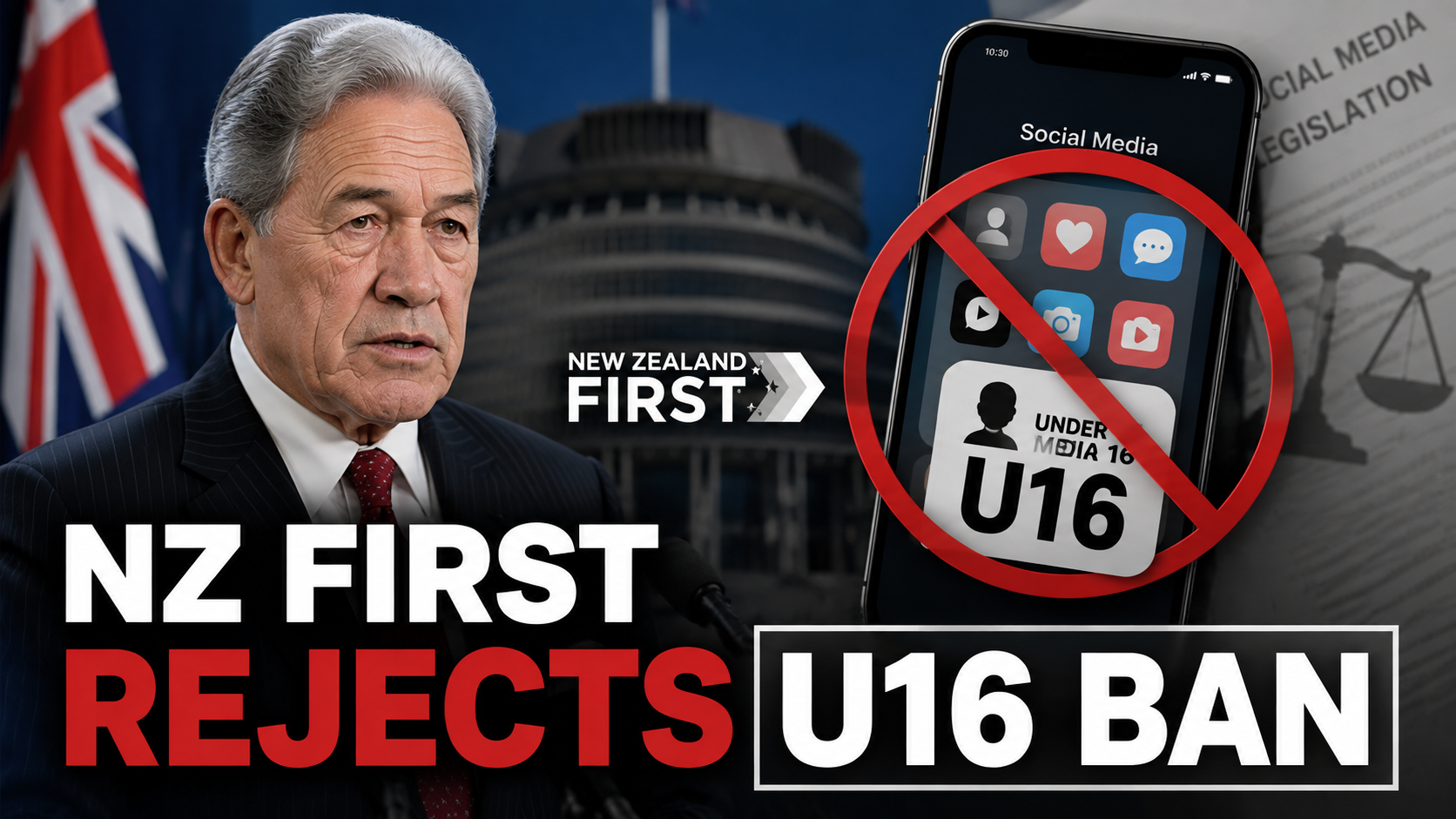
The New Zealand First leader said on Monday that the proposal should not be described as a policy of the entire Government.
“The Government is not moving to ban U16s from social media. The National Party is,” Peters wrote.
He said NZ First shares concerns about the harm social media can cause children, but will not support legislation banning under-16s from social media.
ACT is also opposed.
That leaves National in the unusual position of advancing a major social policy without the backing of either of its coalition partners.
What is National actually proposing?
National has been working on restricting social media access for under-16s since 2025.
Prime Minister Christopher Luxon has argued that children are being exposed to bullying, harmful material, addictive platform design and pressures affecting sleep, mental health, education and family life.
The latest proposal would place the responsibility primarily on social media companies rather than children or parents.
High-risk platforms could be required to take reasonable steps to ensure users are at least 16.
Potential methods include:
- information already held about an account
- facial age-estimation technology
- digital identity services
- formal identification in some circumstances
Platforms failing to meet their obligations could face substantial financial penalties.
Messaging services and some online games are expected to sit outside the core restrictions, while major platforms such as Instagram, TikTok, Snapchat, Facebook, YouTube and X are the types of services the policy is aimed at.
Why is Peters opposing it?
Peters is not arguing that social media is harmless.
His objection is about enforcement.
He says any law strong enough to stop determined teenagers from bypassing an age restriction would eventually require intrusive verification of everybody else.
His concern centres on two things: VPNs and digital identification.
A VPN can make an internet user appear to be accessing a service from another country.
That creates an obvious problem. If New Zealand restricts an account based on location and age, a teenager may attempt to disguise where they are connecting from.
Peters argues that genuinely stopping this would push government towards restricting VPNs or requiring stronger identity verification.
He described that direction as a threat to privacy and personal freedom.
National has previously rejected suggestions that it intends to ban VPNs. Luxon said in July there was no plan to do so.
ACT has made the same issue a red line, saying it would oppose any restriction on legitimate VPN use.
ACT and NZ First now largely agree
It is unusual to see Peters and ACT leader David Seymour landing in almost the same place on a major technology policy.
ACT has opposed a blanket under-16 ban for more than a year.
Its argument is that the harm is real, but the proposed solution risks creating an internet where adults also have to prove their age or identity simply to use ordinary services.
ACT has also warned that teenagers could move towards smaller, harder-to-monitor platforms if mainstream services become inaccessible.
NZ First’s language is stronger, but the practical concern is similar.
Both parties are essentially asking the same question:
How do you protect children without creating a system of identity checks for everyone?
Where does Labour stand?
Labour has previously been open to an under-16 restriction and earlier this year indicated support for moving the proposal forward.
But its support has not been unconditional.
As National developed the legislation, Labour sought access to the detailed bill before making a final decision.
That matters because with both NZ First and ACT opposed, National may need Labour votes to get the legislation through Parliament.
So despite this being championed by National, its future could ultimately depend on the Opposition.
Australia is the real-world test
Much of New Zealand’s debate is based on Australia, where social media age restrictions took effect on 10 December 2025.
Australian platforms are required to take reasonable steps to prevent under-16s from holding accounts.
Early numbers initially looked dramatic.
Australian authorities reported that 4.7 million accounts had been removed, restricted or deactivated soon after the law took effect.
But later research painted a more complicated picture.
A government-commissioned study found more than 80 percent of Australian teenagers were still using social media three months after implementation.
Account ownership fell, but use remained widespread, with young people finding workarounds and age-assurance systems producing mixed results.
That evidence gives Peters and ACT ammunition.
But it does not necessarily prove the Australian policy has completely failed.
Australian regulators argue that laws do not need 100 percent compliance to change behaviour, force platforms to take greater responsibility or give parents stronger support.
Australia is now strengthening enforcement rather than abandoning the policy.
The argument at a glance
| Position | Main argument | Main weakness |
|---|---|---|
| National | Children need stronger protection from harmful and addictive social media | Age verification may create privacy and enforcement problems |
| NZ First | Parents should remain responsible and privacy should not be sacrificed | Does not by itself solve the harms parents are worried about |
| ACT | Blanket bans are technically difficult and may affect adult privacy | Alternatives may struggle to deliver equally clear protection |
| Labour | Has been open to restrictions but wants detailed legislation | Its final position matters because National may need its votes |
| Australia | Shows governments can force platforms to act | Early evidence suggests many under-16s are still getting around restrictions |
The issue is bigger than whether teenagers should use TikTok
There is broad political agreement on one point.
Children can be harmed online.
The disagreement is over who should carry responsibility.
National is leaning towards stronger legal responsibility for technology companies.
Peters puts more emphasis on parents.
ACT wants targeted safety measures without universal identification.
And the Australian experiment suggests enforcement will be far harder than simply writing “16” into legislation.
The uncomfortable question is what happens when a website needs to determine whether someone is 15, 25 or 65.
Age restrictions aimed at children can inevitably affect adults too.
That is why this has become a privacy debate as much as a child-safety debate.
The bottom line
Peters’ intervention has clarified something important.
An under-16 social media ban is not currently a united coalition position.
National wants to move ahead.
NZ First says it will not support it.
ACT is also opposed.
That leaves Labour potentially holding the decisive votes.
The policy debate now comes down to a difficult trade-off.
Parents have legitimate reasons to worry about addictive algorithms, bullying, harmful content and the amount of childhood being lived online.
But New Zealand also has to decide how much identification, monitoring and regulation it is prepared to accept in order to enforce an age limit.
Protecting children sounds straightforward.
Designing a system that actually works without compromising everyone else’s privacy is the hard part.
And after Australia’s mixed early experience, New Zealand can no longer say it has not been warned about that difficulty.
Source: Winston Peters public statement, 24 August 2026; New Zealand Parliament; New Zealand Government material; ACT New Zealand; Australian eSafety Commissioner; Australian Government implementation data and current reporting on the proposed New Zealand legislation.