
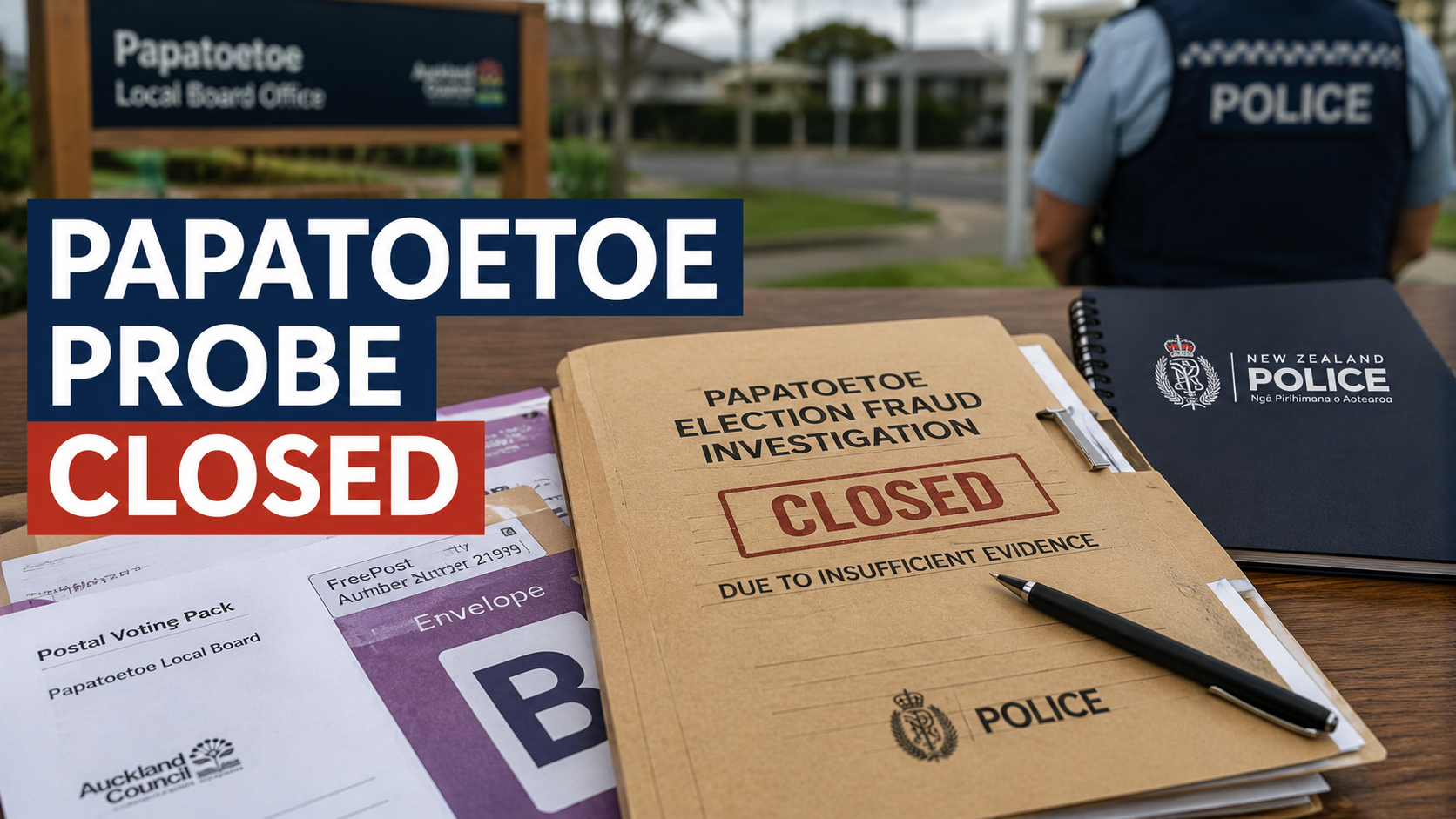
Police have closed their investigation into alleged electoral fraud surrounding the controversial 2025 Papatoetoe local body election, saying there was insufficient evidence to take the matter further.
The development, first reported by RNZ, brings the criminal investigation to an end after about 10 months of enquiries.
But it does not erase what the courts found.
That distinction is important because the Papatoetoe case has generated months of political argument, community tension and, at times, claims that went considerably further than the evidence.
A District Court found serious voting irregularities and voided the original election. The High Court later upheld that outcome.
Police have now determined there is not enough evidence to prosecute anyone.
Both things can be true at the same time.
What have Police actually said?
Counties Manukau Detective Inspector Shaun Vickers said Police conducted a thorough review of the complaints received.
Police had been investigating complaints of alleged electoral fraud after concerns emerged following the October 2025 election for the Papatoetoe subdivision of the Ōtara-Papatoetoe Local Board.
Sixteen complaints had earlier been forwarded to Police by Election Services.
According to Vickers, the evidence ultimately did not reach the standard required to proceed under the Solicitor-General’s Prosecution Guidelines.
All Police files relating to the investigation have now been closed.
That means no criminal charges will be laid on the evidence currently available.
But that does not mean the original election was cleared
This is where the story requires careful explanation.
The Police decision and the court decisions answer different questions.
Police had to determine whether there was sufficient admissible evidence to prosecute an identifiable person for a criminal offence.
The election petition asked whether irregularities had materially affected the result of the election.
Those are not the same legal test.
During the judicial inquiry, 79 voting papers were identified as having been cast without the knowledge of the people they belonged to.
Judge Richard McIlraith concluded that irregularities had materially affected the Papatoetoe subdivision result and declared the election void.
A new election was ordered.
What the High Court later made very clear
This part of the case is particularly important for Papatoetoe’s Indian and wider migrant communities.
After the District Court decision, some social media commentary portrayed the ruling as proof that Indian candidates had organised electoral fraud.
The High Court explicitly rejected that interpretation.
Justice Jane Anderson said it was misleading and improper to suggest the judgment established “immigrant corruption” or that the Indian candidates had masterminded fraudulent votes.
The original petitioner, Vi Hausia, had not alleged that the Papatoetoe Ōtara Action Team candidates themselves were responsible for the misuse of voting papers.
Nor had the District Court made such a finding.
The High Court upheld the decision to void the election, but that is very different from finding that the candidates themselves committed fraud.
That distinction deserves to remain front and centre now that the Police investigation has closed.
How did the controversy begin?
The October 2025 election produced an unusual result.
All four Papatoetoe subdivision seats were won by first-time candidates associated with the Papatoetoe Ōtara Action Team.
At the same time, Papatoetoe recorded an increase in turnout of more than 7 percent while turnout declined across much of Auckland.
Former local board member Vi Hausia, who was not re-elected, sought a judicial inquiry after residents reported that ballots appeared to have been returned in their names despite them saying they had not voted.
The court process eventually resulted in the election being declared void.
What happened in the new election?
Papatoetoe voters returned to the polls in March and April 2026.
The final result produced a mixed outcome.
|
Candidate |
Affiliation |
Final votes |
|
Vi Hausia |
Labour |
2,858 |
|
Jeet Singh |
Papatoetoe Ōtara Action Team |
2,503 |
|
Sandeep Saini |
Papatoetoe Ōtara Action Team |
2,499 |
|
Kushma Nair |
Papatoetoe Ōtara Action Team |
2,399 |
Hausia topped the poll, but three members of the Papatoetoe Ōtara Action Team were also elected.
That result is worth noting.
The group whose candidates had won all four seats in the voided election retained three seats when Papatoetoe voters were asked to vote again.
It does not explain what happened to the invalidly used ballots in 2025.
But it does demonstrate that the Action Team had substantial genuine electoral support in the community.
What does “insufficient evidence” really mean?
It should not be translated into either “fraud definitely happened and Police failed” or “nothing happened at all”.
The courts established that unlawful use of voting papers occurred.
What Police have now said is that the evidence available was insufficient to meet the prosecution threshold against an individual or individuals.
In criminal cases, suspicion is not enough.
Political arguments are not enough.
Statistical anomalies are not enough.
Police need admissible evidence capable of supporting a prosecution.
That threshold was not met.
The bigger problem has not disappeared
For Webfit News, the most important issue now is bigger than which local political team won or lost.
The case exposed a vulnerability in New Zealand’s postal voting system.
If somebody can obtain another person’s voting paper and return it without that voter’s knowledge, the problem is not confined to Papatoetoe.
It becomes a question of electoral system design.
Postal voting relies heavily on trust.
Unlike voting at a supervised polling booth, there is generally no official standing beside the voter confirming that the person completing the paper is the individual to whom it was issued.
That does not mean postal voting is inherently corrupt.
It does mean Parliament and councils should take seriously the weaknesses exposed by this case.
Papatoetoe also deserves to move forward
There is another lesson here.
The case became entangled with ethnicity in a way the High Court specifically warned against.
That should not happen again.
There were genuine electoral irregularities.
A court responded.
A new election was held.
Police investigated.
No prosecution will follow because the evidential threshold was not met.
Those facts can be reported without assigning collective blame to an ethnic or migrant community.
Papatoetoe voters have now had their say again, and the resulting local board includes candidates from both Labour and the Papatoetoe Ōtara Action Team.
The community deserves confidence that its elections are secure, but it also deserves reporting that distinguishes evidence from accusation.
The bottom line
The Police investigation is over.
The electoral controversy is not rewritten by that decision.
The 2025 Papatoetoe election was voided because the courts found irregularities serious enough to affect the result.
At the same time, neither the District Court nor the High Court found that the Papatoetoe Ōtara Action Team candidates themselves orchestrated the misuse of voting papers.
And Police have now concluded there is insufficient evidence for criminal charges.
That is the complete picture.
The next useful question is not who can claim political vindication.
It is what New Zealand learns from a case in which invalid voting was established, an election had to be run again, but investigators still could not obtain enough evidence to prosecute whoever was responsible.
Because restoring trust in the system matters more than winning the argument over who was to blame.
Source credit: RNZ first reported the closure of the Police investigation on 21 August 2026. Additional background checked against earlier RNZ reporting, Auckland Council election results and court findings.