
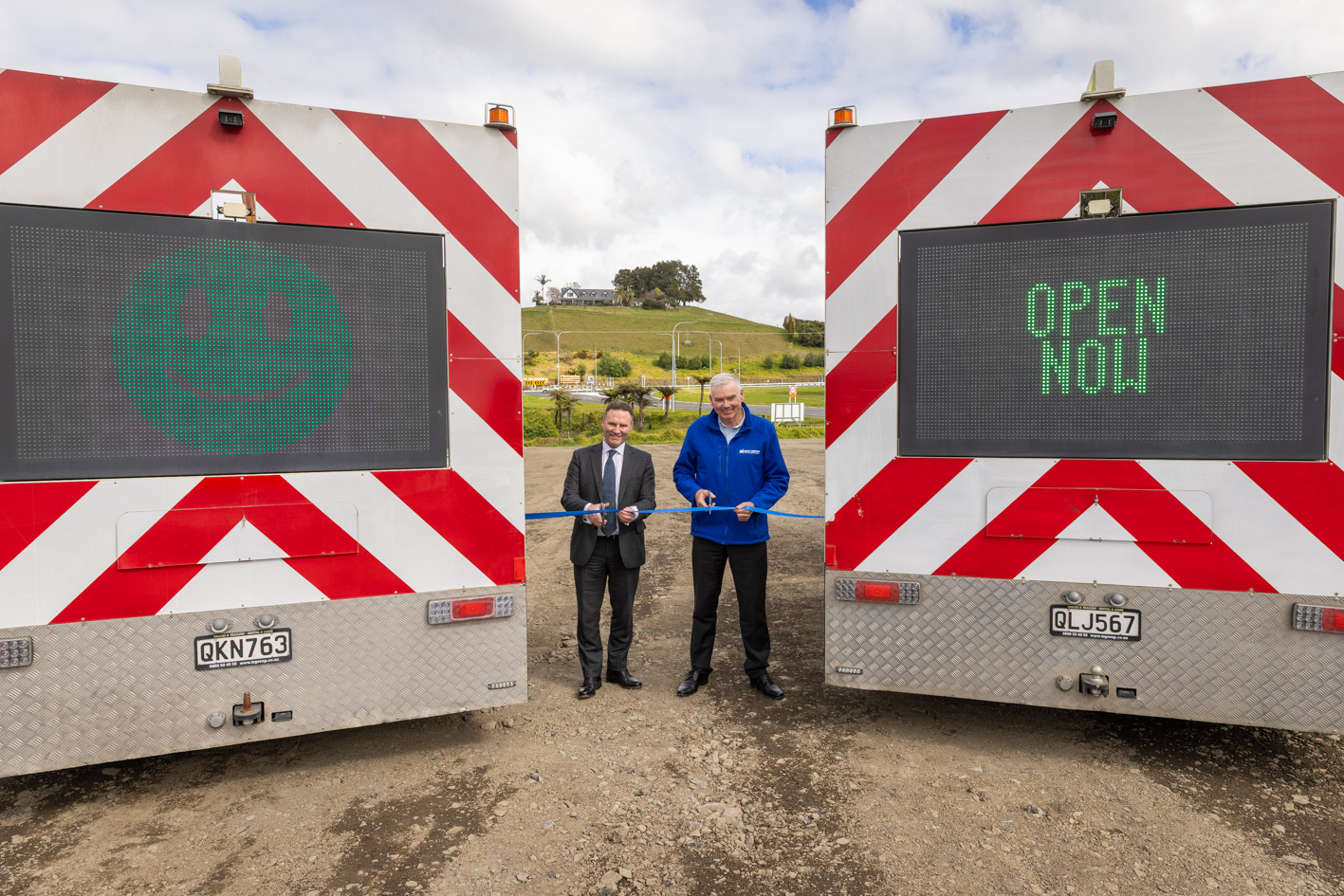
A major $43 million infrastructure upgrade at the entrance to Ōmokoroa has officially opened, marking a significant step in preparing one of the Western Bay of Plenty’s fastest-growing communities for the decades ahead.
The project includes a new roundabout at the State Highway 2 and Ōmokoroa Road intersection, a second roundabout to serve a future industrial area, and the urbanisation and four-laning of Ōmokoroa Road between the state highway and Prole Road.
While the new road layout will immediately change how motorists move through the area, the bigger story is what the project is designed to support.
Ōmokoroa is expected to be home to around 13,000 residents by 2050, and that projected growth will place increasing pressure on roads, housing, employment areas and public infrastructure.
The newly opened gateway is therefore not simply a transport upgrade. It is part of a much wider effort to ensure infrastructure keeps pace with the community that Ōmokoroa is becoming.
A project years in the making
The upgrade follows several years of planning, funding and construction.
Funding was approved in 2022 and physical construction began in late 2023.
Since then, crews have carried out extensive earthworks, utility relocations and major road construction across a highly visible part of the peninsula.
For local residents, the project has been difficult to miss.
Western Bay of Plenty Mayor James Denyer said people had watched the gateway change day by day and had lived through the disruption that comes with a project of this scale.
He said the completed works provide a safer connection to State Highway 2 while also supporting future housing and employment growth.
“This project has been highly visible for the community. People have seen the changes taking place day by day and watched the gateway to Ōmokoroa transform before their eyes,” Mayor Denyer said.
He also pointed to the project being delivered to budget as an important achievement.
“Successfully delivering a large project like this to budget is a result to be proud of, and a testament to the commitment and hard work of all those involved.”
Where the $43 million came from
The project has been backed by a combination of central government and transport funding.
Of the total $43 million investment, $38 million came through the Crown’s Infrastructure Acceleration Fund, managed by National Infrastructure Funding and Financing.
A further $5 million came from New Zealand Transport Agency Waka Kotahi.
Additional land contributions were also part of the project.
That funding structure is significant because growth areas such as Ōmokoroa often face a difficult infrastructure equation.
Housing can only expand if roads, transport links and services are upgraded early enough.
But those projects often require major investment before the full population growth has happened.
In practical terms, the road opened today is being built not only for the people who live in Ōmokoroa now, but also for the thousands expected to move there in the years ahead.
What has actually changed?
The completed works include several major transport improvements.
At the State Highway 2 and Ōmokoroa Road intersection, a new roundabout has been created to provide a safer and more reliable connection between the peninsula and the state highway.
A second roundabout has also been constructed to provide access to a future industrial area.
Ōmokoroa Road between State Highway 2 and Prole Road has been urbanised and widened to four lanes.
Together, those changes are intended to improve traffic flow, strengthen road safety and increase capacity.
For local motorists, this should mean a more structured and safer entry into Ōmokoroa.
For planners, the importance is broader.
The project creates infrastructure capable of supporting future residential and employment growth.
Housing is one of the biggest reasons this project matters
Ōmokoroa has long been identified as one of the Western Bay of Plenty’s priority growth areas.
With the population projected to reach around 13,000 by 2050, significant housing development is expected across the peninsula.
But new homes cannot be built in isolation.
Roads, water systems, transport links and community infrastructure all need to expand alongside them.
If those services fall behind, growth can quickly create congestion, access problems and pressure on existing residents.
That is why the phrase “unlocking housing” matters in this project.
The road network needs to be able to absorb the additional traffic generated by new neighbourhoods.
Minister Scott Simpson, MP for Coromandel, said the upgrade would bring benefits to residents, businesses and tourists.
“From today, residents, businesses and tourists will experience safer and faster travel through Ōmokoroa. Everyone will benefit.”
He said the project would also help enable future housing and employment across the peninsula.
“The upgrade will also help unlock new housing and employment opportunities across the peninsula, laying the foundations for the growth we know is coming to the Western Bay of Plenty.”
The employment side of the project should not be overlooked
Much of the discussion around Ōmokoroa’s growth has naturally focused on housing.
But the construction of a roundabout specifically intended to serve a future industrial area highlights another part of the strategy.
A growing community also needs employment opportunities.
If thousands of additional residents move into an area without corresponding jobs and commercial activity, more people are forced to commute elsewhere every day.
That creates additional pressure on regional transport networks.
Providing infrastructure for industrial and employment growth can help create a more balanced community.
That means people do not simply live in Ōmokoroa.
More of them may eventually be able to work there too.
State Highway 2 remains critical
The State Highway 2 connection is particularly important because it links Ōmokoroa with the wider Western Bay of Plenty and Tauranga.
As the peninsula grows, reliable access to that corridor becomes increasingly important for residents, freight, businesses and visitors.
NZ Transport Agency Waka Kotahi Director of Regional Relationships for Waikato and Bay of Plenty Andrew Corkill said the project was an important milestone for both the community and those travelling through the wider area.
“NZTA has been pleased to support this project and work alongside Council to help align these improvements with the future transport network.”
He said the upgrade would support safer and more reliable access to State Highway 2 while improving movement through Ōmokoroa.
“The project supports safer and more reliable access to State Highway 2, improves movement into and through Ōmokoroa, and helps unlock growth in this important part of the region.”
The project required a large collaborative effort
Major infrastructure projects rarely involve one organisation.
This one was delivered through collaboration between central government, NZTA, Western Bay of Plenty District Council, Beca, HEB Construction, Higgins and numerous contractors, consultants and utility providers.
The project also required considerable patience from the local community.
Construction of this scale inevitably brings traffic changes, delays, noise and disruption.
Western Bay of Plenty District Council acknowledged that residents and businesses had lived through those impacts while the project progressed.
That matters because public infrastructure often looks straightforward once it is complete.
The finished road can hide years of planning, land negotiations, design work, engineering, traffic management and construction.
For Ōmokoroa residents, today’s opening also marks the end of a long period of seeing that work unfold directly around them.
This is only one part of Ōmokoroa’s infrastructure programme
The opening does not mean the wider programme of investment in Ōmokoroa is finished.
Stage 2 of the Ōmokoroa Road urbanisation project is expected to be completed in October this year.
Other major projects have also been delivered across the area.
These include the recently completed Prole Road urbanisation, Wāhi ō Waipapa Wetland and Tangimoana pedestrian bridge.
Taken together, the projects demonstrate how rapidly the area is changing.
Infrastructure that once served a smaller settlement is increasingly being redesigned for a significantly larger community.
Ōmokoroa by the numbers
| Key detail | Figure |
|---|---|
| Total project investment | $43 million |
| Crown Infrastructure Acceleration Fund | $38 million |
| NZTA contribution | $5 million |
| Construction started | Late 2023 |
| Expected population by 2050 | Around 13,000 |
| Stage 2 expected completion | October 2026 |
Why infrastructure has to arrive before the population
One of the most difficult parts of urban growth is timing.
If infrastructure is delivered too late, communities can spend years dealing with congestion, unsafe intersections and inadequate services.
If it is delivered too early, governments and councils can be criticised for spending heavily on infrastructure that does not yet appear fully utilised.
Growth areas require planners to make decisions before every house has been built and before every future resident has arrived.
That is exactly what is happening in Ōmokoroa.
The new gateway may look generous compared with current demand.
But the question is not whether the road is appropriate for today.
The real question is whether it will still be appropriate when the peninsula has thousands more residents.
A significant milestone, but the real test comes later
Today’s opening is clearly an important milestone.
For motorists, there is a new road layout.
For residents, a long construction period has reached a major point of completion.
For council and government, a substantial infrastructure investment has moved from planning documents into physical reality.
But the success of the project will not ultimately be judged by the ribbon-cutting ceremony.
It will be judged by what happens as Ōmokoroa grows.
Can traffic continue to move safely?
Can new housing be delivered without overwhelming the road network?
Can local employment grow alongside the population?
Can the wider infrastructure programme keep pace?
Those are the questions that will determine whether the $43 million investment has achieved what it was designed to do.
The bigger picture
Ōmokoroa is an example of a challenge playing out across many parts of New Zealand.
Communities are growing.
Housing is expanding.
But growth only works properly when infrastructure moves with it.
Roads, public transport, water, schools, parks and employment areas cannot be treated as afterthoughts.
If Ōmokoroa does reach around 13,000 residents by 2050, the infrastructure decisions being made today will shape daily life there for decades.
That gives this project significance beyond the opening of another roundabout.
It represents a decision to invest ahead of growth.
And for one of the Western Bay of Plenty’s fastest-changing communities, that may prove to be the most important part of the story.
Source: Western Bay of Plenty District Council media release, 21 August 2026.