
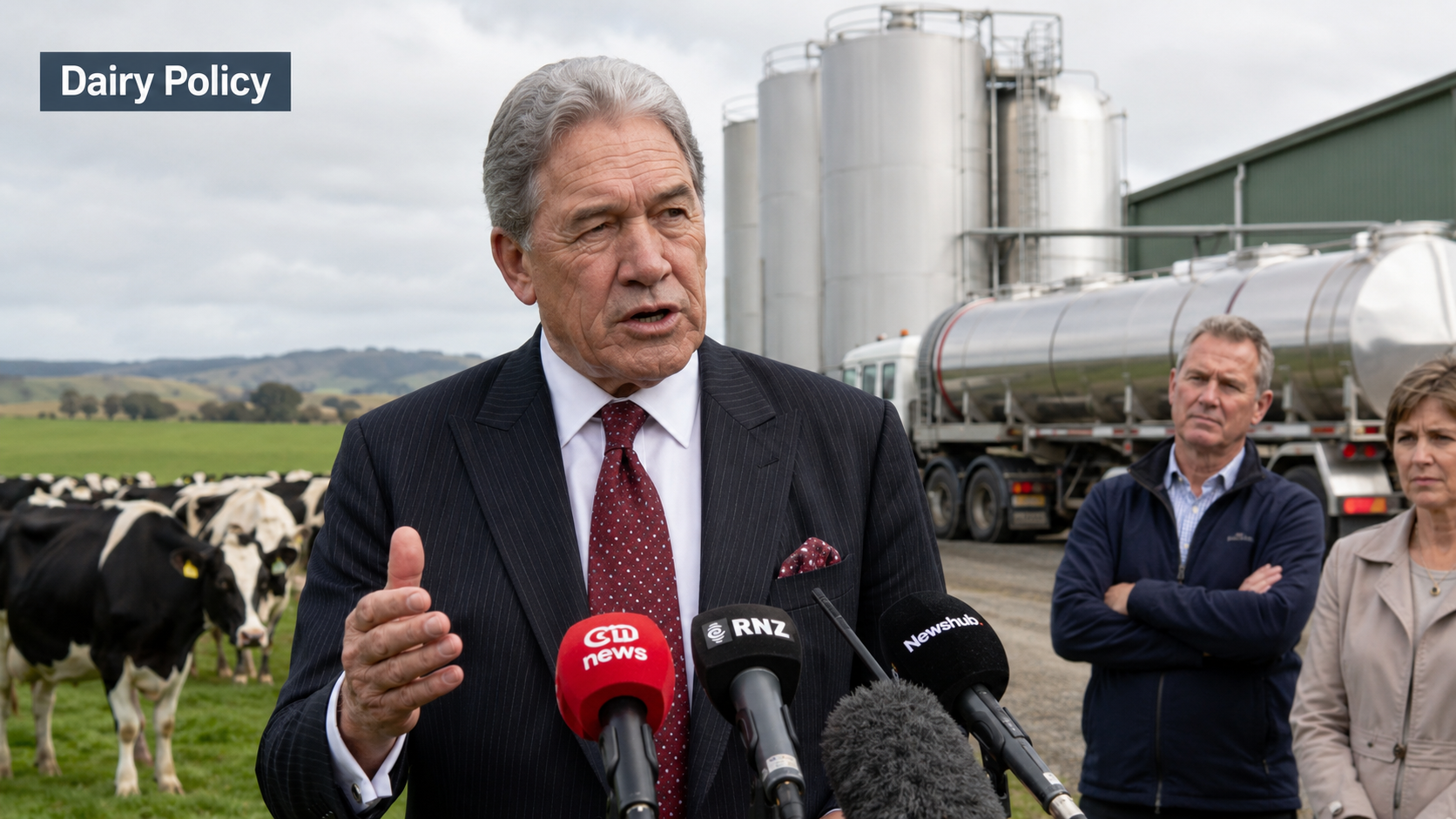
New Zealand First has entered the election-year dairy debate with a policy carrying a simple message: if investors are prepared to build factories and manufacture higher-value dairy products in New Zealand, the country's regulatory system should make sure they can get enough milk to operate at meaningful scale.
The party's new "Use It or Lose It" dairy policy would significantly expand the amount of Fonterra milk that qualifying independent manufacturers could obtain through regulated access arrangements.
The existing individual limit is generally 50 million litres of raw milk per season.
NZ First wants qualifying manufacturers investing in new value-added dairy production to be able to access as much as 500 million litres a year, ten times the current individual limit, with access potentially continuing for a decade.
The proposal arrives only months after Fonterra completed the $4.22 billion sale of its Mainland consumer and associated businesses to French dairy company Lactalis.
NZ First leader Winston Peters is presenting that sale as a reason for New Zealand to think harder about who will own the next generation of dairy manufacturing, intellectual property and brands.
But the policy deserves more scrutiny than the political slogan.
How big is 500 million litres?
Would guaranteed milk actually encourage companies to build factories?
Would New Zealand gain new jobs, brands and export revenue, or would the policy simply redistribute milk already being processed here?
And what could it mean for Fonterra's farmer owners?
Those are the questions that matter.
What exactly is NZ First proposing?
Under NZ First's proposal, an eligible manufacturer that commits to establishing value-added dairy manufacturing in New Zealand could receive regulated access to as much as 500 million litres of Fonterra milk each year.
The entitlement would remain at its maximum level for six years before gradually reducing.
| Year | Maximum access under NZ First proposal |
|---|---|
| 1 | 500 million litres |
| 2 | 500 million litres |
| 3 | 500 million litres |
| 4 | 500 million litres |
| 5 | 500 million litres |
| 6 | 500 million litres |
| 7 | 400 million litres |
| 8 | 300 million litres |
| 9 | 200 million litres |
| 10 | 100 million litres |
| After year 10 | Entitlement ends |
At the maximum entitlement, one qualifying manufacturer could potentially receive up to 4 billion litres over 10 years.
NZ First says the milk would not be subsidised.
Manufacturers would pay the farmgate milk price plus efficient collection and delivery costs.
The party says companies would have to establish dairy manufacturing in New Zealand and market New Zealand dairy products internationally.
The idea is therefore not primarily about providing cheap milk.
It is about providing certainty of milk supply while investors build manufacturing facilities, establish their businesses and eventually develop their own direct supply arrangements with farmers.
What happens under the law today?
This is where the scale of the proposal becomes clearer.
Current Dairy Industry Restructuring regulations generally limit regulated milk supply to an independent processor to 50 million litres per season, apart from separate arrangements applying to Goodman Fielder.
There is also an overall regulated supply limit of 600 million litres per season across independent processors.
The existing rules are designed partly to help new processors establish themselves without allowing them to rely indefinitely on Fonterra for their raw milk.
For example, Fonterra is generally no longer required to provide regulated milk once an independent processor has established sufficient direct milk collection over a specified period.
Current system versus NZ First proposal
| Issue | Current settings | NZ First proposal |
|---|---|---|
| Individual regulated milk limit | Generally 50 million litres | Up to 500 million litres |
| Increase | Current baseline | Ten times current individual limit |
| Overall regulated supply cap | 600 million litres | Not clearly specified |
| Length of access | Primarily designed to help entry and transition | Up to 10 years |
| Pricing | Regulated farmgate-related pricing plus relevant costs | Farmgate milk price plus efficient collection and delivery |
| Main purpose | Encourage entry and competition | Encourage industrial-scale value-added manufacturing |
| Path to independence | Processor expected to develop its own milk supply | Entitlement gradually tapers to zero |
One major unanswered question is what would happen to the existing 600 million-litre overall cap.
One manufacturer receiving 500 million litres would consume an amount equal to more than 80 percent of today's total regulated supply ceiling.
If two or three manufacturers qualified at the same time, the amount of regulated milk potentially involved could be vastly greater than under the current system.
NZ First's announcement does not yet specify how many manufacturers could qualify simultaneously or what overall limit would apply.
That is not a minor technical detail.
It could have a significant effect on Fonterra, competing processors and the wider dairy market.
How big is 500 million litres?
New Zealand dairy companies processed around 21 billion litres of milk during the 2024/25 season, according to DairyNZ.
That means 500 million litres represents roughly 2.4 percent of a full year's national milk production.
As a percentage of the entire industry, that may not sound enormous.
For one factory, however, it is a very substantial volume.
And the proposal is potentially 500 million litres per qualifying manufacturer, rather than a single 500 million-litre pool for the entire scheme.
New Zealand produced a record 1.94 billion kilograms of milksolids in 2024/25 from around 21 billion litres of milk.
DairyNZ says the dairy sector directly employed almost 55,000 people and generated more than $27 billion in export earnings during that period.
The Ministry for Primary Industries has forecast dairy export revenue of around $28.6 billion for the year to June 2026.
So this is not a minor industry policy.
It concerns one of New Zealand's most important export sectors.
Why has NZ First launched this now?
The immediate political trigger is Fonterra's sale of its consumer and associated businesses.
Fonterra agreed in 2025 to sell the Mainland Group businesses to Lactalis.
Farmer shareholders strongly supported the transaction, with 88.47 percent of votes cast in favour.
The transaction was completed on 31 March 2026 for total proceeds of $4.22 billion.
Fonterra subsequently returned about $3.2 billion to shareholders and unit holders through a $2 per share capital return.
NZ First argues the sale should be a turning point in the debate about domestic manufacturing.
The party's argument is straightforward.
New Zealand produces enormous quantities of milk.
Why should the country not encourage more cheese, nutritional products, specialised dairy foods and branded products to be manufactured here?
It is an attractive political message.
But there are important realities to consider.
The Lactalis sale did not mean dairy manufacturing disappeared from New Zealand
This distinction matters.
Fonterra sold ownership of its consumer and associated businesses to Lactalis.
That does not mean the underlying manufacturing operations simply disappeared overseas.
Lactalis-Mainland Dairy continues to operate as a dairy business, including operations connected to New Zealand.
What changed significantly was the ownership of the business, control of the brands and responsibility for future investment decisions.
That is a legitimate economic issue.
But saying New Zealand simply "lost its dairy factories" would overstate what happened.
Fonterra has not abandoned value-added dairy
There is another important reality check.
Fonterra's strategy after selling its consumer business is increasingly focused on Ingredients and Foodservice.
Those are not necessarily low-value commodity businesses.
Fonterra says its Ingredients business represents around 85 percent of the milk solids it sells and generated roughly $16 billion in annual revenue across FY24 and FY25.
That business includes specialised proteins and other technically advanced dairy ingredients.
Its Foodservice operation supplies products to commercial kitchens, bakeries, restaurants and food manufacturers around the world.
Fonterra's position is that focusing capital on Ingredients and Foodservice can generate stronger returns for farmer shareholders than maintaining a large international portfolio of consumer brands.
That complicates the political argument.
The choice is not simply between commodity milk powder and sophisticated branded products.
Some of New Zealand's highest-value dairy exports are already specialised ingredients sold to other businesses.
Where NZ First's policy has a credible argument
There is nevertheless a genuine economic problem behind the proposal.
Building a major dairy factory is expensive.
A new processing facility can require hundreds of millions of dollars in investment before it produces a single commercial product.
But a dairy factory without milk is useless.
That creates a classic investment problem.
An investor needs confidence that milk will be available before committing to a plant.
Farmers may hesitate to leave an established processor until the new factory exists and has proven itself.
The investor struggles to build a factory without guaranteed milk.
The factory struggles to attract farmers because it has not yet been built.
Regulated access can potentially bridge that gap.
This is one of the reasons regulated raw-milk access was created in the first place.
The current 2026/27 review of the Dairy Industry Restructuring Act is considering whether competition provisions applying to Fonterra should be retained, amended or removed.
NZ First is essentially arguing that the existing bridge for new entrants is no longer long enough.
Is 50 million litres enough for industrial-scale manufacturing?
The current 50 million-litre individual limit was created in a different competitive environment.
It may be enough to help a relatively small processor get started.
NZ First's argument is that it is not enough to support a serious export-scale manufacturing investment.
There is some logic to that.
A company considering a major cheese, infant nutrition, protein, specialised ingredient or consumer dairy factory needs confidence that enough milk will be available to operate the plant efficiently.
Large factories generally become more economical when they operate at high utilisation.
A 500 million-litre entitlement would provide far greater certainty than a 50 million-litre entitlement.
That could change the economics of an investment.
But it does not guarantee that an investment will happen.
Guaranteed milk does not guarantee a new factory
This is one of the biggest limitations in treating the policy as an automatic job creator.
Milk supply is only one part of an investment decision.
A company considering a New Zealand dairy plant will also look at:
construction costs
electricity and gas prices
skilled labour availability
environmental consenting
water availability
wastewater infrastructure
transport costs
access to ports
financing costs
exchange rates
export-market access
intellectual property
management capability
international demand
whether producing in New Zealand is more profitable than producing somewhere else
If those economics do not work, access to milk will not magically create a factory.
NZ First has not yet published an independent economic model showing how many factories the policy would generate, how many jobs would be created or how much additional export revenue could result.
That modelling would be valuable before Parliament considered changing rules involving potentially billions of litres of milk.
Who carries the commercial risk?
NZ First says Fonterra farmers would be fairly compensated because processors would pay the farmgate milk price and delivery costs.
That addresses one concern.
Farmers should not be expected to subsidise another company's manufacturing investment.
But there is another issue.
Milk also has an opportunity value.
Imagine Fonterra could take a litre of milk and turn it into a high-margin specialised ingredient.
If regulation required Fonterra to instead sell that litre as raw milk to another processor at the farmgate price, Fonterra could potentially lose the opportunity to earn the additional manufacturing margin.
Whether that would materially affect farmer returns depends on several factors:
how much milk Fonterra has available
seasonal supply
factory capacity
the products Fonterra would otherwise manufacture
the regulated milk pricing formula
whether the new processor creates genuinely new export demand
whether it simply takes business from existing New Zealand processors
That is why paying the farmgate milk price and being economically neutral to Fonterra are not necessarily the same thing.
The difference requires proper economic analysis.
Could farmers eventually supply the new factory themselves?
Yes.
And that is actually one of the stronger parts of the policy design.
NZ First proposes that regulated access gradually taper away.
A manufacturer could receive full access for six years.
That would then reduce to:
80 percent
60 percent
40 percent
20 percent
zero
The new processor would therefore have time to develop its own direct relationships with farmers.
That is the "Use It or Lose It" part of the proposal.
If the company cannot build a sustainable independent milk supply within a decade, the regulated entitlement disappears.
That is more defensible than permanently guaranteeing a private processor access to Fonterra's milk.
Could farmers benefit from more competition?
Potentially, yes.
This may be one of the strongest arguments supporting the proposal.
More processors competing for milk could give farmers:
more choice
competing payment structures
specialised contracts
alternative ownership models
additional bargaining power
opportunities to supply particular high-value products
Fonterra no longer controls anything close to the roughly 90 percent of milk collection associated with the early years of the co-operative.
But it still collects the majority of New Zealand's milk.
More credible processors could increase competition at the farmgate.
That could benefit farmers.
But competition can also create costs
More competition does not automatically mean every outcome is positive.
If substantial volumes leave Fonterra, existing manufacturing facilities and tanker networks may process fewer litres.
That can reduce asset utilisation.
Those assets were built around assumptions about milk volumes.
Lower utilisation can increase unit costs.
Because Fonterra is farmer-owned, those costs ultimately matter to farmers too.
New processors may build better, more efficient factories.
They may also duplicate infrastructure that already exists.
The question policymakers need to answer is whether the additional economic value created by new manufacturing would outweigh any efficiency losses elsewhere.
The biggest unanswered questions
NZ First has announced the broad architecture of its proposal, but many details remain unclear.
| Question | Why it matters |
|---|---|
| How many manufacturers could qualify? | Determines the potential total milk volume involved |
| Would the current 600 million-litre overall cap disappear? | The present system could not support multiple 500 million-litre allocations |
| What qualifies as "value-added"? | Almost every processed dairy product adds some value |
| Does the manufacturer need to be NZ-owned? | The policy focuses on manufacturing here, not necessarily local ownership |
| What minimum investment would be required? | Prevents small projects obtaining excessive milk rights |
| Would companies have employment obligations? | Jobs are a major part of the policy's political case |
| What happens if promised investment is delayed? | Essential to making "Use It or Lose It" meaningful |
| Could the milk entitlement be transferred? | A regulatory entitlement could become commercially valuable |
| Who decides which companies qualify? | Significant discretion could sit with regulators or ministers |
| How are Fonterra farmer owners protected? | Fonterra is owned by farmers, not the Government |
| What happens during milk shortages? | Dairy production varies with weather and farming conditions |
| Why exactly 500 million litres? | A tenfold increase requires economic justification |
These are not reasons to dismiss the policy.
They are questions that should be answered before it becomes law.
Election-year reality check
There is a powerful political message behind the proposal.
Build the factories here.
Build the brands here.
Employ New Zealanders here.
Take higher-value New Zealand dairy products to the world.
Few voters are likely to disagree with that ambition.
The harder question is whether milk-access regulation is the main thing stopping it from happening.
What supports NZ First's case
The policy is grounded in several genuine economic realities:
New Zealand dairy export revenue is approaching $28.6 billion annually
the country produces roughly 21 billion litres of milk each year
major manufacturing investment requires confidence about supply
Fonterra remains the dominant milk collector
the individual regulated milk limit is currently only 50 million litres
the Dairy Industry Restructuring Act is already under formal review
stronger processor competition could give farmers more options
These are legitimate points.
What weakens the political sales pitch
There are also important qualifications:
Fonterra's sale to Lactalis did not mean New Zealand manufacturing disappeared
Fonterra continues significant value-added Ingredients and Foodservice production
no public independent modelling yet demonstrates that 500 million litres will create the promised factories
the proposed overall supply limit remains unclear
farmgate compensation does not necessarily capture the full opportunity value of milk
energy, labour, infrastructure, finance and export demand also influence investment decisions
Those factors matter just as much as access to milk.
Could the policy work?
Yes.
There is a plausible scenario where it works very well.
An international or New Zealand investor identifies an opportunity.
It wants to build a $300 million or $500 million dairy processing plant.
Its lenders and shareholders require certainty that milk will be available.
Regulated access provides that certainty.
The factory gets built.
New Zealand workers are employed.
New export products are developed.
Over time, farmers sign direct supply contracts with the new processor.
Regulated access gradually disappears.
The business becomes independent.
A new competitor remains in the New Zealand dairy industry.
That is the outcome NZ First is aiming for.
What could go wrong?
There is also a less attractive scenario.
A company qualifies for a large milk allocation.
Its actual investment is smaller than anticipated.
Rather than creating genuinely new export demand, it simply competes with existing New Zealand processors for existing customers.
Fonterra has to redirect milk from products it could otherwise manufacture.
New factories duplicate existing capacity.
The processor struggles to attract direct farmer supply.
After 10 years, New Zealand discovers that it mainly rearranged who processes the milk rather than creating substantially more value from it.
That possibility is why the policy details matter so much.
Why 500 million litres?
Perhaps the most obvious question is why 500 million litres is the correct number.
It is politically simple.
The existing limit is 50 million.
NZ First proposes increasing it tenfold.
But economic policy should not be based simply on a neat multiplier.
Why not 200 million litres?
Why not 300 million?
Why not make the entitlement proportionate to the size and economic value of the investment?
Should a new cheese factory receive the same maximum entitlement as a specialised nutritional-protein facility?
Should a $100 million investment qualify for the same volume as a $500 million investment?
Should access depend partly on the number of jobs being created or additional export revenue expected?
The 500 million-litre number therefore needs a detailed economic justification.
What happens next?
Nothing changes immediately.
This is an NZ First election policy, not current law.
New Zealand's scheduled 2026/27 review of the Dairy Industry Restructuring Act is already underway.
That review is considering whether the competition provisions applying to Fonterra should remain, be amended or eventually be removed.
NZ First says its proposal should be considered through that process, with the next Minister of Agriculture expected to report to Parliament in 2027.
Whether the policy progresses will therefore depend partly on the result of the 2026 election and the parliamentary numbers that follow.
Even if it gains political support, the details would still require substantial regulatory and economic work.
The bigger question goes beyond NZ First
Strip away the election campaign and political rhetoric, and there is a legitimate economic question underneath this proposal.
New Zealand produces an extraordinary amount of high-quality milk.
Dairy remains one of the foundations of the country's export economy.
The country should therefore continually ask whether it is capturing as much value from that milk as possible.
That does not automatically mean consumer brands are better than ingredients.
It does not mean foreign investment is bad.
It does not mean Fonterra necessarily made the wrong commercial decision by selling its consumer business.
And it does not mean Parliament should dictate how a farmer-owned co-operative runs every part of its operation.
But it does mean New Zealand should ask:
If a credible investor wants to spend hundreds of millions of dollars building genuinely new, high-value dairy manufacturing in New Zealand, are our current rules helping that investment happen or unnecessarily standing in its way?
NZ First has offered one answer.
Increase regulated access from 50 million litres to as much as 500 million litres.
The election campaign will determine whether the idea gains political momentum.
The more important test will come afterwards.
Does the economic evidence actually show that 500 million litres is the right number, that additional factories would genuinely be built, and that New Zealand farmers, workers and exporters would ultimately be better off?
That is the reality check the policy still needs.
Sources
New Zealand First, "Use It or Lose It" dairy policy, 20 August 2026.
Ministry for Primary Industries, 2026/27 review of the Dairy Industry Restructuring Act.
New Zealand Legislation, Dairy Industry Restructuring (Raw Milk) Regulations 2012.
Ministry for Primary Industries, Situation and Outlook for Primary Industries, June 2026.
DairyNZ and LIC, New Zealand Dairy Statistics 2024/25.
Commerce Commission, dairy-sector competition material.
Fonterra, Mainland Group sale announcements and 2026 transaction completion.
Fonterra financial results and strategy information concerning Ingredients and Foodservice.