
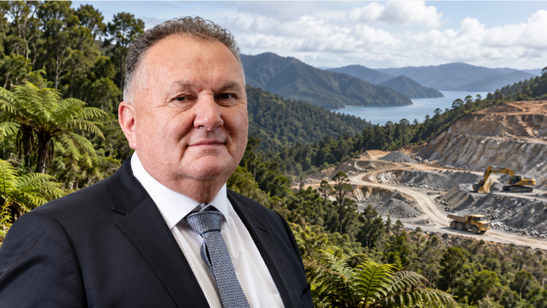
New Zealand First will campaign at the 2026 election for greater economic use of conservation land, including mining and quarrying in some areas, setting up a significant political debate over how New Zealand should balance environmental protection with jobs, exports and regional development.
Deputy leader and Resources Minister Shane Jones says the party wants conservation legislation to recognise economic opportunities on Department of Conservation land, although he has excluded national parks from the proposal.
At the centre of the debate is a clause currently contained in the Conservation Amendment Bill before Parliament’s Environment Select Committee.
The provision, known as section 6(ea), says DOC should recognise and enable economic opportunities on conservation land “to the greatest extent practicable”.
Jones says he fought to keep the provision in the bill and intends to make its future an election issue.
Whether it remains in its current form, is strengthened, weakened or removed is now likely to depend heavily on the composition of the next Parliament.
What NZ First is proposing
Jones has made clear that New Zealand First does not believe all conservation land should automatically be treated as unavailable for economic activity.
He wants activities such as mining and quarrying to be considered on conservation land outside national parks.
“We, NZ First, rejects the notion that [conservation land is] some type of Camelot lotus land feature of New Zealand that can never ever be used or developed,” Jones told RNZ.
He said the party wanted economic development to have greater status within conservation legislation.
“That drove us to introduce into legislation that there has to be priority and status given to economic development.”
The argument is consistent with Jones’ broader political focus on mineral development, regional employment, exports and resource extraction.
But it also raises a fundamental policy question.
Should conservation land primarily be protected because of its environmental and public value, or should parts of that estate also be available for economic use where development can be justified?
The clause is not yet law
An important distinction is that section 6(ea) remains part of a bill still being considered by the Environment Select Committee.
It is not yet settled law.
The committee has begun hearing submissions, but Conservation Minister Tama Potaka has indicated the process is unlikely to be completed before the end of the current parliamentary term.
That means the next Parliament may inherit the bill.
Potaka said the Environment Select Committee in the next Parliament would likely continue hearings and consider possible changes, including provisions relating to economic development.
That makes the clause a live election issue rather than a completed policy change.
Earlier proposal involving 2.8 million hectares was withdrawn
The wider Conservation Amendment Bill has already undergone significant political revision.
Earlier proposals could have made approximately 2.8 million hectares of conservation land potentially eligible for sale.
Potaka later withdrew support for those provisions and asked that they be removed during the redrafting process.
That retreat is important because it shows the Government itself has drawn distinctions between different forms of economic use of conservation land.
Allowing a concession, quarry, mine or access arrangement is not the same policy question as making conservation land available for sale.
Those issues should not be treated as interchangeable.
Jones says national parks would remain off limits
Jones has specifically said his proposal would not extend to national parks.
That significantly narrows the scope compared with the idea of opening the entire conservation estate to development.
However, the conservation estate contains many categories of land outside national parks, and some of those areas can still have substantial ecological, landscape or recreational value.
That means excluding national parks does not automatically resolve the environmental concerns.
The practical debate will be over which types of conservation land could qualify, what activities would be permitted and what environmental tests would have to be passed.
Critics say conservation law has a different purpose
Opponents argue that conservation legislation exists precisely because some land should be protected from commercial pressure.
Greenpeace has argued that conservation land should be protected from economic exploitation so native species can thrive and future generations can continue to enjoy those places.
That is the core counterargument to NZ First’s position.
If economic development becomes an explicit objective within conservation law, critics fear conservation decisions could gradually shift away from protection and towards commercial use.
The question is therefore not only whether individual projects might be environmentally manageable.
It is whether the legal purpose of the conservation system itself would change.
Jones argues development can provide jobs and exports
Jones rejects that approach.
His case is that New Zealand should not rule out productive use of land simply because it sits within the conservation estate.
He has framed the issue in terms of employment, economic growth and export earnings.
That argument may resonate particularly strongly in regions where extractive industries, forestry, mining and infrastructure development can provide high-value employment.
For some communities, the discussion is not abstract.
Access to natural resources can determine whether major projects proceed, whether businesses invest and whether employment is created.
The economic argument therefore deserves to be assessed seriously rather than dismissed simply because development involves conservation land.
But economic benefits also need to be demonstrated, not assumed.
A proposed mine or quarry may create jobs and exports, but it can also create environmental rehabilitation costs, infrastructure demands, landscape impacts and long-term liabilities.
Each proposal would need to be evaluated on its actual merits.
Not all conservation land is the same
One of the difficulties in the debate is that “conservation land” is an extremely broad term.
New Zealand’s conservation estate includes areas of exceptional ecological significance as well as land with different levels of conservation value and different management histories.
That means a blanket argument in either direction can be misleading.
Saying no conservation land should ever support economic activity may ignore differences between individual sites.
But saying conservation land should be opened for development because some areas have lower conservation values creates the opposite risk, particularly if the legal safeguards are weak.
A serious policy framework would need to distinguish between different categories of land, ecological values and development impacts.
Existing concessions already allow some commercial activity
The debate is also more complicated than a simple choice between preservation and development.
Commercial and recreational activities already occur on conservation land through concessions, permits and access arrangements.
Tourism businesses, guiding operations, infrastructure providers and other users can operate on parts of the conservation estate under existing rules.
The real policy shift proposed by NZ First is therefore not the invention of economic activity on conservation land.
It is the possibility of giving economic development greater legislative status and priority within DOC decision-making.
That is a more significant change.
NZ First also wants DOC restructuring considered
Jones has gone further than the clause itself.
He has also suggested restructuring the Department of Conservation so that functions dealing with concessions, permits and access rights could potentially be separated from the department’s other work.
Those functions could either operate in a distinct part of DOC or be transferred to another organisation.
Jones’ argument appears to be that economic applications may be better handled by an entity less focused exclusively on conservation.
That proposal raises another major question.
Would separating development-related decisions create more balanced decision-making, or would it weaken the conservation expertise that currently sits behind those decisions?
The answer would depend heavily on the institutional design.
Potaka wants conservation outcomes protected
Conservation Minister Tama Potaka has taken a more cautious approach.
In correspondence to the Environment Select Committee, he asked that the committee work with relevant non-government organisations, iwi and sector groups to ensure section 6(ea) supports “strong and enduring conservation outcomes”.
That language suggests the minister is not treating economic development as an unrestricted priority.
It also illustrates an important difference within the coalition.
NZ First is making the economic-development element a central political argument.
Potaka is emphasising the need for the provision to remain compatible with conservation outcomes.
Those positions are not necessarily irreconcilable, but they reflect different priorities.
The real issue is what happens when conservation and development conflict
Much of the political language around the issue can obscure the practical problem.
There will be projects where development and conservation objectives can coexist.
There will also be proposals where they cannot.
The real test of section 6(ea) is what happens in those difficult cases.
If a mineral deposit sits beneath land containing important native habitat, which objective takes priority?
If a quarry could create local employment but damage a significant landscape, how should that trade-off be assessed?
If environmental effects can be mitigated but not eliminated, what threshold should apply?
Those are the questions legislation ultimately has to answer.
Economic development does not automatically mean economic value
It is also worth separating the existence of a resource from the value of developing it.
A mining or quarrying proposal only creates meaningful economic benefit if the project is commercially viable, provides sufficient employment or export value, and does not leave the public carrying disproportionate environmental or infrastructure costs.
That means opening more land to potential development does not guarantee more successful projects.
The quality of the investment matters.
So does the economic case.
So does the environmental cost.
Conservation protection also has economic value
The debate should not assume that land only has economic value when it is developed.
Conservation areas support tourism, recreation, biodiversity, water quality and ecosystem services.
New Zealand’s international image is also closely connected to its natural environment.
That does not mean conservation must always override other considerations.
But it does mean the comparison is not simply “economic development versus no economic benefit”.
Protection itself can create economic and social value.
The challenge is measuring benefits that do not always appear immediately in a project balance sheet.
Election 2026 could determine the direction
Jones has openly linked the future of the provision to the election result.
That gives voters a relatively clear choice.
NZ First will campaign for a stronger role for economic development on conservation land, particularly where resources can support jobs and exports.
Environmental organisations and political opponents are likely to argue that conservation legislation should continue to place protection first.
The National Party’s eventual position will also be important, particularly because Potaka has already sought changes to other controversial elements of the bill.
A debate that needs more detail, not just slogans
There are legitimate arguments on both sides.
New Zealand needs economic growth, regional employment, exports and access to resources.
It also has native ecosystems and landscapes that cannot simply be recreated once lost.
The useful debate is therefore not whether development is always good or conservation is always untouchable.
It is about the rules.
Which land could be considered?
Which land would remain completely protected?
Who makes the decision?
What environmental threshold applies?
How are economic benefits measured?
Who carries the rehabilitation risk?
And what happens when the conservation value is permanent but the economic project lasts only a few decades?
Those details will ultimately determine whether NZ First’s proposal represents a pragmatic approach to resource development or a fundamental weakening of New Zealand’s conservation framework.
For now, the policy is not settled.
But with Jones confirming New Zealand First intends to campaign on it, conservation land is set to become another significant dividing line in the 2026 election.
Reporting note: This article was developed after Webfit News reviewed reporting by RNZ senior reporter Ellen O’Dwyer on New Zealand First’s position on economic development on conservation land. Webfit News has expanded the story with additional policy context and analysis based on the information contained in that reporting.
Original reporting: RNZ, Ellen O’Dwyer, 5 September 2026.