
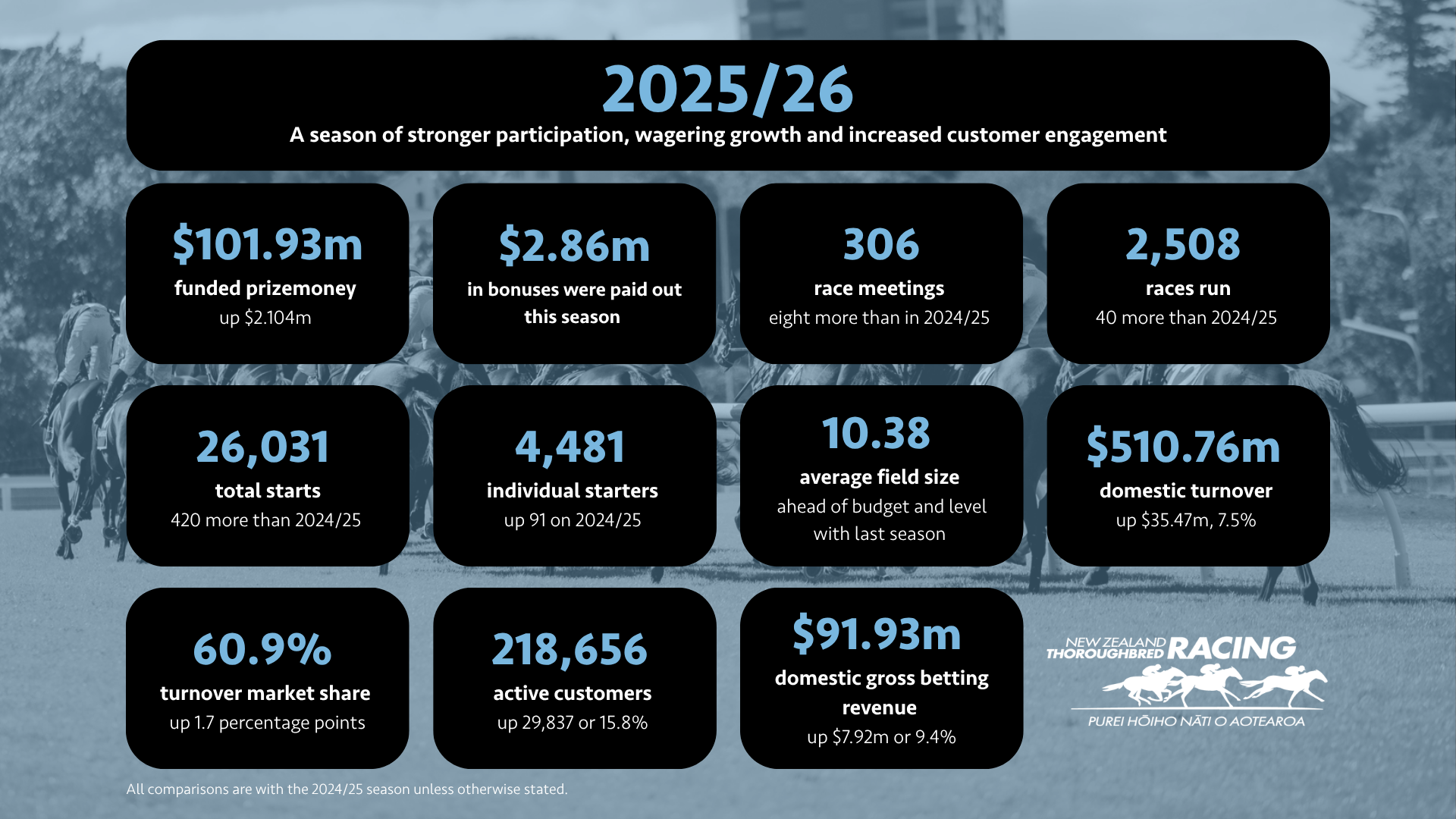
New Zealand thoroughbred racing has closed the 2025/26 season with stronger participation, rising domestic wagering and a significant increase in active customers, giving the industry a solid base heading into the new season.
New Zealand Thoroughbred Racing says 306 race meetings were held across the season, with 2,508 races run, while funded prizemoney reached almost $102 million.
A total of 4,481 individual thoroughbreds competed, 91 more than the previous season, generating 26,031 starts.
The strongest growth, however, came from wagering.
New Zealand customers wagered $510.76 million on domestic thoroughbred racing during the season, up $35.47 million, or 7.5 percent, on 2024/25.
At the same time, the number of active wagering customers climbed to 218,656, an increase of almost 30,000 in a single season.
NZTR Chief Executive Matt Ballesty said the results reflected the work of people across the industry, including owners, trainers, jockeys, breeders, stable staff, volunteers and racing clubs.
“More horses participated, more races were run and domestic wagering performance strengthened during the season,” Ballesty said.
“These results give thoroughbred racing in New Zealand a solid platform to build from.”
2025/26 season at a glance
| Measure | 2025/26 result | Change from 2024/25 |
|---|---|---|
| Race meetings | 306 | +8 |
| Races run | 2,508 | +40 |
| Individual starters | 4,481 | +91 |
| Total starts | 26,031 | +420 |
| Average field size | 10.38 | Broadly unchanged |
| Funded prizemoney | $101.93m | +$2.10m |
| Bonuses paid | $2.86m | Not stated |
| Domestic wagering turnover | $510.76m | +$35.47m, 7.5% |
| Domestic gross betting revenue | $91.93m | +$7.92m, 9.4% |
| Active wagering customers | 218,656 | +29,837, 15.8% |
| Domestic turnover market share | 60.9% | +1.7 percentage points |
Figures are to 31 July 2026 unless otherwise stated.
Nearly $102 million distributed in funded prizemoney
Funded prizemoney reached $101.93 million during the season, up $2.10 million from 2024/25.
A further $2.86 million was distributed in bonuses to racing stakeholders.
That matters because prizemoney sits at the centre of the thoroughbred racing economy.
Owners take considerable financial risk buying, breeding and maintaining horses. Trainers, jockeys, stable staff, breeders and clubs all depend in different ways on racing activity generating enough revenue to make continued participation viable.
For NZTR, therefore, the season was not simply about running more races. The important measure is whether racing activity is generating enough commercial value to support the people producing the product.
On that front, domestic wagering was one of the clearest positives.
Domestic wagering growth was stronger than turnover alone suggests
New Zealand customers wagered $510.76 million on domestic thoroughbred racing, an increase of 7.5 percent from the previous season.
But gross betting revenue rose even faster.
Domestic gross betting revenue reached $91.93 million, up $7.92 million, or 9.4 percent.
That difference is significant.
Turnover measures how much money customers wager.
Gross betting revenue measures the amount retained from wagering after winning bets are paid.
Because gross betting revenue grew faster than total turnover, NZTR says the wagering margin improved compared with last season.
In simple terms, the value generated from every dollar wagered improved.
Ballesty said that was particularly important because betting revenue ultimately supports funding across the wider racing industry.
“The growth in gross betting revenue is particularly important because it supports the funding available to the wider racing industry and, ultimately, the returns delivered to participants,” he said.
Almost 30,000 more active customers
The biggest percentage increase came from customer numbers.
A total of 218,656 active New Zealand thoroughbred wagering customers participated during the season.
That was 29,837 more than in 2024/25, representing growth of 15.8 percent.
The increase is notable because customer growth outpaced wagering turnover growth.
That suggests the racing industry did not simply extract more wagering from an existing customer base. It also brought a substantially larger number of people into the market.
For NZTR, the next challenge will be keeping them there.
Ballesty said the industry wanted to convert that interest into longer-term engagement.
“This customer growth is encouraging and shows the opportunity to bring more New Zealanders closer to racing, whether they are attending, participating, owning or engaging through wagering,” he said.
“Our focus is on converting that interest into sustained engagement.”
That distinction is important.
A single strong season can produce impressive numbers, but racing's longer-term health depends on repeat participation, not simply one-off growth.
More meetings, more races and more horses
Participation also moved in the right direction.
The industry held 306 meetings during the season, eight more than in 2024/25.
A total of 2,508 races were run, 40 more than the previous season.
The number of individual thoroughbreds competing increased from 4,390 to 4,481.
Combined, those horses made 26,031 starts, an increase of 420.
Those numbers suggest the racing calendar was able to absorb additional activity without causing a decline in average field size.
Average field size remained steady at 10.38 runners and was ahead of budget.
That is important because field size affects both racing competitiveness and betting appeal.
Larger, competitive fields generally create more wagering options and greater uncertainty about the outcome, both of which can make races more attractive to punters.
But the overall average hides one of the season's less positive trends.
More races had fewer than eight starters
Despite the stable average field size, NZTR says 396 races were run with fewer than eight starters.
That was 44 more than in 2024/25.
This is one of the figures the industry will need to watch carefully.
A healthy overall average can coexist with uneven distribution.
Some meetings may have very strong fields while others struggle to attract enough runners.
Ballesty acknowledged that field composition remained a challenge.
“Average field size remained steady at 10.38 and was ahead of budget, but the increase in races with fewer than eight starters shows that field composition remains a challenge,” he said.
For race clubs and punters, smaller fields can affect both the spectacle and the economics of a race.
They can reduce betting options and, depending on the type of wagering, make a race less attractive.
So while the headline participation figures are encouraging, the quality and distribution of that participation remain important.
Domestic strength was not matched by export income
Another area of concern was racefields export income.
NZTR says export income was down 6.4 percent on the previous season to the end of June, with July returns still outstanding.
That creates a clear contrast with the domestic market.
At home, turnover, gross betting revenue and customer numbers all increased.
Internationally, the value generated from New Zealand racing was softer.
Ballesty said the difference was clear and would require attention.
“We also saw a clear difference between strong domestic wagering performance and softer export income,” he said.
“We will continue working with industry stakeholders to address these pressures while building on the areas showing positive momentum.”
That will likely become one of the industry's more important commercial questions in the coming season.
Domestic growth is valuable, but New Zealand racing also benefits when its product is wagered on overseas.
If export income remains weak, the industry will become more reliant on domestic wagering performance.
Why the nearly $102 million prizemoney figure matters
The $101.93 million funded prizemoney figure is likely to attract the most attention within the racing industry itself.
Prizemoney influences almost every level of participation.
For owners, it affects the potential return from racing a horse.
For trainers and jockeys, it influences earnings.
For breeders, stronger returns can support demand for bloodstock.
For the wider industry, it affects whether people continue investing in horses, staff, training facilities and racing operations.
The additional $2.86 million paid in bonuses also provides another incentive layer beyond ordinary race purses.
The question for NZTR will be whether wagering and other revenue growth can continue supporting those levels.
A racing industry can increase prizemoney for a period, but sustainable growth ultimately depends on the revenue base underneath it.
The 2025/26 numbers suggest domestic wagering is currently moving in the right direction.
Thoroughbred racing increased its domestic market share
NZTR also reported that thoroughbred racing's share of domestic wagering turnover rose to 60.9 percent.
That was an increase of 1.7 percentage points from the previous season.
This matters because thoroughbred racing competes for customer attention and wagering expenditure with other racing codes and forms of betting.
A higher market share means thoroughbred racing did not simply benefit from general growth in wagering. It increased its relative position within the domestic racing market.
That is another reason NZTR is likely to view the season positively.
More customers participated.
Those customers wagered more.
The industry generated more gross betting revenue.
And thoroughbred racing captured a larger share of the market.
But one strong season does not solve every structural challenge
The overall picture is positive, but the figures also show why NZTR is not declaring the job finished.
Three issues stand out.
First, more races were being run with fewer than eight starters.
Second, export income was weaker.
Third, the industry now has to convert a sharp rise in customer numbers into sustained involvement.
That could mean encouraging people to attend meetings, become owners, join syndicates or simply remain active wagering customers.
The danger for any sport or entertainment product is confusing a spike in attention with permanent growth.
NZTR appears aware of that distinction.
Ballesty said the focus now was on maintaining momentum and delivering “compelling experiences” for customers while continuing to produce meaningful returns for participants.
A stronger platform heading into 2026/27
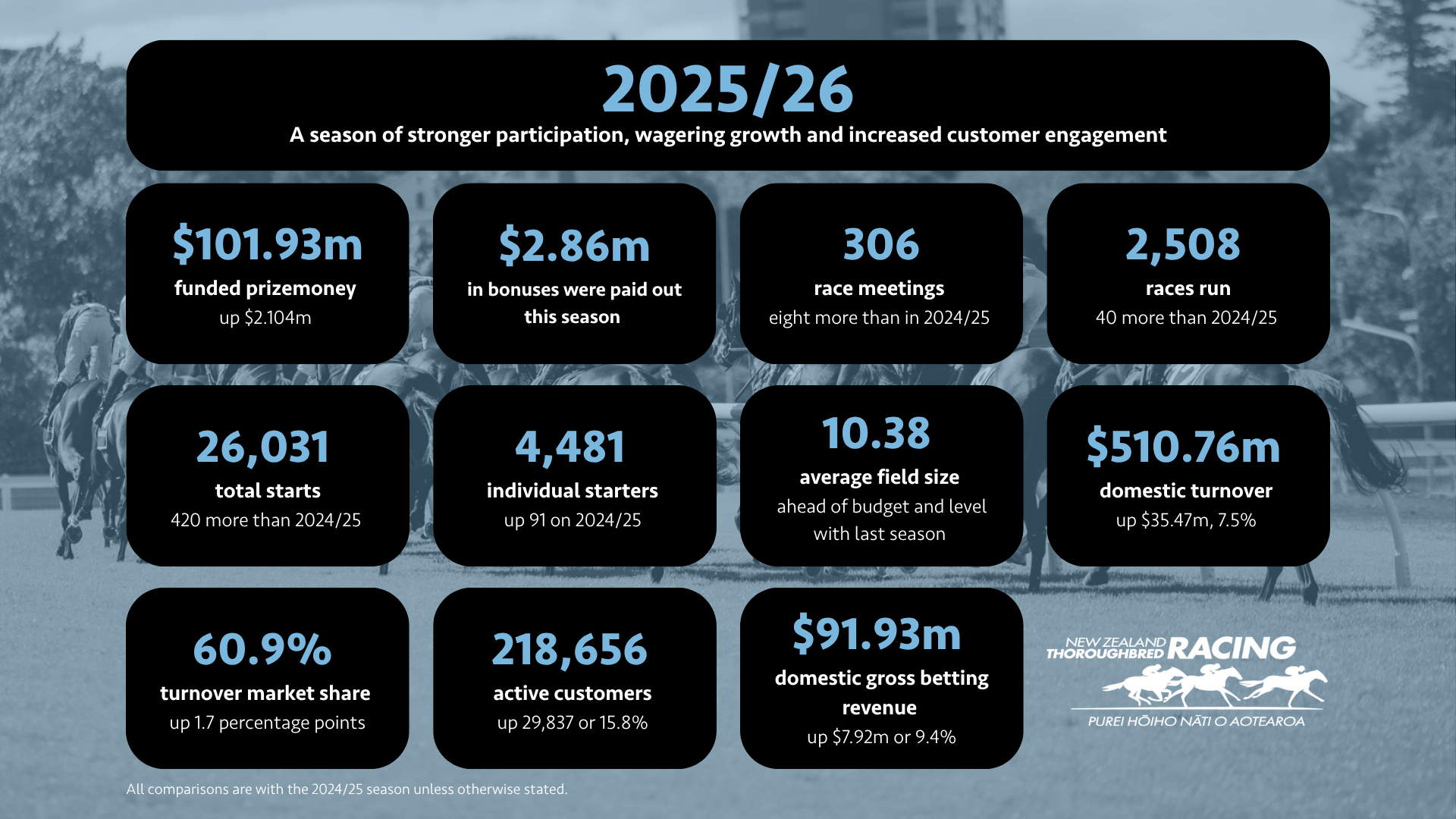
On the numbers released so far, the 2025/26 season was stronger across several of the measures that matter most to thoroughbred racing.
More horses raced.
More meetings were held.
More races were run.
Domestic customers wagered more.
Almost 30,000 additional customers became active.
Gross betting revenue increased faster than turnover.
And nearly $102 million in funded prizemoney was distributed.
Those are substantial positives.
The next test is whether they represent the start of sustained growth or simply an unusually strong season.
The weaker export income and increase in smaller fields show that there are still pressure points below the headline numbers.
But for an industry heavily dependent on participation, wagering and confidence, the direction of travel during 2025/26 was clearly positive.
The challenge for New Zealand Thoroughbred Racing now is turning that momentum into something durable.
Source: New Zealand Thoroughbred Racing, 1 September 2026.