
New Zealand’s technology sector has produced an impressive headline number.
According to a new report by Dealroom and NZ Growth Capital Partners, the combined enterprise value of New Zealand’s venture-backed companies is now estimated at $133 billion.
More than 400 companies are included in that ecosystem.
Eight have reached “unicorn” status, meaning a valuation or exit of more than US$1 billion.
Two, Rocket Lab and FNZ, have gone even further into “decacorn” territory, with valuations above US$10 billion.
For a country of New Zealand’s size, that is a remarkable achievement.
It shows that Kiwi founders, engineers and investors can build companies capable of competing internationally.
It also shows something else that is arguably just as important: New Zealand has been unusually efficient at turning venture capital into enterprise value.
But once the celebration settles, a more difficult question appears.
How much of the wider economic value created by these companies actually stays in New Zealand?
That is the question raised in analysis published by the University of Auckland, and it deserves serious attention.
The $133 billion number is impressive, but it does not tell the whole story
Enterprise value tells us what companies are worth.
It does not necessarily tell us how much capability, employment, intellectual property, management expertise or investment remains anchored in New Zealand.
That distinction matters.
A company can be founded here, grow rapidly, attract international capital and eventually move substantial parts of its operations offshore.
Its valuation may still be counted as part of New Zealand’s entrepreneurial success story.
But the broader economic benefits can become more dispersed.
That is why the real value of a successful technology company is not simply the company itself.
It is also what happens next.
Does the company build research teams here?
Does it train senior engineers and managers here?
Do experienced employees go on to start new companies here?
Do founders and early investors recycle their gains into new New Zealand ventures?
Do local suppliers and professional services gain from the company’s growth?
Does intellectual property remain connected to the country?
Those questions tell us much more about whether one successful company helps create the next one.
New Zealand is good at creating value from relatively modest capital
One of the most striking findings in the report is New Zealand’s capital efficiency.
Compared with several peer innovation economies, New Zealand appears to generate a relatively high amount of enterprise value from the venture capital invested.
That is a strong signal.
It suggests the country is not simply throwing large amounts of money at start-ups.
It is producing meaningful company value from a comparatively modest capital base.
In practical terms, that points to strengths in entrepreneurship, technical skill, problem-solving and the ability to build businesses with limited resources.
For policymakers, that is encouraging.
It suggests New Zealand already has many of the raw ingredients required for a strong innovation economy.
But it also creates a policy challenge.
If the country can create valuable companies efficiently, then losing too much of the downstream value becomes even more costly.
The “double loss” problem
The Dealroom analysis identifies more than ten billion-dollar businesses created by Kiwi founders but built offshore.
That matters because when a successful company is primarily developed overseas, New Zealand may lose twice.
First, it can miss some of the direct value generated by the company.
That may include jobs, tax, management roles, research activity and investment.
Second, it can miss the follow-on effect.
Successful technology companies tend to produce future founders.
Engineers leave and start companies.
Senior managers become advisers and directors.
Founders invest in new ventures.
Employees use their equity gains to back other companies.
Investors recycle capital.
Networks deepen.
That is how technology ecosystems compound over time.
If too much of that activity happens offshore, New Zealand can lose not only part of the first success, but some of the next generation as well.
That is why the issue is bigger than headquarters.
It is about where capability accumulates.
Xero, Trade Me, Pushpay and Rocket Lab show why recycling matters
New Zealand already has examples of successful companies producing wider ecosystem effects.
The report points to companies such as Xero, Trade Me, Pushpay and Rocket Lab as part of this process.
Their importance goes beyond valuation.
They create people who have learned how to scale.
They create executives who understand international markets.
They create technical staff who have worked inside globally competitive companies.
They create investors who are more confident about backing the next generation.
That experience is difficult to manufacture through policy alone.
It usually comes from people having actually built something.
The more of that experience New Zealand retains, the stronger the next wave of companies can become.
So does New Zealand simply need more venture capital?
Not necessarily.
More capital would help in some areas.
The report suggests New Zealand still has less venture capital-backed enterprise value per person than several comparable innovation economies.
It also shows that domestic investors remain especially important in the early stages, while international investors provide much of the capital required for breakout and later-stage growth.
That pattern makes sense.
New Zealand is a small market.
A company trying to become global may need investors with deeper pockets, international customer networks and specialist scaling experience.
Foreign investment is therefore not the problem.
The problem is assuming that more capital alone solves everything.
Capital is only one part of the equation.
The other part is what happens to the company as it scales.
Growth can change where a company’s centre of gravity sits
A New Zealand-founded company may begin with local staff, local management and local research.
As it grows, that can change.
International investors may introduce overseas directors.
Large customers may be closer to the United States, Europe or Asia.
Senior executives may be hired overseas.
Sales teams may expand offshore.
Research may follow talent.
Management may move closer to capital markets.
Over time, the company’s economic centre of gravity can shift.
That does not necessarily mean the company has “left” New Zealand.
But it can mean that some of its highest-value activities are no longer concentrated here.
This is why a simple question such as “where is the headquarters?” is not always enough.
A company can remain headquartered in New Zealand but carry out most of its growth, hiring and investment overseas.
Equally, a company can move its headquarters offshore while retaining major research, engineering and technical operations here.
The more useful measure is not simply corporate address.
It is productive capability.
International capital can help growth, but it can also influence location
The University of Auckland analysis points to a 2024 study of around 11,000 venture-backed start-ups across 17 countries.
About 6 percent relocated internationally.
Those relocated firms represented around 17 percent of the value created.
Foreign venture capital, particularly investment from the United States, was strongly associated with relocation.
That should not be interpreted as an argument against international investment.
Global capital is essential for many New Zealand companies.
But it does show that capital comes with networks, incentives and relationships that can gradually influence where important business functions are located.
A company’s growth path is shaped not just by money, but by the ecosystem around that money.
That includes investors, directors, customers, senior hires and strategic partners.
The real issue is what successful companies leave behind
This is probably the most important point in the entire debate.
A successful technology company should not only be judged by how much it is eventually worth.
It should also be judged by what it leaves behind.
That can include:
experienced engineers
senior managers
founders with capital to reinvest
new angel investors
specialist lawyers and accountants
board directors
research capability
technical know-how
global customer networks
people confident enough to start again
These are the foundations of a mature technology ecosystem.
One company becoming a unicorn is good.
One company producing ten future founders is potentially much more important.
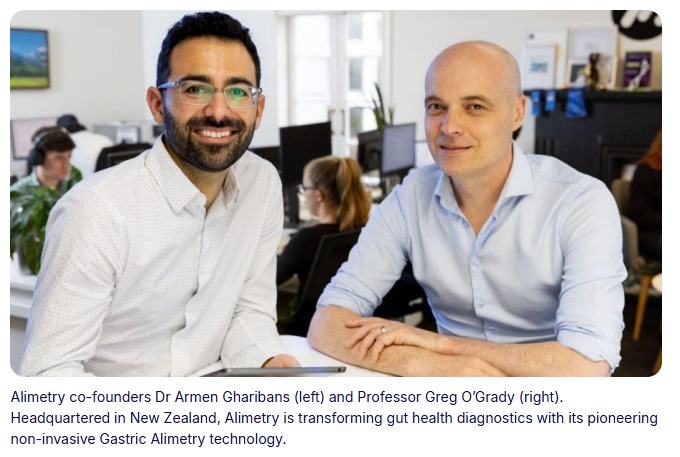
Alimetry is a useful example of what staying connected can look like
The University of Auckland article highlights Alimetry, a New Zealand-headquartered company working in gut health diagnostics.
Its Gastric Alimetry technology is designed as a non-invasive way to support diagnosis of gastric disorders.
The company illustrates one possible path.
A technology business can pursue international growth while keeping a meaningful base in New Zealand.
That matters because high-value research, engineering and clinical capability can remain connected to the country even as the company expands globally.
This is the type of outcome New Zealand should be trying to encourage.
Not forcing companies to remain small and local.
But making it attractive for them to keep meaningful, high-value functions here while they grow.
New Zealand should not try to stop companies going global
That would be the wrong lesson.
For most serious New Zealand technology companies, internationalisation is essential.
The domestic market is too small to support large-scale growth in many sectors.
A company that refuses to expand offshore may simply limit its own potential.
The goal should therefore not be to keep everything inside New Zealand.
It should be to retain enough of the value chain that international success still strengthens the domestic economy.
That could mean keeping:
research and development
engineering
product design
senior technical teams
strategic decision-making
intellectual property development
founder and investor networks
If those elements remain strong, a company can become global without becoming disconnected from New Zealand.
The policy debate needs to move beyond unicorn counts
Governments naturally like simple metrics.
How many start-ups were funded?
How much venture capital was invested?
How many unicorns were created?
How much are companies worth?
Those numbers are useful.
But they can also create a distorted picture.
A country can produce valuable companies while losing much of the talent, research and follow-on investment that should accompany them.
That means innovation policy needs better questions.
How many founders stay and reinvest?
How many senior technical jobs are created here?
How much research remains here?
How many second-generation companies are started by alumni of successful firms?
How much local capital is recycled?
How many globally experienced managers remain connected to New Zealand?
Those measures are harder to put on a political graphic.
But they may matter more.
Capital efficiency should be seen as an opportunity
New Zealand’s ability to generate strong enterprise value from relatively modest venture investment is not a weakness.
It is an opportunity.
It suggests the country already has the ability to create successful companies without needing to copy the scale of Silicon Valley funding.
The policy challenge is to build the conditions that help those companies remain deeply connected to New Zealand as they grow.
That includes access to talent.
It includes research capability.
It includes experienced management.
It includes domestic investors with enough depth to stay involved beyond the earliest stages.
And it includes an environment where successful founders want to reinvest locally.
The bigger economic question
New Zealand has spent years worrying about productivity.
Technology is regularly presented as one of the sectors capable of lifting wages, creating high-value exports and reducing reliance on industries constrained by geography and physical resources.
The $133 billion figure shows that the potential is real.
But technology only delivers its full economic benefit if success becomes cumulative.
A high-value company should make the next high-value company easier to create.
If every major success eventually shifts most of its talent, capital and decision-making offshore, the ecosystem has to keep rebuilding itself.
If successful companies leave behind experienced people, capital and technical capability, the country develops momentum.
That is the difference between producing successful companies and producing a successful technology economy.
The numbers at a glance
| Measure | Finding |
|---|---|
| Estimated enterprise value of NZ venture-backed companies | $133 billion |
| Venture-backed companies identified | More than 400 |
| Unicorns | 8 |
| Decacorns | 2 |
| Decacorns identified | Rocket Lab and FNZ |
| Kiwi-founded billion-dollar companies built offshore | More than 10 |
| Internationally relocated start-ups in 2024 study | About 6% |
| Share of value represented by relocating firms | About 17% |
What should success look like from here?
New Zealand should absolutely celebrate the fact that its technology companies are creating remarkable value.
The country should also resist the temptation to treat valuation as the final score.
The better objective is a cycle.
A New Zealand company succeeds.
Its employees gain experience.
Its founders gain capital.
Its investors make returns.
Those people then back, advise or build the next company.
Universities and researchers deepen their connections with industry.
Technical talent grows.
Local investors become more sophisticated.
And each generation of companies begins from a stronger base than the one before it.
That is how a technology ecosystem becomes durable.
The bottom line
New Zealand’s venture-backed technology companies are now estimated to be worth $133 billion.
For a country of just over five million people, that is a substantial achievement.
The report also suggests New Zealand is unusually effective at turning venture investment into company value.
But the next stage of the conversation should not simply be about creating more unicorns.
It should be about making sure successful companies leave more behind.
More research.
More technical capability.
More experienced founders.
More investors.
More senior managers.
More capital recycled into the next generation.
The best outcome is not to stop New Zealand companies becoming global.
It is to make sure that when they do, New Zealand becomes stronger because of it.
Because ultimately, the real measure of a successful technology company may not be what it is worth when it reaches its peak.
It may be how much easier it makes it for the next New Zealand company to succeed.
Source and reference: University of Auckland analysis, "Keeping NZ tech benefits", August 2026, drawing on the Dealroom and NZ Growth Capital Partners report.