
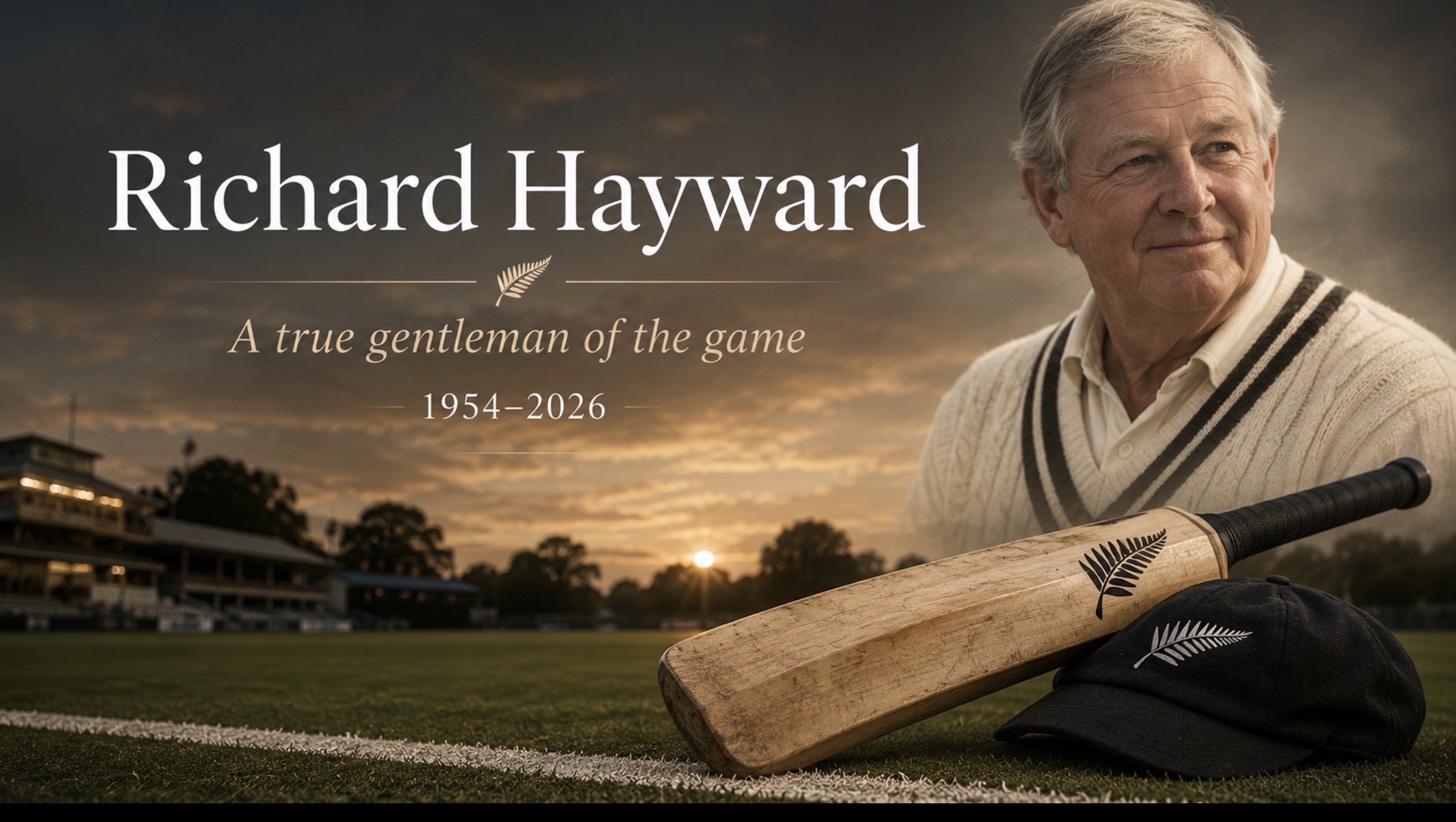
New Zealand cricket is mourning the death of former Central Stags captain, coach and match referee Richard Hayward, who has died in Nelson at the age of 72.
Hayward, remembered by colleagues as a “true gentleman of the game”, spent decades contributing to cricket in New Zealand as a player, coach, administrator and official.
Born in Middlesex, England, he arrived in Nelson in the late 1970s as a 25-year-old player-coach and soon became part of the New Zealand cricket community.
His career would eventually span domestic cricket, coaching, administration and match officiating, leaving a legacy across several generations of players and officials.
Richard Hayward at a glance
|
Area |
Details |
|
Age |
72 |
|
Born |
Middlesex, England |
|
Arrived in New Zealand |
Late 1970s |
|
Playing role |
Left-handed batter |
|
Nickname |
“Shots” |
|
First-class matches |
50 |
|
First-class matches for Central Districts |
27 |
|
One-day matches |
48 |
|
One-day matches for Central Districts |
16 |
|
Match referee career |
2016/17 to 2025/26 |
|
First-class matches refereed |
43 |
|
List A matches refereed |
47 |
|
Super Smash fixtures refereed |
69 |
|
Women’s internationals refereed |
19 |
From England to Nelson
Hayward built his early playing career in England, with stints at Buckinghamshire in Minor Counties cricket and with first-class counties Hampshire and Somerset.
After moving to Nelson, he quickly established himself as a stylish and attacking left-handed batter.
His assertive stroke-play earned him the nickname “Shots”.
He also enjoyed notable Hawke Cup success with Nelson before making his Central Stags debut in the 1982/83 summer.
Hayward went on to play 27 of his 50 first-class matches for Central Districts.
He also represented the Stags in 16 of his 48 one-day appearances.
During that period, he featured in a Central Districts batting line-up alongside some highly regarded names in New Zealand cricket, including Martin Crowe, Ian Smith, Derek Stirling, Gary Robertson and Scott Briasco.
A career that continued well beyond playing
Hayward’s contribution to cricket did not stop when his playing days ended.
He became Nelson’s first full-time professional coaching director and later held coaching roles with Canterbury.
He then returned to Nelson Cricket as General Manager.
One of the major achievements during that period was helping bring ICC Cricket World Cup matches to Saxton Oval in 2015.
That role reflected a pattern that would define much of Hayward’s career after playing. He remained closely involved in the game, often behind the scenes, helping create opportunities for others.
Respected career as a match referee
In the 2016/17 season, Hayward joined New Zealand Cricket’s Officials panel as a match referee.
He remained involved through to the 2025/26 season, when a recurrence of cancer reduced his availability.
Across his time as a referee, Hayward oversaw:
|
Competition level |
Matches |
|
First-class |
43 |
|
Plunket Shield |
37 |
|
Men’s and women’s List A |
47 |
|
Super Smash |
69 |
|
Women’s internationals |
19 |
NZC said his humility and knowledge of the game quickly made him a popular figure on the domestic cricket circuit.
His work also extended into international women’s cricket, adding another layer to a career that covered nearly every part of the game.
‘A great man with a huge amount of passion’
New Zealand Cricket chief executive Geoff Allott said Hayward’s death was a significant loss.
“He was a great man with a huge amount of passion for the game and the people who played it,” Allott said.
“He touched so many of us in different ways, and I know the joy he got from watching other people’s successes over the years, and it’s those sorts of people that leave lasting legacies.”
Allott said Hayward would be remembered fondly throughout the cricket community.
“He’ll be fondly remembered by a lot of people within cricket, and we’re very grateful for everything he’s done and the impact he’s had on our game.”
Match officials remember his professionalism and warmth
NZC Head of Match Officials Andrew Duncan said Hayward’s passing would be felt deeply, particularly within the match officials network.
“Richard was an outstanding Match Referee whose success at the national and international level was built on meticulous preparation, professionalism and an exceptional understanding of the game,” Duncan said.
He said Hayward’s personal qualities left an even stronger impression than his work on the field.
“While his contributions on the field were significant, it was the person he was off the field that made the greatest impression.”
Duncan described him as a valued colleague and trusted friend.
“Richard was a valued colleague, a trusted friend to many within our team, and someone whose warmth and genuine care for people will be greatly missed.”
Honoured across Central Districts and Nelson cricket
Hayward was made a Life Member of the Central Districts Cricket Association in 2019.
He was also a life member of Nelson Cricket and served as patron of Wakatu Cricket Club.
Central Districts Cricket chief executive Lance Hamilton said Hayward’s warmth extended throughout the sport, from international players to young club cricketers and grounds volunteers.
Hamilton described him as “a true gentleman of the game, in every sense”.
That description captures the breadth of Hayward’s influence.
His career was not defined by one role or one team.
He was a player, captain, coach, administrator and official.
He worked at both elite and grassroots levels and remained part of the cricket community for decades.
A legacy built across generations
Hayward’s story is also a reminder that some of the most important contributions to sport happen away from the spotlight.
His playing career gave him credibility within the game, but his later work helped shape opportunities for players, officials and communities.
From Nelson cricket to the Central Stags, from Canterbury coaching roles to World Cup hosting, and later to national match officiating, Hayward remained involved in cricket across different eras.
That continuity is part of why his passing is being felt so widely.
New Zealand Cricket has extended its condolences to his wife Sue, his family, friends, former teammates and the many colleagues who worked alongside him.
Richard Hayward leaves behind a career measured not only in matches played or officiated, but in the relationships he built and the people he supported throughout the game.