
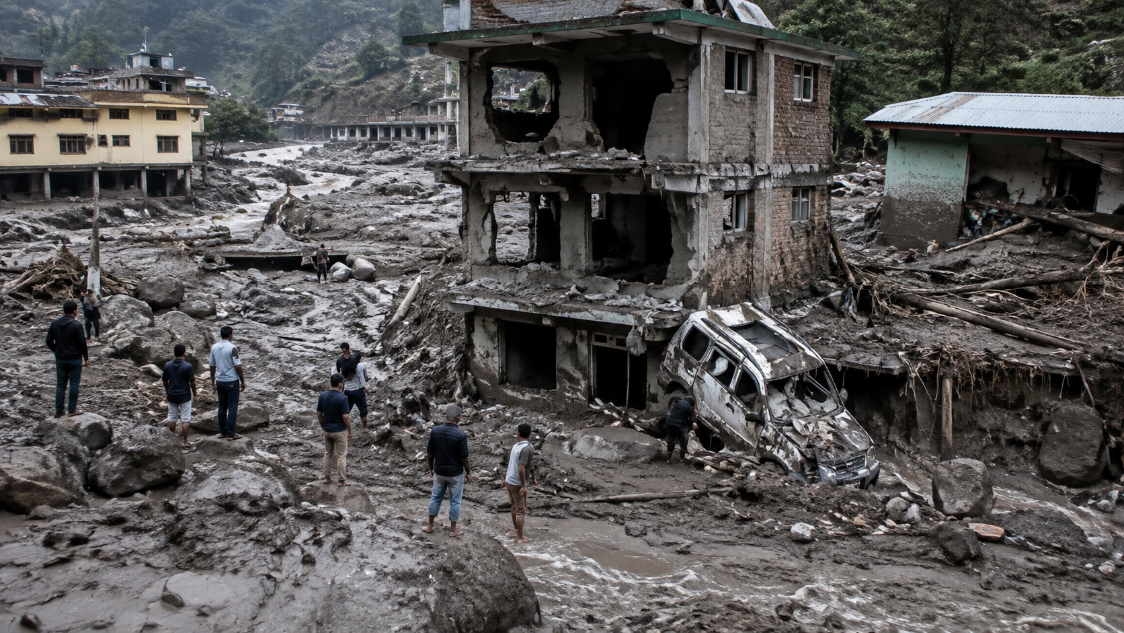
Nearly a week after a wall of ice, rock, mud and water tore through the Himalayan border region between Nepal and China, the scale of the disaster is still growing.
More than 1,000 people have now been confirmed dead, while 4,462 remain missing across Nepal and China’s Tibet region, according to the latest figures available on 1 September.
Nepalese authorities have confirmed 987 deaths and say 3,916 people remain unaccounted for. Chinese authorities have reported another 16 deaths and 546 missing in Tibet.
Among those still missing are hundreds of foreign nationals and five New Zealanders whose whereabouts remain unknown.
What happened on Wednesday, 26 August was not an ordinary monsoon flood.
A massive collapse high in the Himalayas sent ice, rock and debris into the river system, generating a destructive surge that raced through narrow valleys, settlements, hydropower projects and the Nepal-China border crossing.
In places, buildings simply disappeared.
Roads and bridges were torn apart.
Entire communities were cut off.
And almost a week later, rescue teams are still searching through tunnels, mud and shattered infrastructure for people who might somehow have survived.
Latest figures
|
Situation |
Latest reported figure |
|
Confirmed deaths in Nepal |
987 |
|
Confirmed deaths in China |
16 |
|
Combined confirmed deaths |
1,003 |
|
Missing in Nepal |
3,916 |
|
Missing in Tibet |
546 |
|
Combined missing |
4,462 |
|
Foreign nationals missing in Nepal |
583 |
|
Foreign nationals missing in Tibet |
261 |
|
People rescued |
More than 11,000 |
|
New Zealanders reported missing |
5 |
The figures remain subject to change as authorities reconcile missing-person lists, locate survivors and recover victims from areas that were initially inaccessible.
Five New Zealanders are still missing
For New Zealand, this disaster is no longer something happening far away.
Five New Zealanders have been reported missing after travelling towards the Kailash Mansarovar pilgrimage route when the flood struck.
They have been named by friends and family as Mihir Patel, Kinnari Patel, Shweta Mhatre, Dejan Kuzmic and Suhasini Reddy.
Nepal’s official list of foreign nationals affected by the disaster also recorded five New Zealanders as missing.
As of the latest public update, their whereabouts remained unknown.
The family of Suhasini Reddy has travelled to Kathmandu and publicly urged authorities and rescue teams to continue searching after incorrect reports circulated online suggesting she had been found.
Her family said they intended to leave “no stone unturned” in trying to establish what happened.
The Ministry of Foreign Affairs and Trade has been working through consular channels as efforts continue to establish the status of the missing New Zealanders.
New Zealand’s SafeTravel advice warns that the flooding has badly affected Rasuwa district and the Nepal-China border, particularly areas used by pilgrims travelling towards Mount Kailash.
New Zealand Governor-General acknowledges the tragedy
Governor-General Dame Cindy Kiro issued a message expressing New Zealand’s sympathy to those affected.
She acknowledged that the full extent of the disaster, including its impact on New Zealanders, was still being understood.
She also pointed to the long relationship between Nepal and New Zealand, shaped in part by the historic connection of Sir Edmund Hillary and Tenzing Norgay and strengthened over decades through tourism, development work and personal ties.
Dame Cindy also acknowledged New Zealand’s Nepalese community as families wait anxiously for news from home.
What caused the disaster?
Scientists and authorities are still examining the precise chain of events, but the evidence increasingly points towards a catastrophic glacier collapse or ice-rock avalanche high in the Himalayas.
The collapse released an enormous mass of ice and rock into the mountain river system.
That material combined with water and debris and became a rapidly moving flood capable of destroying almost everything in its path.
The flood moved through river valleys towards Nepal’s Rasuwa and Nuwakot districts and devastated areas around the border with Tibet.
The Gyirong border crossing, one of the key transport and trade routes between Nepal and China, was particularly badly damaged.
Chinese rescue personnel arriving in the area encountered widespread destruction, with buildings, roads and infrastructure buried or swept away.
Hundreds of hydropower workers remain a major concern
One of the most difficult rescue operations is taking place around Nepal’s hydropower facilities.
Projects were built along the same river valleys hit by the flood.
Hundreds of workers were caught when the water and debris arrived.
The latest Nepalese figures indicate 639 hydropower personnel remain among the missing.
At several projects, rescue teams believe workers may have survived inside tunnels.
That possibility has produced a desperate race against time.
Army engineers have been attempting to enter damaged tunnels, while Chinese and South Korean specialists have also been involved in technical rescue work at some sites.
At Upper Trishuli-1, an under-construction 216-megawatt project, hundreds of people have already been rescued.
Other projects, including Upper Trishuli-3A, Upper Trishuli-3B, Rasuwagadhi, Chilime, Langtang Khola and Mailung Khola, have also reported missing workers.
For anyone trapped underground, access to breathable air and clean water is becoming increasingly important as the disaster moves further beyond the first critical days.
Experts caution that survival becomes more difficult with time, although previous tunnel disasters have shown people can survive for extended periods if they have air, water and protected space.
More than 11,000 people rescued
There are also extraordinary stories of survival.
More than 11,000 people have been rescued as emergency personnel gradually reach communities that were cut off by collapsed bridges, destroyed roads and communications failures.
Helicopters have been used extensively in Nepal.
Temporary bridges are being installed and damaged roads reopened to bring equipment, food, medical supplies and rescue teams into isolated areas.
India and China are among countries supporting the response, while international humanitarian organisations are providing assistance to affected communities.
But the geography makes almost everything difficult.
The disaster zone includes steep mountains, narrow valleys and unstable slopes.
Mud and debris remain metres deep in some places.
Further rainfall also creates the possibility of fresh landslides or flooding.
The disaster is destroying more than buildings
For communities in Nepal’s Rasuwa region, the loss extends beyond homes and infrastructure.
Families have lost relatives, livelihoods, monasteries, community spaces and possessions handed down through generations.
Some displaced residents have expressed fears that the disaster could permanently break apart communities with distinctive Himalayan Buddhist and Indigenous cultural traditions.
If people cannot return and rebuild, younger generations may lose not only their homes but also the everyday connection through which language, customs, festivals and traditions are passed down.
The human consequences will therefore remain long after the search operation ends.
A disaster that also raises uncomfortable climate questions
The catastrophe has again focused attention on the changing Himalayan environment.
Nepal’s mountains contain thousands of glaciers and glacial lakes.
As temperatures rise, scientists have repeatedly warned that retreating glaciers, unstable ice, thawing slopes and growing glacial lakes can increase the risk of sudden high-altitude disasters.
Researchers examining this event have pointed towards glacier instability as a major factor, although a detailed scientific assessment of the exact trigger will take time.
The lesson is becoming increasingly difficult to ignore.
Communities that have lived beneath these mountains for generations are facing hazards that can develop kilometres away and arrive with almost no warning.
New Zealanders can help
For people watching these images from New Zealand, the scale of the disaster can make an individual contribution feel small.
It is not.
Families have lost homes, possessions and livelihoods in minutes. Survivors will need food, clean water, temporary shelter, medical support and assistance rebuilding their lives.
Webfit News has launched the Nepal Flash Flood Relief Appeal 2026 through Good Cause to give people in New Zealand and elsewhere a direct way to contribute.
There is no expectation that everyone should make a large donation.
A small contribution from many people can collectively become meaningful support.
If you can contribute, please do.
If you cannot donate, sharing the appeal with your family, friends, workplaces and community networks can help it reach someone who can.
Donate here:
https://goodcause.webfitnews.co.nz/campaigns/nepal-flash-flood-relief-2026
The search is not over
As the confirmed death toll moves beyond 1,000, it is increasingly difficult to remain optimistic about everyone still listed as missing.
But thousands of families have not yet received an answer.
For them, a missing-person number is not a statistic.
It is a husband, wife, parent, child, friend or colleague whose phone has stopped ringing.
Rescue teams are still digging.
Families are still waiting.
And five of those families have a direct connection to New Zealand.
Until their whereabouts and those of thousands of others are established, this disaster remains not only a recovery operation but a search for answers.
For New Zealand’s Nepalese community, for the families of the missing Kiwis, and for communities devastated across the Himalayas, the coming days will be extraordinarily difficult.
This is a moment when distance should not become indifference.
Sources: Nepal National Disaster Risk Reduction and Management Authority; Nepal Ministry of Foreign Affairs; New Zealand Ministry of Foreign Affairs and Trade / SafeTravel; Reuters; Associated Press; Office of the Governor-General of New Zealand.