
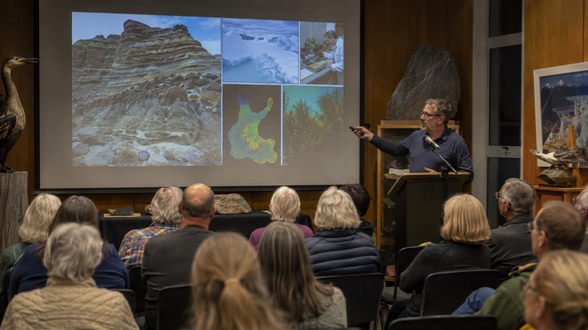
The Nelson Science Society has unveiled a packed programme for the rest of 2026, bringing together public talks on some of the biggest scientific questions of the moment, from misinformation and decision-making to ancient ecosystems, biodiversity and how organisms adapt to rapidly changing environments.
The programme begins with the 83rd Annual Thomas Cawthron Memorial Lecture on 8 September and continues through October and November with talks from leading researchers and practitioners.
Nelson Science Society President Jenny Pollock says the schedule is designed to give the community access to a broad mix of scientific ideas and current research, while also connecting people with other science-focused events happening across the region.
Cawthron Annual Lecture to tackle science and disinformation
The first major event is the Cawthron Annual Lecture on Tuesday, 8 September.
This year’s theme is:
“Truth in a noisy world: Science, disinformation and decisions for our future.”
The lecture will run from 7pm to 8.30pm at the Annesbrook Event Centre, 40 Saxton Road, Stoke.
Tickets are $20, or what attendees can afford.
The topic is especially timely.
Public debate increasingly takes place in an environment where scientific evidence, opinion, social media, political messaging and misinformation can become difficult to separate.
The lecture will look at how people can make sound decisions in a crowded information environment and what role science should play when public confidence is challenged by competing claims.
For a public science lecture, that is a particularly relevant subject because the issue is no longer simply whether scientific information exists.
The harder question is whether people trust it, understand it and can distinguish reliable evidence from noise.
Fossils of Foulden Maar and New Zealand’s open ecosystems
On Wednesday, 21 October, the Nelson Science Society will host a joint presentation by Professor Daphne Lee and Professor Bill Lee.
The session will run from 7pm to 9pm at Greenmeadows, on the corner of Main Road Stoke and Songer Street.
A gold coin donation applies for non-members.
Professor Daphne Lee will speak about the fossils of Foulden Maar.
Foulden Maar is a 23-million-year-old volcanic crater near Middlemarch and is internationally significant because of the quality of fossil material preserved there.
Professor Lee, Emeritus Professor in the Department of Geology at the University of Otago, has spent more than two decades coordinating research connected with the site.
Her work has contributed to studies of ancient leaves, fish, diatoms, freshwater sponges and other evidence of past ecosystems.
The significance of Foulden Maar lies not only in the fossils themselves but in what they can reveal about climate, biodiversity and ecological change millions of years ago.
Bill Lee to examine overlooked open ecosystems
Professor Bill Lee will speak on:
“Open ecosystems in forested landscapes: an overlooked biome for species assembly.”
His presentation will look at the role of non-forest ecosystems below the treeline in New Zealand.
These open ecosystems have existed for millions of years and developed under very different conditions from open landscapes elsewhere in the world.
In many countries, large grazing mammals and fire were major forces in shaping grasslands and other open ecosystems.
New Zealand’s evolutionary history was different.
Environmental conditions instead created a range of smaller, often fragmented and sometimes temporary open ecosystems.
These areas support specialised plants, endemic species and distinctive ecological communities.
They are also important for understanding New Zealand’s ecological and evolutionary history.
Since human settlement, however, many open ecosystems have been heavily modified or lost, and a number of associated plant species are now threatened.
That makes the subject relevant not only to ecological history but also to modern conservation.
Epigenetics and adaptation in changing marine environments
On Wednesday, 11 November, Dafni Anastasiadi from the Bioeconomy Science Institute will speak about epigenetics and how it may help explain adaptation and evolution in aquatic species.
The talk will run from 6pm to 7.45pm at Greenmeadows.
Again, a gold coin donation applies for non-members.
The presentation will explore how epigenetic mechanisms can influence the way organisms respond to rapidly changing environments, particularly in aquatic systems.
The distinction between genetics and epigenetics is central to the discussion.
Genetics refers to the underlying DNA sequence.
Epigenetics refers to chemical modifications that affect how genes are switched on or off without changing that underlying sequence.
One useful way to think about it is that genetics provides the instruction manual, while epigenetics can highlight or hide different parts of that manual.
These epigenetic changes can respond to environmental conditions and, in some cases, may persist across generations.
That raises important questions about how species adjust to changing marine conditions and how much of that response is shaped by inherited DNA versus more flexible biological regulation.
Why epigenetics matters now
For aquatic species, the issue has particular relevance because marine environments are changing rapidly.
Temperature, acidity, oxygen levels, pollution and other environmental pressures can all influence how species survive and reproduce.
Researchers are increasingly interested in whether epigenetic changes give some organisms a faster way to respond than genetic evolution alone would allow.
That does not mean organisms can simply adapt to any level of environmental change.
But it does add another layer to understanding how species respond under pressure.
For fisheries, aquaculture and conservation, that could become increasingly important.
Another Cawthron public lecture is also planned
The Nelson Science Society has also indicated that another Cawthron public lecture is expected in mid to late November.
Details have not yet been confirmed.
That means the science calendar may still expand further before the end of the year.
Rocks Road engineering and landslide risk also in focus
Outside the Nelson Science Society’s own programme, several other science and engineering events are being promoted to local audiences.
One of the most locally significant is the AUSIMM Nelson Discussion Group meeting on Friday, 25 September.
The presentation is titled:
“The Nelson Rocks Road Saga.”
It will feature Lauren Foote, Senior Engineering Geologist with WSP Nelson, and Sigfrid Dupre, Principal Geotechnical Engineer with NZTA.
The meeting begins with refreshments and networking at 5pm, followed by a 5.30pm start at the Constance Barnicoat Room, Richmond Library, 280 Queen Street, Richmond.
The talk will examine the long history of cliff instability along Rocks Road and how engineers are trying to manage the continuing landslide and rockfall risk.
Rocks Road has faced instability for more than a century
Rocks Road opened in 1899 and has repeatedly experienced rockfall and landslide events.
These have led to closures, debris removal and repair work over many years.
The issue became particularly visible again after heavy rainfall in June and July 2025 triggered another series of landslides and rockfalls.
Those events highlighted the vulnerability of the route and renewed attention on how to reduce risk while minimising disruption.
The road carries about 20,000 vehicles a day, making closures and instability a significant transport issue for Nelson.
The September presentation will cover the history of the route, previous mitigation methods and the current engineering solutions being used to improve resilience.
Speakers bring direct project experience
Lauren Foote was the first geologist on site during the June 2025 landslides that helped trigger the current cliff stabilisation works.
She has been involved from the initial response through option development, design and construction.
Foote completed undergraduate and master’s degrees in geology at the University of Canterbury and moved into engineering geology following the Canterbury earthquake sequence.
Sigfrid Dupre brings more than 25 years of engineering experience and specialises in landslide and rockfall risk assessment across New Zealand’s state highway network.
He trained in engineering geology in France and later completed geotechnical engineering study at the University of Auckland before becoming a chartered geotechnical engineer.
For Nelson residents, the presentation offers a chance to understand not just what work is happening on Rocks Road, but why particular engineering decisions are being made.
Renewable energy and astronomy also feature in the wider programme
The wider science calendar also includes a talk at the Boathouse on 15 October, where Nathan Clarke is expected to speak about his ambitions for New Zealand’s renewable energy future.
The Nelson Astronomical Society is also continuing its programme of talks, including sessions examining astronomy and the technology used to observe distant galaxies.
Taken together, the events show a strong local appetite for public science.
A programme that spans immediate issues and deep time
One of the strengths of the schedule is its range.
Disinformation and public decision-making are immediate social issues.
Rocks Road is a local engineering challenge happening now.
Epigenetics looks at biological responses to environmental change.
Foulden Maar takes audiences back 23 million years.
Open ecosystem research asks how New Zealand’s landscapes and species evolved.
That breadth is exactly what public science societies can offer.
They provide a place where complex research can move outside universities and specialist institutions and into community discussion.
Science as a community conversation
Public talks may seem small compared with formal research programmes, but they play an important role.
They allow people to hear directly from scientists.
They create room for questions.
They help communities understand why research matters.
And in a period when public trust in institutions and information is often contested, that direct connection can be valuable.
Nelson’s upcoming programme reflects that.
The subjects are diverse, but the underlying purpose is consistent: to make scientific knowledge easier to access and easier to discuss.
For a region with strong interests in conservation, infrastructure, marine science, geology and environmental change, the timing could hardly be better.
Source: Nelson Science Society communication from President Jenny Pollock, with additional event detail from the AUSIMM Nelson Discussion Group notice for 25 September 2026.