
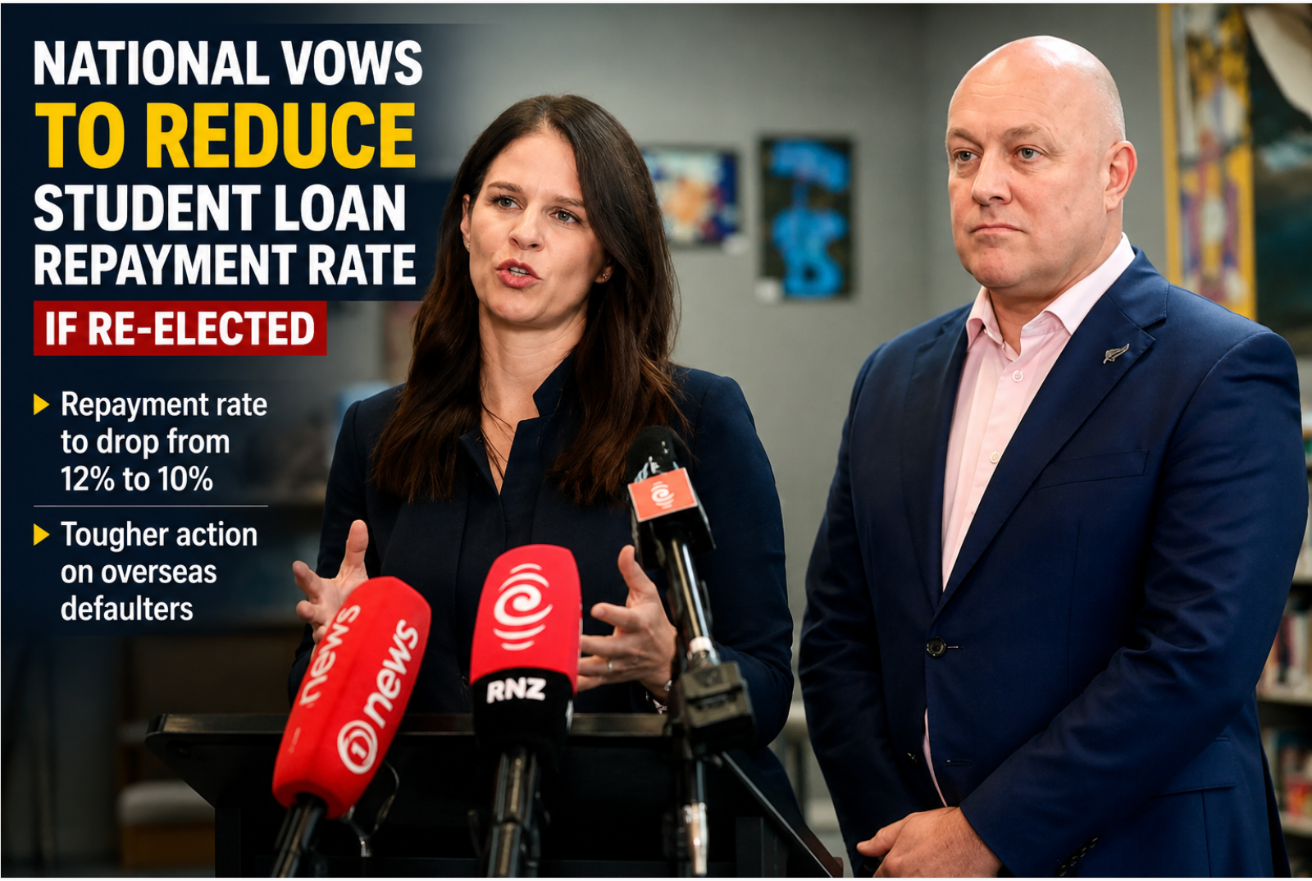
National is promising to cut the compulsory student loan repayment rate from 12 percent to 10 percent if it wins the November election, pitching the move as immediate cost-of-living relief for graduates.
The policy would take effect from April 2027 and would allow New Zealand-based borrowers to keep more of each dollar they earn above the repayment threshold.
At the same time, National wants to take a much harder line on people who move overseas with student debt, including additional interest, restrictions around KiwiSaver withdrawals and stronger enforcement against serious, sustained defaults.
On the surface, the pitch is simple: give young workers more breathing room at home, and chase harder those who leave without repaying.
But the policy also raises important questions.
Would borrowers simply take longer to repay their loans? What would slower repayments cost the Crown? How much difference would the change make for people on average incomes? And is this primarily good policy, or a politically attractive election promise aimed at younger voters?
What National is proposing
National says it would reduce the compulsory repayment rate from 12 cents to 10 cents for every dollar earned above the student loan repayment threshold.
The current threshold is $24,128.
For someone earning $75,000, National says the policy would leave them with about $39 extra each fortnight, or roughly $1,000 a year.
The calculation broadly stacks up.
A borrower earning $75,000 has about $50,872 of income above the threshold. Reducing the repayment rate by two percentage points would reduce compulsory annual repayments by just over $1,000.
What the change could mean in practice
| Annual income | Approximate extra cash per year at 10% instead of 12% |
|---|---|
| $40,000 | $317 |
| $50,000 | $517 |
| $60,000 | $717 |
| $75,000 | $1,017 |
| $90,000 | $1,317 |
| $100,000 | $1,517 |
These are indicative calculations based on the current $24,128 repayment threshold.
The important point is that the benefit grows with income.
Someone earning $40,000 would gain only around $6 a week.
Someone earning $100,000 would keep close to $30 extra a week.
That does not make the policy inherently unfair, because the repayment system itself is income-based. But it does mean the headline benefit will vary significantly depending on what a graduate earns.
The first catch: loans would generally take longer to repay
This is the obvious trade-off.
Reducing compulsory repayments does not reduce the amount someone owes.
It reduces how quickly they are required to pay it back.
For New Zealand-based borrowers, student loans are generally interest-free, so taking longer to repay is not necessarily financially harmful in the same way that stretching out a mortgage or credit-card balance would be.
That makes the policy unusual.
A borrower could gain extra weekly cash flow without necessarily paying more interest.
But there is still a consequence: the debt remains on the books for longer.
That may matter psychologically for some borrowers and financially for the Government, because Crown repayments arrive more slowly.
New Zealand already has a very large student loan book
The scale of the scheme matters when assessing the proposal.
As at March 2026, Inland Revenue data showed:
| Measure | Figure |
|---|---|
| Total student loan borrowers | 631,310 |
| New Zealand-based borrowers | 516,586 |
| Overseas-based borrowers | 114,724 |
| Total nominal student loan balance | $16.8 billion |
| Median student loan balance | $18,302 |
| Total overdue repayments | $2.663 billion |
That means even a relatively small change in compulsory repayment rates could affect government cash flow across hundreds of thousands of borrowers.
National has not, in the material available so far, set out the full fiscal cost of receiving those repayments more slowly.
That is one of the biggest unanswered questions.
The second half of the policy is much tougher
National is pairing the domestic repayment cut with stronger enforcement against overseas borrowers.
Nicola Willis says overseas-based borrowers account for the overwhelming majority of overdue student loan debt and have much lower compliance rates.
The broad concern is supported by official data.
As at March 2026, Inland Revenue recorded about $2.478 billion in overdue repayments from overseas-based borrowers, compared with $185 million from New Zealand-based borrowers.
That means roughly 93 percent of the overdue dollar value was linked to borrowers overseas.
Compliance is also sharply different.
Inland Revenue says 94.7 percent of New Zealand-based borrowers were meeting their repayment obligations at March 2026, compared with just 26.5 percent of overseas-based borrowers.
So National is not inventing the overseas repayment problem.
It is real and substantial.
But enforcement is not always simple
The harder question is whether stronger penalties will recover significantly more money.
Once borrowers move overseas, Inland Revenue faces practical limits.
Different countries have different legal systems, enforcement arrangements and income information.
Some borrowers may have low incomes. Others may be difficult to locate. Some may have large balances that have grown because overseas borrowers are charged interest.
Official data shows overseas borrowers generally carry larger balances than borrowers who stay in New Zealand.
The 2025 Student Loan Scheme Annual Report showed an average overseas-based balance of about $37,678, compared with a lower overall average across all borrowers of $26,075.
Tougher rules may improve compliance, but they are not automatically the same thing as successful debt recovery.
KiwiSaver restrictions would need careful explanation
National also proposes restricting KiwiSaver withdrawals for some overseas-based borrowers who have failed to meet their student loan obligations.
That is politically eye-catching, but the details matter enormously.
Would the restriction apply to first-home withdrawals?
Would it apply only to borrowers in serious default?
How long would restrictions remain?
What safeguards would exist for hardship?
Those details could determine whether the policy functions as a targeted enforcement measure or becomes an overly broad penalty.
Until National releases the full policy design, those questions remain open.
Arrest warrants will attract attention, but context matters
National also wants to make it easier for police to issue arrest warrants for serious and sustained student loan defaults.
New Zealand already has strong enforcement provisions for some defaulting overseas borrowers.
The important issue is where National would set the threshold.
There is a major difference between someone who misses a payment and someone who deliberately avoids a large debt for years.
A credible policy needs to distinguish between the two.
Otherwise, a tough-sounding enforcement measure risks becoming more useful as an election slogan than as an effective debt-recovery tool.
Is the policy good for young graduates?
For many borrowers staying in New Zealand, yes, in one immediate sense.
It would increase take-home pay.
For a recent graduate dealing with rent, groceries, transport, KiwiSaver deductions and other costs, an extra $20, $30 or $40 a fortnight is not meaningless.
National is clearly betting that younger workers will value cash in their pocket today more than faster repayment of an interest-free loan.
That is a reasonable political calculation.
But it should not be presented as debt relief.
The debt does not disappear.
Repayment simply slows.
Could this become an election battleground?
Almost certainly.
With the general election approaching, student loans are politically useful territory.
They affect hundreds of thousands of voters, many of them younger workers struggling with housing costs and living expenses.
National can present the policy as a practical cost-of-living measure.
Opposition parties have several obvious lines of attack available.
Labour could argue that the policy shifts repayments into the future and weakens Crown revenue without reducing the actual debt.
The Greens could question whether reducing repayments is enough when tertiary costs, rent and graduate wages remain under pressure.
Other parties could focus on the fairness of punishing people overseas more aggressively while giving domestic borrowers relief.
As of the latest material available, there was no substantive opposition response to National's announcement that could be responsibly quoted here.
That will likely change quickly.
Is this policy or an election card?
It can be both.
That is the reality of election-year policymaking.
A policy can deliver a genuine benefit and still be designed to appeal to a politically important group.
The 10 percent repayment rate would clearly improve short-term cash flow for borrowers.
The overseas enforcement problem is also backed by official data.
But the unanswered issues are just as important:
- What is the fiscal cost?
- How much longer will average loans take to repay?
- How much additional overseas debt does National realistically expect to recover?
- What exactly would the KiwiSaver restrictions cover?
- What safeguards would exist around stronger enforcement powers?
- Would the repayment threshold also change over time?
Those are the questions voters should be asking before treating the policy as either a breakthrough or a gimmick.
The ground-level reality
For the average borrower, the policy is unlikely to transform their financial life.
It is more likely to provide modest but noticeable weekly relief.
For someone earning $75,000, about $1,000 a year matters.
But that same borrower may still be facing high rent, mortgage costs, insurance, food bills and transport expenses.
The policy therefore sits somewhere between meaningful relief and limited relief.
It is not nothing.
It is also not a solution to the broader affordability pressures facing younger New Zealanders.
The bigger test
National has made the political trade-off clear.
Borrowers who stay and work in New Zealand would repay more slowly.
Borrowers who leave and default would face tougher consequences.
That is easy to communicate.
The tougher question is whether the numbers work for taxpayers as well as borrowers.
Until National publishes the full fiscal costing and enforcement details, voters are being given only part of the picture.
And with the election approaching, that distinction matters.
Sources
- National Party student loan policy announcement, 30 August 2026.
- Inland Revenue student loan statistics, March 2026.
- Ministry of Education, Student Loan Scheme Annual Report 2025.
- Inland Revenue annual reporting on borrower repayment compliance.