
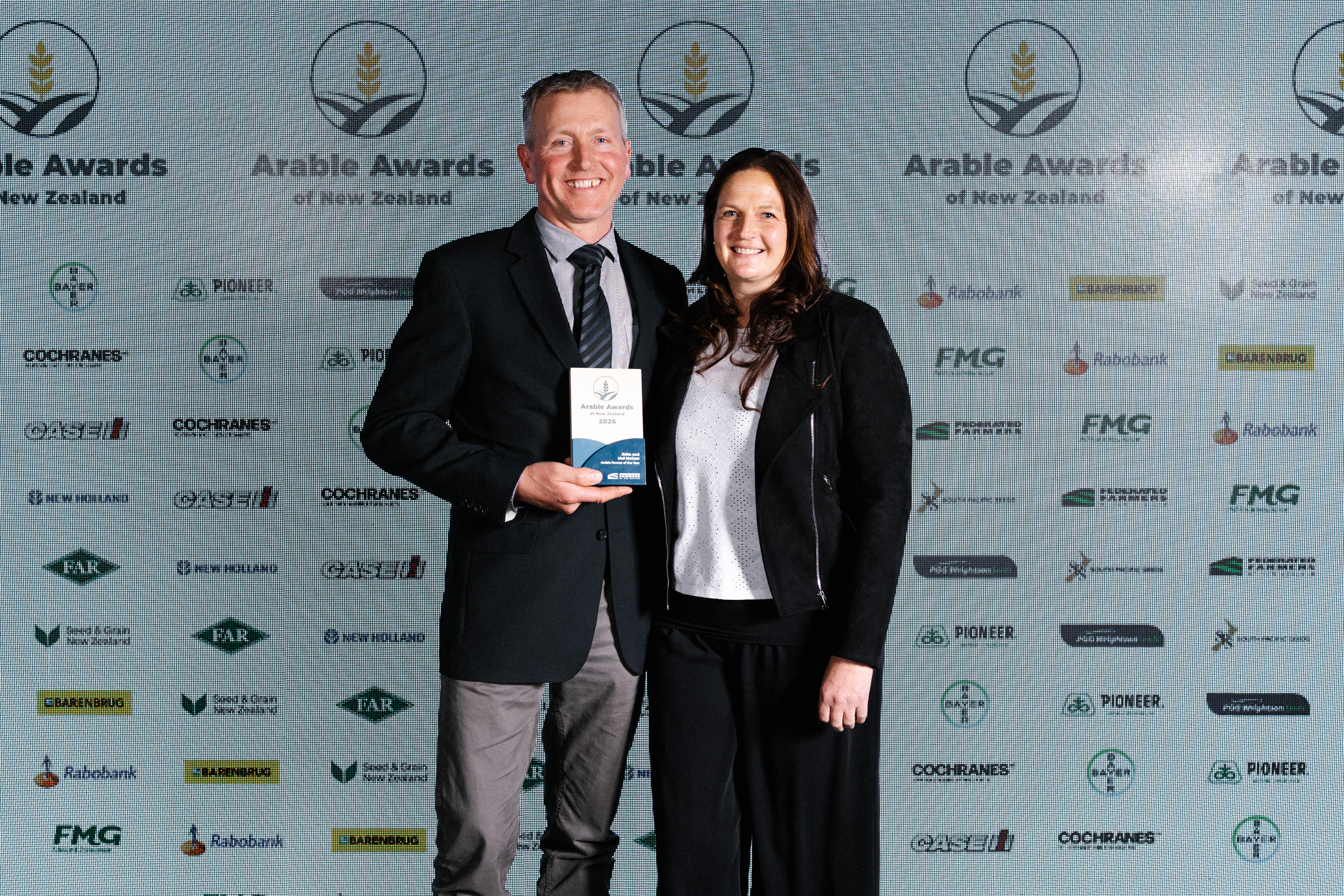
Methven farmers John and Mel McCaw have been named Arable Farmers of the Year at the 2026 Arable Awards in Christchurch, recognised for a farming system that combines strong commercial performance with careful soil management, crop diversity and long-term industry leadership.
Nearly 500 people attended the fourth annual awards at the Air Force Museum, where winners were recognised across seven categories covering arable farming, environmental performance, innovation, agronomy and wheat production.
The McCaws’ win is notable because the judges were not simply looking at yield or scale.
They were recognised for the way they run a balanced arable system, integrating multiple crops and livestock while keeping the operation simple, profitable and environmentally conscious.
That gives the award a wider significance.
At a time when farmers are being asked to improve productivity, manage rising costs and reduce environmental impact, the McCaws were recognised for showing that those goals do not necessarily have to compete with one another.
Why the McCaws stood out
The Arable Farmer of the Year is selected from winners of four major grower categories.
This year those finalists were:
| Category | Winner |
|---|---|
| Seed Grower of the Year | John and Mel McCaw |
| Maize Grower of the Year | Mark Shera, Ashburton |
| Cereal Grower of the Year | Andrew and Amy Darling, Timaru |
| Positive Environmental Impact Grower of the Year | Lovett Family Farms |
The judges said they were impressed by the McCaws’ ability to keep their arable rotation relatively simple while still maintaining a strong understanding of crop performance.
They also highlighted the strategic integration of multiple arable crops and livestock classes.
The result is a system that is not only productive, but also commercially sustainable.
Profitability and sustainability together
One of the strongest elements of the McCaws’ operation is that good profitability is being achieved alongside environmental management.
Their system includes the use of:
trees
cover crops
tillage practices designed to support soil conservation
integration of livestock with arable production
That matters because arable farming can place pressure on soils if rotations, cultivation and nutrient use are poorly managed.
The McCaws’ recognition reflects a broader shift in farming where the best-performing systems are increasingly judged not just on output, but on how well the land is managed over time.
Why arable farming matters
The grain and seed sector can sometimes attract less public attention than dairy or sheep and beef farming, but it plays an important role in New Zealand agriculture.
Arable farmers produce grain, seed, cereals, maize and specialist crops that feed into food production, livestock systems, export markets and seed supply.
Many of the businesses involved are technically complex.
They rely on strong agronomy, careful crop rotation, accurate timing, weather management, machinery investment and an increasingly detailed understanding of soil performance.
The 2026 awards reflect that diversity.
John McCaw’s role beyond the farm
John McCaw has also been recognised for his contribution to the wider sector.
He has held a number of representative, community, governance and advisory roles and has chaired the Federated Farmers Herbage Seed Subsection for the past six years.
Earlier this year, he was named Federated Farmers Arable Advocate of the Year.
At the time, then Arable chair David Birkett described McCaw’s contribution as "exceptional and hugely valuable".
"The intellect and the balanced approach he brings to advocacy is outstanding," Birkett said.
That wider contribution appears to have strengthened the significance of the McCaws’ award.
The recognition is not only about how they farm their own property, but also about the role John McCaw has played in representing and supporting the arable sector.
Innovation was also a major theme
Another standout result came from Marty and Georgina Skurr, who won the Innovation Award.
The couple farm Canterbury land that has been in the family since the 1920s.
Their award recognised an attempt to capture more value from grain grown on the farm.
Instead of stopping at production, they developed an on-farm stone-ground flour business.
They now manage the full chain themselves, from growing and harvesting the grain through to milling, marketing and selling the finished product.
That is significant because it changes the relationship between farmer and consumer.
Instead of selling grain as a raw commodity and leaving processing and branding to someone else, the Skurrs are creating a direct connection between the farm and the final product.
It is a useful example of value-added agriculture.
A different kind of arable success
The Innovation Award also points to a broader question facing agriculture.
Should farmers only focus on producing more, or should more of them try to capture additional value after the farm gate?
The Skurrs have chosen the second approach.
That does not mean every grain grower should start a milling business.
But their success shows there can be opportunities in processing, branding and direct sales, particularly where consumers want to know more about where food comes from.
Hall of Fame recognises decades of contribution
The awards also inducted four sets of contributors into the Arable Hall of Fame:
John Mckay
John McKenzie
Eric and Maxine Watson
the late Murray Kelly
Each represents a different part of the sector.
John Mckay and specialist seed production
John Mckay has been a central figure in South Pacific Seeds since the company’s beginnings in the early 1990s.
The business has grown into New Zealand’s largest vegetable seed production company.
Mckay has served as managing director throughout that growth.
The Hall of Fame citation credited him with helping develop production systems and grower networks that allowed New Zealand arable farmers to successfully produce specialist seed crops including:
carrot
radish
Chinese cabbage
He also helped develop new markets, particularly in Asia.
His contribution was described as extending beyond commercial growth into research and industry capability.
John McKenzie and forage genetics
John McKenzie was recognised for a career spanning several decades in pasture seed and forage.
His influence extended across seed sales, commercial plant breeding, research commercialisation, export agribusiness and the integration of science with farming practice.
The citation also highlighted his contribution to developing New Zealand forage genetics for international markets.
That is an important reminder that arable farming is not only about grain.
Seed genetics and pasture systems can have a much wider impact on the productivity of the livestock sector as well.
Eric and Maxine Watson recognised for record-breaking performance
Eric and Maxine Watson have farmed at Wakanui, near Ashburton, for more than 30 years.
They have been longstanding supporters of the arable sector and have also achieved remarkable productivity results.
The couple achieved Guinness World Records for wheat yields twice.
But their Hall of Fame recognition was not based on those records alone.
The Watsons’ farm has hosted dozens of grain and seed trials.
Eric Watson has worked closely with researchers throughout his farming career and has been widely recognised for sharing his knowledge with other growers.
The citation said he had been generous in giving advice to farmers of all ages, both local and international.
That willingness to share information is one of the recurring themes across this year’s awards.
Murray Kelly remembered for research leadership
The late Murray Kelly was inducted into the Hall of Fame for his contribution as a senior research agronomist at PGG Wrightson Seeds.
Kelly and his team worked on techniques designed to increase seed yields and improve crop production.
He was also recognised as an effective communicator and mentor.
Growers and research colleagues described him as "a walking encyclopedia on all aspects of seed production".
His recognition highlights the importance of research behind farm performance.
High yields and improved farming systems are rarely the result of farmers working alone.
They are often built through decades of interaction between growers, scientists, agronomists and seed companies.
Other 2026 Arable Award winners
A number of other growers, teams and agronomists were also recognised.
| Award | Winner |
|---|---|
| Working Together Award | The SCID Rebuild Team |
| Positive Environmental Impact Award | Lovett Family Farms |
| Agronomist of the Year | Sean Mulligan |
| United Wheat Growers Feed Wheat Award | Andrew and Amy Darling, Adar Farming Ltd |
| United Wheat Growers Milling Wheat Award | Dan and Tash White, Willowbank Ag |
| United Wheat Growers Premium Milling Wheat Award | Robin and Lisa Kingsbury, Tahuri Farm |
The spread of awards shows how broad the modern arable sector has become.
It is no longer enough to think only in terms of yield.
Environmental performance, agronomy, collaboration, processing and market development are all increasingly important.
What the 2026 awards say about the sector
Taken together, this year’s awards point to several clear themes.
The first is that profitability and sustainability are increasingly being judged together.
The McCaws’ win reflects that.
The second is that innovation is becoming more important, particularly when it creates more value from what is already being grown.
The Skurrs’ flour business is a good example.
The third is that research and knowledge-sharing remain central.
The Hall of Fame inductees show how much the arable sector depends on growers, scientists and industry leaders who are willing to test, improve and share what works.
The bigger lesson
Farming awards can sometimes look like industry celebrations with little relevance outside the room.
This one carries a broader point.
The arable sector is being pushed in several directions at once.
Farmers need to remain profitable.
They need to look after soils.
They need to improve efficiency.
They need to adapt to changing markets.
And they increasingly need to think beyond raw production.
The 2026 winners show different ways of doing that.
The McCaws have built a balanced and commercially strong farming system.
The Skurrs have moved further into processing and direct sales.
The Hall of Fame inductees have spent decades building markets, genetics, research and grower capability.
That combination of productivity, stewardship and knowledge is probably the most important story behind the awards.
The bottom line
John and Mel McCaw’s recognition as Arable Farmers of the Year is about more than one successful Methven farming business.
Their award reflects a model of arable farming that aims to keep the system understandable, commercially strong and environmentally responsible.
It also sits within a wider industry story.
New Zealand’s arable sector is increasingly rewarding farmers and industry leaders who combine production with research, sustainability, innovation and added value.
That is what made this year’s awards meaningful.
Not simply who won.
But what kind of farming the sector is choosing to celebrate.
Source: Federated Farmers