
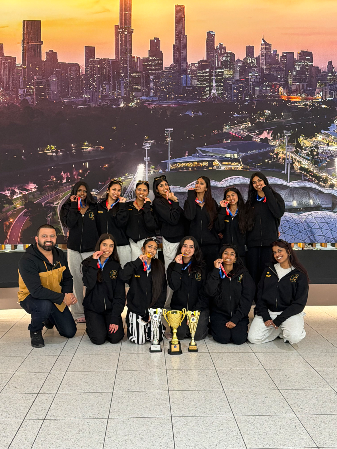
A group of Auckland high school students has returned home with more than trophies after making history on an international stage.
The Lynfield College Indian Dance Team has become the first New Zealand high school Indian dance team to travel overseas to compete, representing both their school and New Zealand at an international high school dance competition in Melbourne.
And they did not simply participate.
The team received the highest marks from the judges, won the Best Choreography Award, placed third in audience voting and also received the Best Audience Participation Award.
For the students, teachers and families behind the team, the result was the culmination of months of preparation, fundraising and community support.
A first for a New Zealand high school team
The Melbourne trip marked a milestone not only for Lynfield College, but for Indian cultural performance within New Zealand schools.
Indian dance is already a visible part of school cultural events, festivals and community celebrations across Auckland.
But taking a school team overseas to compete internationally is a different level of commitment.
It required training, organisation, travel planning, fundraising and the confidence to perform in front of an unfamiliar audience.
Teachers and team coordinators Rahul Chopra and Sahridha Anna Philip said that was what made the experience so special.
“Seeing our students take Indian dance onto an international stage with such confidence and pride was incredibly special,” they said.
“To be the first New Zealand high school Indian dance team to do this makes the achievement even more meaningful.”
Strong results across judging and audience categories
The team’s performance was recognised in several areas.
Their results included:
- highest marks from the judges
- Best Choreography Award
- third place in audience voting
- Best Audience Participation Award
That combination is significant.
Judges’ scores reflect technical quality and performance.
Audience voting reflects how strongly the performance connected with people in the room.
And winning Best Audience Participation suggests the team did more than execute choreography well. They created energy and brought the crowd into the performance.
For a student team competing overseas for the first time, that is an impressive outcome.
More than a competition
The organisers stressed that the trip was never only about winning.
For the students, the experience also meant stepping into a new environment, travelling as a team and representing their culture outside New Zealand.
Those experiences can have a lasting effect.
Performing internationally requires confidence.
It also requires students to trust each other, stay disciplined and adapt to the pressure of competition.
The team returned to Auckland with stronger friendships, greater self-belief and memories likely to stay with them well beyond school.
That is part of what makes achievements like this meaningful.
A trophy eventually sits on a shelf.
The confidence built through earning it often lasts much longer.
Culture represented with pride
The trip also carried a strong cultural dimension.
Indian dance is not simply entertainment.
It can be a way for young people growing up in New Zealand to stay connected with language, music, tradition and identity while also sharing that culture with a wider audience.
For students from migrant or multicultural backgrounds, school-based cultural groups can become an important bridge between home and wider New Zealand life.
They allow students to participate fully in a New Zealand school community without feeling they need to leave their cultural identity at the gate.
In Melbourne, the Lynfield College team had the opportunity to take that identity onto an international stage.
They were representing their school.
They were representing Indian culture.
And they were representing New Zealand at the same time.
The wider community helped make the trip possible
International school trips are rarely simple or inexpensive.
The Melbourne tour was made possible through support from Lynfield College, parents, local businesses and the wider community.
Fundraising included a community Garba Night, while local sponsors also contributed towards making the journey possible.
Chopra and Philip said that support was central to the team’s success.
“We are incredibly grateful to everyone who supported this journey,” they said.
“Our students represented their school, their culture and New Zealand exceptionally well.”
That community backing is an important part of the story.
The students were the ones on stage, but achievements like this are usually built by many people behind the scenes.
Parents help with transport and costumes.
Teachers give up time.
Businesses contribute sponsorship.
Community members attend fundraisers.
Schools provide the structure that allows the opportunity to happen.
The final performance may last only a few minutes, but the work behind it can stretch over months.
A positive story for multicultural New Zealand
New Zealand schools have become increasingly multicultural, particularly in Auckland.
That change is visible in classrooms, languages, festivals, food, music and performance.
Stories such as Lynfield College’s Melbourne success show what can happen when that diversity is treated as an asset rather than something separate from mainstream school life.
Students can celebrate their cultural background while contributing to the wider identity of their school and country.
That matters.
For younger students watching from the sidelines, seeing a school team take Indian dance overseas and succeed can also expand their idea of what is possible.
It tells them their culture has a place not only at home or within community events, but on major stages as well.
The role of teachers deserves recognition
The success also highlights the importance of teachers willing to support activities outside the traditional classroom.
School life is not only about exams and grades.
Sport, music, theatre, cultural groups and other extracurricular activities often provide students with some of their strongest opportunities to develop leadership, teamwork and confidence.
For Chopra and Philip, coordinating the team meant responsibilities well beyond rehearsals.
There would have been planning, communication with families, logistics, fundraising and the responsibility of taking a group of students overseas.
Their role illustrates how much work teachers often contribute to school communities beyond what is visible during normal teaching hours.
A memory the students will carry forward
The students returned to Auckland with trophies, but also with something more difficult to measure.
They now know they can prepare for an international competition, walk onto a stage in another country and perform successfully under pressure.
For teenagers still working out what they are capable of, that can be powerful.
Some may continue dancing.
Some may never compete again after school.
But the lessons from the experience, discipline, teamwork, resilience and confidence, can carry into university, careers and other parts of life.
A historic first, but hopefully not the last
Being the first comes with special significance.
But the best legacy of Lynfield College’s achievement would be if, in a few years, a New Zealand high school Indian dance team travelling overseas was no longer unusual.
This trip has shown that it can be done.
It has shown that students can compete successfully.
And it has shown that schools and communities are willing to support young people who want to take cultural performance seriously.
For Lynfield College, Melbourne will remain a milestone.
For the students involved, it will remain a personal memory.
And for New Zealand’s growing multicultural school community, it may also be the beginning of something bigger.
Source: Lynfield College Indian Dance Team organisers.