
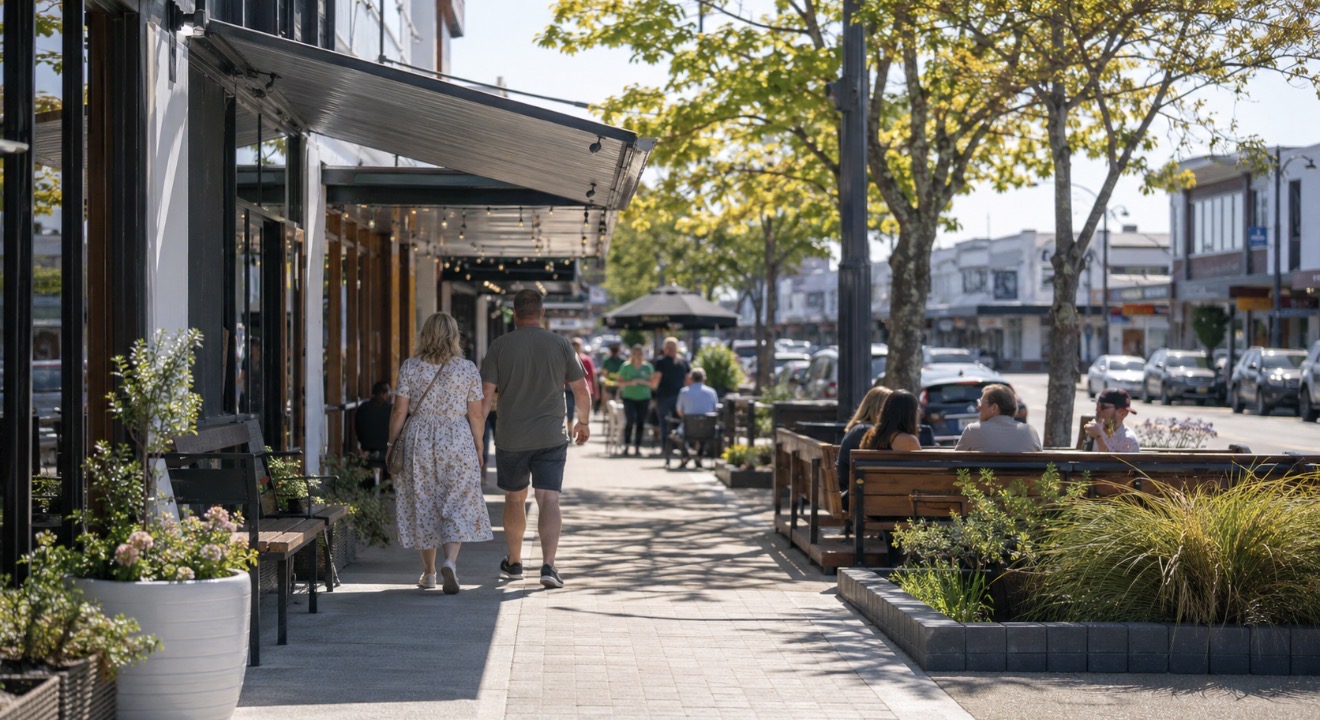
Levin’s long-running town centre transformation is moving into a more practical phase, with Horowhenua District Council approving a new retail strategy, setting aside $200,000 for early improvements and advancing redevelopment opportunities for six Council-owned properties on Oxford Street.
The decisions are designed to shift the focus from planning to delivery and prepare Taitoko, Levin for a significant change in how people move through the district once the Ōtaki to north of Levin expressway opens.
The expressway is currently expected to open in late 2029.
Council says the aim is to make Levin town centre a destination in its own right rather than somewhere people simply pass through.
Two major decisions at the same meeting
Horowhenua District Council made two significant decisions.
The first was to adopt the Levin Town Centre Retail Transformation Strategy and approve $200,000 to begin implementing it.
The second was to confirm a pathway for the redevelopment of six strategically located Council-owned properties on Oxford Street.
Together, the decisions give Council a clearer framework for both short-term improvements and longer-term redevelopment.
What the $200,000 will be used for
The funding will support early initiatives intended to improve the look, feel and functionality of the town centre.
These are expected to include:
- improved street cleaning
- upgraded gardens
- better signage
- improvements to public spaces
- work to improve safety and accessibility
- measures to create more activity and vibrancy
- support for retailers and property owners to improve shopfronts
The $200,000 will be reallocated from the Council’s existing 2026/27 Town Centre Activation capital budget.
Council says the decision will not increase its overall forecast borrowing requirement.
That distinction is important because it means the early work is being funded from money already allocated rather than through additional borrowing.
Shopfront improvement fund planned
Council will also create a contestable fund for town centre retailers and property owners.
The idea is to help businesses improve the appearance and presentation of their premises.
Potential projects could include:
- repainting
- upgraded signage
- improved lighting
- façade improvements
Eligibility criteria, application details and timing have not yet been finalised.
Council says those details will be released in the coming weeks.
If structured well, the fund could allow relatively small investments to produce visible improvements across a number of properties rather than concentrating the entire budget in one location.
A 10 to 15-year plan
The Retail Transformation Strategy is not designed as a short-term beautification programme.
It sets out a roadmap for the next 10 to 15 years.
The wider objective is to strengthen Levin’s role as a place where people choose to meet, eat, shop and spend time.
That means the strategy will have to deal with more than landscaping and signage.
The real test will be whether it can help create a stronger retail mix, attract hospitality businesses, encourage private investment and increase the number of people spending time in the central area.
Residents, retailers and property owners who contributed feedback to the strategy identified several priorities.
These included:
- greater retail variety
- a stronger hospitality offering
- more activity in the town centre
- a refreshed streetscape
- improved public spaces
Councillor says planning now has to become visible
Levin Ward Councillor Clint Grimstone, who represents Council on the project’s Steering Group, said the decisions were intended to create momentum.
“We know the Taitoko, Levin town centre has huge potential, and these decisions give us a clear direction and some real momentum,” he said.
Grimstone said Council wanted to create a town centre the community could feel proud of while supporting local businesses.
He also acknowledged one of the common weaknesses of long-term urban strategies: plans can be adopted but remain largely invisible to residents.
“A strategy sitting on a shelf won’t transform our town centre,” he said.
“By making $200,000 available from our existing Town Centre Activation budget, we can get moving now and deliver improvements our community can see and experience.”
That point will ultimately determine whether the strategy succeeds.
Residents are more likely to support a long-term transformation programme if they can see practical results emerging early.
Oxford Street properties could become the bigger development story
The more significant long-term opportunity may be the six Council-owned properties on Oxford Street.
Council has decided to apply the intent of its First Right of Refusal to Iwi Policy.
That means iwi and hapū will receive an exclusive opportunity to submit redevelopment proposals through an Expression of Interest process before the sites are offered to the wider market.
Council sees the properties as strategically important to the future of the town centre.
Grimstone said the process could generate ideas capable of delivering wider redevelopment outcomes.
“This is an opportunity to work in partnership with iwi and hapū and invite forward ideas that can deliver the outcomes we want for these important sites,” he said.
The final form of any redevelopment remains to be seen.
But the sites could become important because successful central-city redevelopment often depends on a few substantial projects acting as anchors for wider private investment.
Why the expressway changes everything
The timing of the strategy is closely connected to the Ōtaki to north of Levin expressway.
Once the new route opens, traffic patterns through Horowhenua will change significantly.
For Levin, that creates both a risk and an opportunity.
The risk is obvious.
Businesses that currently benefit from passing motorists could see fewer vehicles travelling directly through the town centre.
Places that rely heavily on through-traffic can struggle when major highways bypass them.
But there is another possibility.
Reducing through-traffic can allow a town centre to become more pedestrian-friendly, attractive and locally focused.
The challenge is ensuring people still have a reason to leave the expressway and visit Levin.
Levin will need to become somewhere people choose to stop
Grimstone said Council did not want to wait until the expressway was operating before responding.
“We’re not waiting for the expressway to open before thinking about what comes next,” he said.
“This is our opportunity to make Taitoko, Levin town centre a destination in its own right, somewhere people choose to stop, spend time and return to, rather than simply pass through.”
That is arguably the central issue facing the strategy.
A bypass changes the economic logic of a town.
The town centre can no longer rely as heavily on vehicles being forced through it.
It has to compete for attention.
That means Levin will need attractions, food, retail, events, good public spaces and a strong enough identity to give people a reason to visit.
$200,000 can start the process, but it cannot transform the town alone
The approved funding is useful, but its scale should be kept in perspective.
Two hundred thousand dollars can improve gardens, signage, cleaning, public spaces and shopfronts.
It cannot deliver a complete town centre redevelopment.
The bigger transformation will require a combination of:
- Council investment
- private property investment
- successful retail businesses
- hospitality growth
- redevelopment of key sites
- cooperation with iwi and hapū
- good transport planning
- continued community support
The early funding should therefore be viewed as a catalyst rather than the total solution.
If those early improvements increase confidence and encourage further private investment, their impact could be much larger than the initial amount suggests.
The challenge of attracting better retail
One of the most difficult goals in the strategy will be increasing retail variety.
Councils can improve streets and public spaces.
They cannot force businesses to open.
Retailers make decisions based on population, foot traffic, rents, operating costs and expected sales.
That means Levin’s transformation will need to improve the commercial environment as well as the physical one.
If the town centre becomes cleaner, more attractive, safer and busier, it becomes easier to attract businesses.
If commercial vacancies remain high or customers continue shopping elsewhere, cosmetic improvements alone will have limited impact.
Hospitality could be particularly important
A stronger hospitality offering was another issue raised through community feedback.
That could become increasingly important after the expressway opens.
People travelling through the region are more likely to deliberately leave a highway for a town offering good cafés, restaurants, markets or other experiences.
Hospitality also changes how people use town centres.
Retail often concentrates activity during traditional shopping hours.
Food and beverage businesses can extend activity into evenings and weekends.
That can help make central areas feel more active and improve perceptions of safety and vibrancy.
Public spaces matter more than they appear
The strategy’s emphasis on better public spaces may sound modest compared with major redevelopment.
But good town centres depend heavily on spaces where people actually want to remain.
Seating, shade, landscaping, lighting, cleanliness, accessibility and pedestrian movement all influence how long people stay.
A town centre designed only to move people quickly between shops can feel functional but uninviting.
A successful centre encourages people to slow down.
That extra time can translate directly into economic activity for surrounding businesses.
Iwi partnership will attract attention
The decision to give iwi and hapū an exclusive first opportunity to propose redevelopment of the Oxford Street properties will likely attract interest.
Council says the approach reflects the intent of its First Right of Refusal to Iwi Policy.
The key question will be what proposals emerge and whether they can deliver both commercial and community value.
If the process produces a strong redevelopment concept, it could become one of the most visible parts of Levin’s transformation.
If no suitable proposal emerges, Council still retains the option of taking the opportunity to the wider market.
Either way, transparency around the evaluation process will be important because the sites are publicly owned assets.
What residents should watch next
There are several developments worth following over the coming months.
First will be the publication of the Retail Transformation Strategy itself.
That should provide more detail about the 10 to 15-year vision and how Council intends to measure progress.
Second will be the first round of visible town centre improvements.
Residents will be able to judge whether the $200,000 allocation produces noticeable change.
Third will be the design of the shopfront contestable fund.
Local businesses will want to know how much support is available, who qualifies and whether property owners will be required to contribute.
And finally, the Expression of Interest process for the Oxford Street properties could determine whether a substantial redevelopment project begins to take shape.
The real test begins now
Levin has no shortage of plans.
The significance of the latest Council decisions is that money and property decisions are now sitting behind the strategy.
That creates a higher level of expectation.
The expressway gives the town a deadline of sorts.
By the time traffic patterns change in 2029, Levin will need to have a clearer sense of what its town centre is becoming.
The objective should not simply be to protect existing businesses from losing passing traffic.
It should be to build a centre strong enough that people deliberately choose to visit.
That requires a different mindset.
A successful future Levin town centre would be a place people travel to, rather than merely travel through.
The Council has now adopted the strategy, allocated the first funding and started moving key Oxford Street sites towards possible redevelopment.
The planning phase is giving way to something more difficult.
Delivery.
Source: Horowhenua District Council media release, 3 September 2026.