By Webfit News | 8 June 2026
Labour has released its party list for the 2026 New Zealand general election, placing ethnic representation, public service experience and community leadership firmly in the spotlight.
The 2026 general election is scheduled for 7 November, with voters set to elect members to Parliament under New Zealand’s MMP system. Under this system, party lists matter because they determine which candidates enter Parliament depending on a party’s share of the party vote.
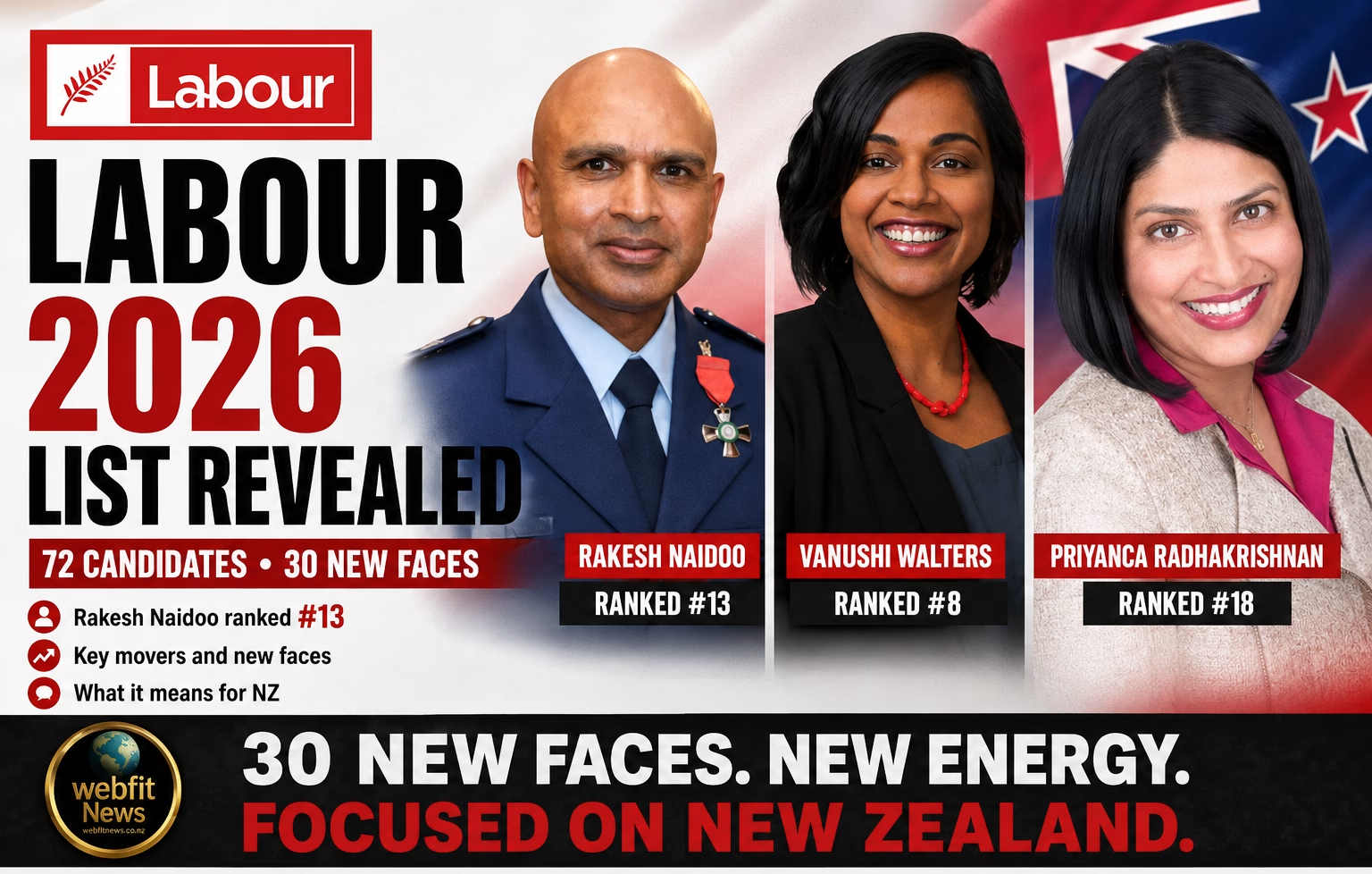
Labour’s newly announced list includes 72 names and 30 newcomers. But the headline for many migrant and ethnic communities is clear: Superintendent Rakesh Naidoo has been placed at number 13, a ranking that gives him a strong chance of entering Parliament if Labour performs close to current polling expectations.
Naidoo, a senior New Zealand Police officer, is listed above several sitting MPs and former ministers, including Priyanca Radhakrishnan, who is ranked 18th. That ranking is politically significant. It suggests Labour is not only refreshing its list but also making a deliberate statement about community connection, policing experience, anti-racism work and ethnic representation.
Naidoo is currently known for his work as Ethnic, Iwi and Communities Relationships Manager for New Zealand Police. His wider governance and community roles have included involvement with anti-racism, sport and family harm prevention initiatives. He has also been associated with interfaith and multicultural community leadership.
For many ethnic communities, his high placement will be seen as more than symbolic. It places someone with direct experience working with migrant, faith-based and minority communities near the top of Labour’s parliamentary pipeline.
The list also shows strong movement for Vanushi Walters, who has risen to number 8. Walters has taken on major portfolios, including foreign affairs and legal-related responsibilities, and her elevation signals Labour’s confidence in her role as part of its senior team.
Cushla Tangaere-Manuel has also moved sharply upward, rising to number 9. Her rise is notable given Labour’s renewed focus on Māori electorates and representation.
Priyanca Radhakrishnan, New Zealand’s first Indian-origin Cabinet Minister, is ranked 18th. While still placed within the safer part of the list, her move below Naidoo will attract attention within Indian and wider South Asian communities.
Other ethnic and diverse candidates on Labour’s list include Jenny Salesa at 24, Ibrahim Omer at 31, Anae Neru Leavasa at 32, Naisi Chen at 35, Naresh Perinpanayagam at 57 and Kharag Singh at 61.
This creates an interesting political picture. Labour appears to be presenting diversity across the list, but the rankings show a clear difference between symbolic inclusion and realistic parliamentary opportunity. In MMP politics, position matters. A name on the list is one thing. A winnable ranking is another.
That is where Naidoo’s placement stands out.
His ranking at 13 puts him in a much stronger position than many new candidates usually receive. It also places him above a number of experienced Labour figures, which suggests the party sees him as a serious future parliamentary voice rather than simply a community-facing candidate.
The move also comes at a time when ethnic communities are becoming increasingly important in New Zealand politics. Migrant communities are growing in size, economic contribution and civic influence, especially in Auckland. Yet many still argue their representation in Parliament, senior decision-making and policy design has not kept pace with their contribution to the country.
For Labour, this list is therefore not just about who may become an MP. It is also about who the party believes can speak to New Zealand’s changing population.
The party’s top rankings remain familiar. Chris Hipkins leads the list at number 1, followed by Carmel Sepuloni, Barbara Edmonds, Willie Jackson, Megan Woods and Ayesha Verrall. The top tier shows continuity in Labour’s leadership team, while the middle section of the list reveals where the party is attempting renewal.
Some sitting MPs have moved down. Camilla Belich is ranked 23rd, Deborah Russell 27th, Phil Twyford 40th and Arena Williams 41st. These placements may create uncertainty depending on Labour’s final party vote and electorate results.
Former minister Michael Wood is expected to contest Mt Roskill again, although his political return will be watched closely given the controversy that preceded his exit from Cabinet.
Assistant Speaker Greg O’Connor is not on the list, and Christchurch Central MP Duncan Webb has already announced his retirement from politics.
Labour Party president Jill Day has described the list as a diverse and experienced team focused on working people and cost-of-living pressures. The party is positioning the election as a choice between the current National-led government and a Labour team it says is focused on ordinary New Zealanders.
But beyond the party’s official message, the deeper question is this: will diverse candidates be given real power, real voice and real influence once inside Parliament?
That is the question ethnic communities will be watching.
For New Zealand’s Indian, South Asian, African, Muslim, Pacific and wider migrant communities, Naidoo’s ranking will be seen as a major development. But representation should not be reduced to ethnicity alone. The real test will be whether candidates with community experience can influence policy on crime prevention, social cohesion, family harm, immigration, education, business opportunity and economic inclusion.
Labour’s 2026 list gives voters a clearer picture of the party’s election strategy. It is trying to combine experience with renewal, senior leadership with fresh faces, and traditional Labour figures with candidates who reflect New Zealand’s changing society.
Whether that strategy works will depend on the party vote in November.
For now, the message from the list is clear: Labour has placed Rakesh Naidoo in a position of real political significance, and ethnic representation is no longer sitting quietly at the margins of the campaign.
Labour’s 2026 Party List
- Chris Hipkins
- Carmel Sepuloni
- Barbara Edmonds
- Willie Jackson
- Megan Woods
- Ayesha Verrall
- Willow-Jean Prime
- Vanushi Walters
- Cushla Tangaere-Manuel
- Kieran McAnulty
- Rachel Brooking
- Ginny Andersen
- Rakesh Naidoo
- Tangi Utikere
- Jan Tinetti
- Damien O’Connor
- Jo Luxton
- Priyanca Radhakrishnan
- Shanan Halbert
- Chris Flatt
- Reuben Davidson
- Kingi Kiriona
- Camilla Belich
- Jenny Salesa
- Glen Bennett
- Sophie Handford
- Deborah Russell
- Tracey McLellan
- Max Harris
- Warrick Cleine
- Ibrahim Omer
- Anae Neru Leavasa
- Georgie Dansey
- Te Pūoho Kātene
- Naisi Chen
- Dan Rosewarne
- Rachel Boyack
- Helen White
- Ingrid Leary
- Phil Twyford
- Arena Williams
- Lemauga Lydia Sosene
- Kerrin Leoni
- Toni Boynton
- Hannah Pia Baral
- Angela Roberts
- Estefania Muller-Palarés
- Anahila Kanongata’a
- Gary Payinda
- Alex Hedley
- Craig Renney
- George Hampton
- Dominik Yanzick
- Rory Paterson
- Ashleigh Latimer
- Rata Jamieson
- Naresh Perinpanayagam
- Peter McDonald
- Amanda Clinton-Gohdes
- Myra Williamson
- Kharag Singh
- Janice Lee
- Sam Collins
- Sange Malama
- Rhieve Grey
- Karl Severinsen
- Henrietta Hunkin-Tagaloa
- Fisher Wang
- Brendan McEnroe
- Campbell Matthews
- David Pattemore
- Nathaniel Howe
Key Takeaway
Labour’s 2026 party list is more than a ranking sheet. It is a political signal. The elevation of Rakesh Naidoo to number 13, the rise of Vanushi Walters, and the continued presence of several ethnic and migrant-background candidates show Labour trying to speak to a changing New Zealand.
But voters will judge whether this is meaningful representation or just careful election-year positioning. The answer will come not from the list itself, but from what these candidates are allowed to influence if Labour forms the next government.
Photo credits: Images courtesy of Google Images and the New Zealand Parliament. Used for news reporting and editorial purposes.