
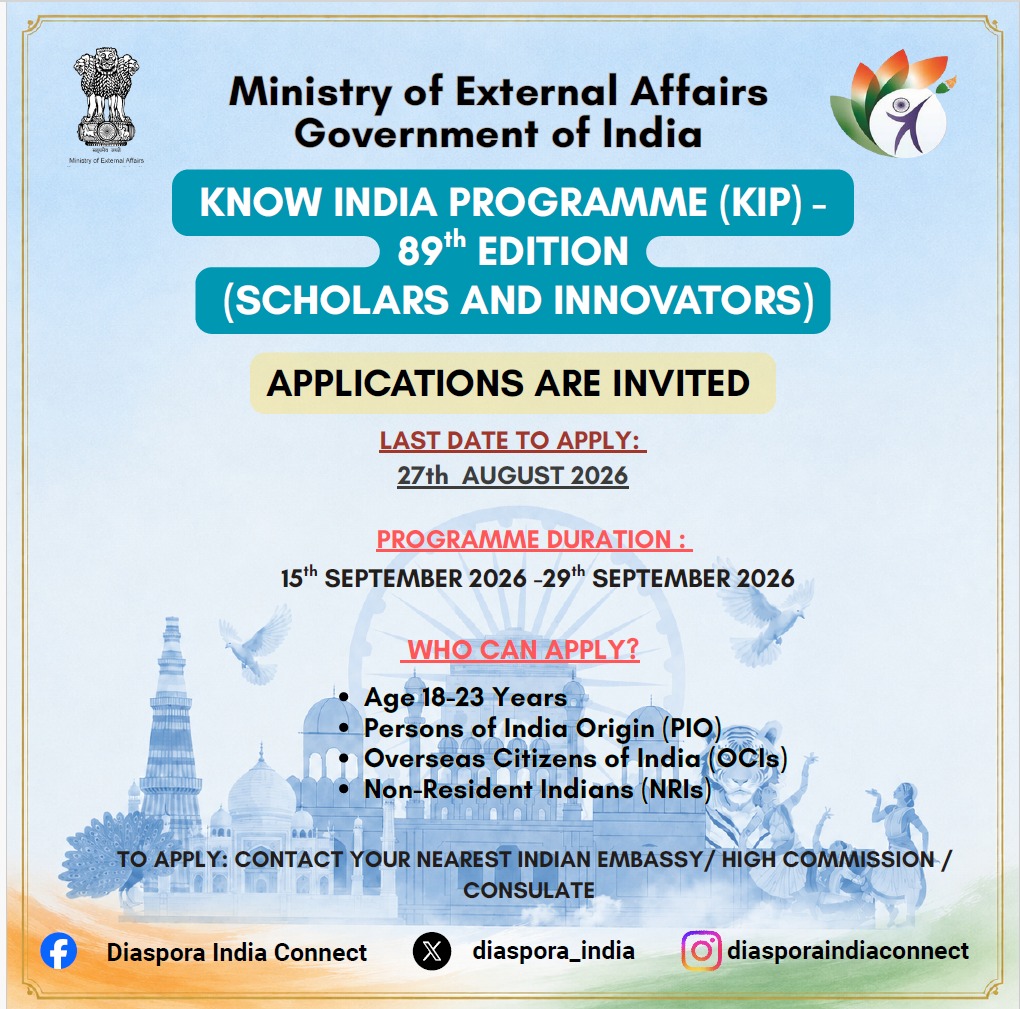
Applications are open for the 89th edition of the Know India Programme, with the deadline set for 27 August 2026.
The programme will run in India from 15 September to 29 September 2026 and this edition is specifically for the Scholars and Innovators cohort, aged 18 to 23 years.
For eligible young Indian-origin New Zealanders, particularly those who have grown up outside India or have never visited before, the opportunity is substantial.
Participants will not simply visit tourist attractions.
The programme is designed to expose them to contemporary India, including its technology and start-up ecosystem, universities, scientific institutions, public policy, economic development, culture, history and regional diversity.
And one of the most important practical details is this:
The Government of India will bear 90 percent of the participant's return international airfare, with the participant contributing the remaining 10 percent.
Local accommodation and transportation within India are also arranged for selected participants.
The Know India Programme, commonly known as KIP, is an initiative of India's Ministry of External Affairs aimed at young members of the global Indian diaspora.
It was launched in 2003-04.
Its purpose is to help young people of Indian origin understand not only India's cultural heritage and their ancestral connection with the country, but also the India that exists today.
That second part is important.
For many second-generation and third-generation Indian families overseas, their understanding of India may come primarily through parents, grandparents, family visits, films, food or cultural events.
KIP attempts to broaden that picture.
Participants are introduced to India's contemporary economy, technology, governance, education, scientific development, entrepreneurship and changing international role alongside its cultural and historical traditions.
The Ministry describes the programme as part of a wider effort to strengthen the connection between diaspora youth and India while encouraging them to participate in India's future development.
The 89th edition is for 18 to 23-year-olds
The September programme is specifically for the Scholars and Innovators category.
Applicants must be aged 18 to 23 years, with age eligibility determined according to the programme rules.
The edition has an intake of 25 participants.
Eligible applicants can include:
Persons of Indian Origin
Overseas Citizens of India
Non-Resident Indians
Applicants who have never previously visited India are given preference.
For young people growing up in New Zealand who know India mainly through their families, that makes this edition particularly relevant.
What will participants actually experience?
This is where the programme becomes much more than a sponsored cultural trip.
The Scholars and Innovators stream has been designed around young people who may be studying, exploring careers, interested in entrepreneurship or trying to understand where India fits into the global economy.
According to the programme guidelines, participants may receive exposure to India's innovation and entrepreneurship ecosystem through interactions with:
start-ups
incubators
entrepreneurs
industry leaders
universities
researchers
scientific and research institutions
The guidelines identify institutions such as IITs, IIMs, ISRO, BARC and T-Hub among the types of organisations that may form part of the programme experience.
Participants may also take part in discussions on:
public policy
innovation
governance
economic development
Digital India
Skill India
Startup India
Aatmanirbhar Bharat
For a 19, 20 or 22-year-old student in New Zealand interested in engineering, business, technology, public policy or entrepreneurship, that can offer a very different view of India from a family visit.
India is being presented as more than an ancestral homeland
This may be the most interesting aspect of the current KIP model.
The programme is not simply asking diaspora youth to reconnect emotionally with their roots.
It is also trying to introduce them to India as a contemporary economic and technological country.
The programme material specifically refers to developments in:
science and technology
information technology
space research
infrastructure
digital public infrastructure
education
agriculture
tourism
That reflects a deliberate shift in how India engages with its diaspora.
The message is not only, "Come and see where your family came from."
It is also, "Come and see what India is becoming."
Culture and heritage remain a major part of the experience
The programme does not leave the cultural side behind.
Participants can also receive exposure to India's historical and civilisational heritage.
The guidelines refer to visits to major heritage locations such as the Taj Mahal, Red Fort, Qutub Minar, Khajuraho Temples, Konark Sun Temple, Bodh Gaya and the ghats of Varanasi, depending on the edition and itinerary.
Participants may also experience:
Yoga
Ayurveda
classical music
classical dance
regional traditions
cultural performances
Each programme is intended to involve visits to at least two States or Union Territories, allowing participants to experience some of India's linguistic, regional and cultural diversity.
That is an important point for diaspora youth.
India cannot really be understood through one city, one state, one language or one family background.
Who could benefit most from this programme?
The obvious audience is a young person with Indian heritage who has never had the opportunity to experience India beyond a family connection.
But there are several other groups for whom the programme could be particularly valuable.
A university student interested in technology may gain exposure to India's start-up and scientific ecosystem.
A young entrepreneur may see opportunities in one of the world's largest markets.
A student interested in government may gain a better understanding of India's public institutions and policy direction.
Someone born and raised in New Zealand may simply want to better understand their own family history and cultural identity.
And for some participants, the most valuable outcome may simply be meeting 24 other young people from the Indian diaspora who have grown up in different countries but share similar questions about identity and belonging.
The financial support makes the opportunity unusually accessible
International programmes can quickly become unaffordable for students and young adults.
That is why the KIP funding arrangements deserve attention.
For selected participants, Indian Missions and Posts will arrange the return journey to India.
The Government of India bears 90 percent of the international airfare.
The participant is responsible for the remaining 10 percent.
The programme also provides local hospitality, including accommodation and transportation within India.
Accommodation is arranged on a twin-sharing basis, and internal transportation is organised as part of the programme.
For participants requiring a visa, the guidelines also provide for gratis visas to selected candidates through the relevant Indian Mission or Post.
This significantly lowers the financial barrier for eligible young people who may otherwise never consider participating in an international programme of this kind.
What participants still need to pay or arrange themselves
Government support does not mean there are no responsibilities for participants.
All selected participants must have comprehensive international travel and medical insurance covering their full stay in India.
A medical fitness report or certificate from a recognised doctor is also required before air tickets and visas are processed.
Participants are expected to comply with the programme rules and complete the full programme.
The application declaration specifically notes that a participant who leaves the programme midway or is removed for misconduct may lose eligibility for the Government's airfare reimbursement.
So applicants should treat this as a formal Government programme rather than a flexible personal trip.
Minimum education requirements
For the Scholars and Innovators category, applicants must have completed at least Class 12 or its equivalent at a recognised school or institution.
Applicants must also be proficient in spoken English.
The guidelines state that applicants should have studied English at high-school level or undertaken education where English was the medium of instruction.
For most young applicants educated in New Zealand, that language requirement is unlikely to be difficult.
There are restrictions on previous participation
KIP is intended to give new participants an opportunity.
Applicants must not previously have participated in a Know India Programme.
They also must not have taken part in another programme funded by India's Ministry of External Affairs, another Government of India ministry or department, or an Indian State Government, according to the guidelines.
Preference is also given to applicants who have not previously visited India.
That reinforces the programme's objective of reaching young diaspora members who have had relatively little direct exposure to the country.
What proof of Indian origin is required?
The application form asks applicants to provide evidence of their connection to India.
This can include details of:
an OCI card
a PIO card
an NRI certificate
eligible documentation relating to parents or grandparents
The application form also contains a provision for people who do not have documentary evidence of Indian origin.
In those cases, an applicant can provide a declaration explaining their Indian origin, which must then be appropriately countersigned and stamped by the relevant Indian Mission or Post.
What information is required in the application?
Applicants should not leave the paperwork until the final day.
The application form requests detailed information including:
passport details
date and place of birth
nationality
contact details
residential and mailing address
family origin in India
proof of Indian origin
relatives in India
educational background
employment information, if applicable
achievements
interests and hobbies
travel and medical insurance information
Applicants must also write, in no more than 250 words, why they want to take part in the Know India Programme.
That short statement deserves some thought.
Rather than simply saying they want to visit India, applicants would be better served explaining what they hope to learn, how the programme relates to their studies, career, identity or interests, and how they hope to use the experience afterwards.
Participants also have responsibilities after the programme
KIP is not considered complete simply when participants return home.
Selected participants are required to submit a 750 to 1,000-word programme report outlining their experiences, lessons and key takeaways.
They are expected to explain how the programme improved their understanding of contemporary India and its cultural legacy.
Participants receive a certificate after successful completion.
This requirement is another sign that the programme is intended as a structured learning experience rather than tourism.
Why this matters particularly for Indian families in New Zealand
New Zealand has a large and established Indian community.
But each generation's relationship with India is different.
Parents who migrated as adults may have lived, studied and worked there for decades.
Their children may know India mostly through holidays, grandparents, weddings, food, festivals or stories.
The next generation can be even further removed.
That does not necessarily weaken their Indian identity.
It simply means their relationship with India is being formed from outside India.
A programme like KIP offers young people the chance to construct that relationship for themselves.
They can see India rather than simply inherit somebody else's description of it.
They can meet people their own age.
They can see universities and technology organisations.
They can experience different regions.
And they can decide for themselves what connection they want to maintain with India in adulthood.
There is also a professional opportunity hidden inside the cultural one
For young New Zealanders, the programme may have professional value too.
India is a huge market with growing technology, financial services, digital infrastructure, research and entrepreneurial sectors.
A young Kiwi of Indian origin who understands both New Zealand and India potentially has something valuable.
Language may help.
Cultural understanding may help.
Family connections may help.
But direct exposure to contemporary India could be just as important.
For someone who later works in technology, trade, healthcare, finance, education, government or entrepreneurship, understanding both countries could become a genuine professional advantage.
That is why the programme should not be viewed only as a heritage initiative.
It can also be a bridge into future relationships between New Zealand and India.
Only 25 places are available
This edition of the programme is not large.
The guidelines provide for 25 participants per cohort in each edition.
The Ministry of External Affairs also maintains a reserve list of 10 candidates in case selected participants withdraw.
That makes early and complete applications important.
Applications are recommended through Indian Missions and Posts, with the final selection made by the Ministry of External Affairs.
Meeting the eligibility requirements therefore does not automatically guarantee a place.
The deadline is very close
For New Zealand applicants, this is probably the most important practical point.
Applications close on Thursday, 27 August 2026.
The programme begins on 15 September.
That leaves only a short period between selection, documentation, travel preparation and departure.
Anyone interested should therefore begin preparing the application and supporting documents immediately.
The official announcement directs applicants to contact their nearest Indian Embassy, High Commission or Consulate to apply.
89th Know India Programme at a glance
| Detail | Information |
|---|---|
| Programme | Know India Programme |
| Edition | 89th |
| Cohort | Scholars and Innovators |
| Age | 18 to 23 years |
| Programme dates | 15 to 29 September 2026 |
| Application deadline | 27 August 2026 |
| Duration | Around two weeks including travel |
| Participants | 25 |
| Eligible groups | PIOs, OCIs and NRIs |
| Minimum education | Class 12 or equivalent |
| English requirement | Spoken English proficiency |
| International airfare | 90% Government of India, 10% participant |
| Accommodation | Provided under programme arrangements |
| Internal transport | Provided |
| Visa | Gratis visa for selected participants where required |
| Medical/travel insurance | Mandatory |
| Preference | Applicants who have not previously visited India |
| Application route | Nearest Indian Embassy, High Commission or Consulate |
A message worth sharing with families
This is one of those opportunities that can easily pass unnoticed.
A student may assume it is only for people studying Indian culture.
A parent may assume their child is not eligible because they were born in New Zealand.
A young OCI holder may simply never have heard of KIP.
That is why awareness matters.
If there is an 18 to 23-year-old person of Indian origin in your family, university, workplace or community who has not had the opportunity to properly experience India, this programme is worth bringing to their attention.
It offers something relatively unusual.
A chance to experience India's history while also seeing its technology.
To understand family roots while meeting contemporary India.
To visit cultural sites while interacting with researchers, entrepreneurs and institutions.
And to do so through a structured Government of India programme where most of the international airfare and local programme costs are supported.
The bigger idea behind KIP
The Indian diaspora is no longer connected to India only through migration.
For younger generations, the relationship will increasingly be shaped by education, technology, business, culture, travel and professional networks.
That is where programmes such as KIP may have their greatest long-term value.
A young person who spends two weeks in India at 20 may return to New Zealand with a different understanding of where their family came from.
They may also return with an entirely different understanding of where India is going.
And sometimes that is all it takes to turn an inherited connection into a personal one.
For eligible young Indian-origin New Zealanders, the immediate message is simple:
Do not wait too long. Applications for the 89th Know India Programme close on 27 August 2026.
Source: Government of India, Ministry of External Affairs, Know India Programme guidelines, application material and 89th KIP announcement provided through the Consulate General of India.