
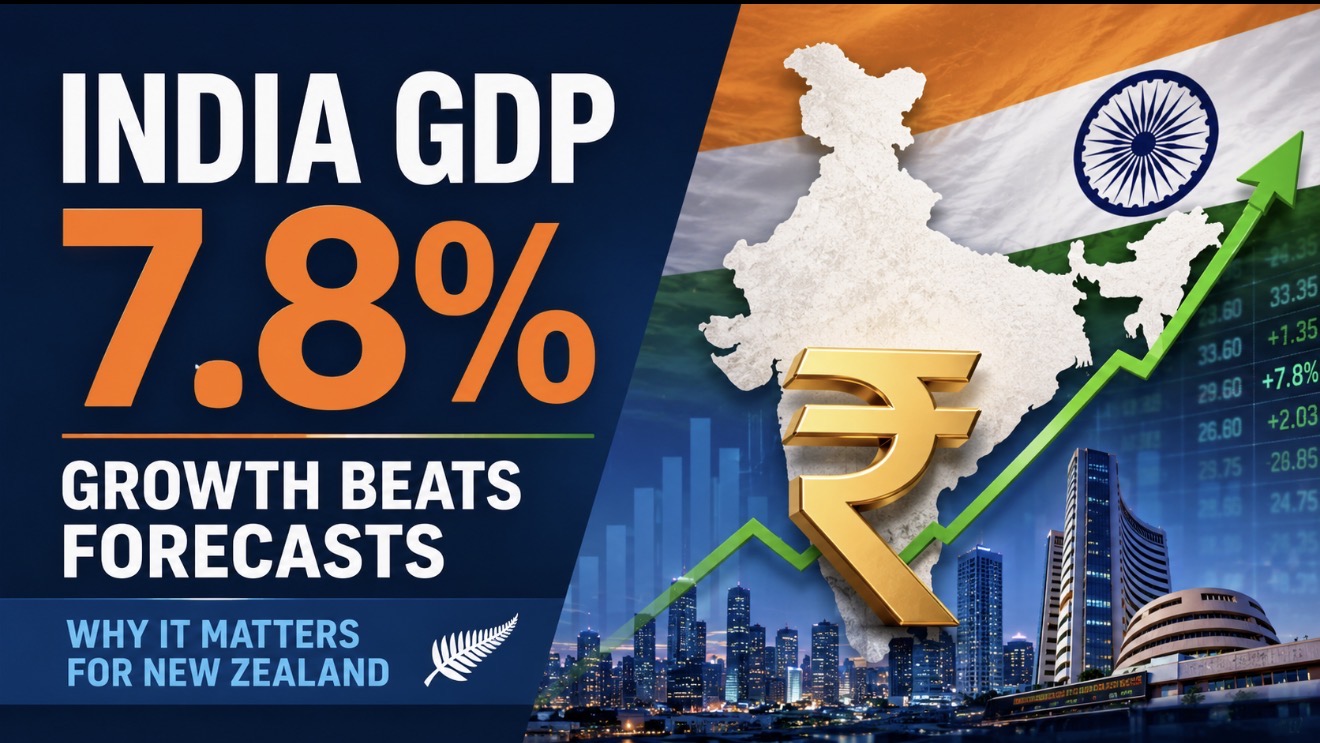
India’s economy grew by a stronger-than-expected 7.8% in the April to June 2026 quarter, outperforming both economist forecasts and the Reserve Bank of India’s own expectations despite global energy disruption, a weaker rupee and continued pressure from foreign investor outflows.
The result reinforces India’s position as one of the fastest-growing major economies in the world and comes at a time when New Zealand is building a much closer economic relationship with the country through its new free trade agreement and strategic partnership.
Official data from India’s Ministry of Statistics and Programme Implementation showed growth exceeded the Reserve Bank of India’s 7% forecast and the 7.1% median estimate from economists surveyed by Reuters.
The strength of the result was driven by investment, manufacturing, services, private consumption and exports.
For New Zealand, the numbers matter because India is becoming an increasingly important trade partner, with both governments targeting NZ$7 billion in two-way trade by 2030.
India’s key economic figures
Real GDP growth: 7.8%
Real GVA growth: 8.2%
Services sector growth: 10.0%
Manufacturing growth: 9.2%
Agriculture and allied sectors: 3.6%
Gross fixed capital formation: 11.9%
Private consumption growth: 7.1%
Real export growth: 12.0%
Nominal GDP growth: 10.3%
Source: Government of India, Ministry of Statistics and Programme Implementation.
Investment and manufacturing drive growth
The headline GDP figure was strong, but the composition of the growth provides a clearer picture of what is happening inside the Indian economy.
Gross fixed capital formation, which measures investment in assets such as factories, infrastructure and machinery, grew 11.9% in real terms compared with 5.8% in the same quarter a year earlier.
Manufacturing expanded by 9.2%, while the broader secondary sector, which includes manufacturing, construction and utilities, grew by 8.6%.
India’s services sector performed even more strongly, expanding by 10%.
Financial services, real estate, information technology and professional services recorded growth of 12.1%.
Private consumption, another major driver of the Indian economy, increased by 7.1%.
Exports at constant prices rose by 12%, while imports declined by 1.1% in real terms during the quarter.
Together, those figures help explain why the economy performed significantly better than expected.
Growth came during severe global disruption
The result is particularly notable because of the international environment in which it was achieved.
The April to June quarter coincided with severe disruption to global energy markets linked to the conflict involving the United States and Iran.
Shipping through the Strait of Hormuz was disrupted, crude oil prices rose sharply and energy-importing countries faced renewed inflationary pressure.
India is especially vulnerable to oil shocks because it imports most of the crude oil it consumes.
Brent crude traded above US$90 a barrel during periods of heightened tension, increasing concerns that higher energy costs could slow India’s economy and push inflation higher.
Instead, domestic economic activity remained strong.
Investment, consumer spending, manufacturing and services continued to expand despite the external pressure.
For policymakers in New Delhi, the figures provide evidence that India has been able to absorb a significant global shock without losing its growth momentum.
India remains one of the world’s fastest-growing major economies
The latest figures reinforce India’s position as one of the fastest-growing major economies.
The 7.8% expansion was lower than the revised 8.6% growth recorded in the previous quarter, but it still placed India well ahead of most large developed and emerging economies.
With a population of more than 1.4 billion, India is attempting an economic transformation on an enormous scale.
The country is investing heavily in infrastructure, manufacturing, technology and digital services while trying to expand exports and increase domestic consumption.
India is widely expected to become the world’s third-largest economy by the end of this decade.
Its rapidly expanding middle class is also becoming increasingly important to countries seeking new markets for goods, services, tourism and investment.
Foreign investors remain a major challenge
Despite the strong domestic economy, India continues to face a significant challenge from foreign investor withdrawals.
Foreign investors withdrew around US$48 billion from Indian equities over approximately 18 months.
During 2026 alone, foreign portfolio investors had withdrawn a net US$24.6 billion from Indian equities by the end of August.
Some international investors shifted capital towards markets including South Korea, Taiwan and Japan, where technology and artificial intelligence-related companies have attracted strong interest.
Concerns about India’s relatively high market valuations, rising oil prices and currency weakness have also influenced investor sentiment.
There are, however, signs that conditions may be changing.
Foreign investors returned a net US$3.1 billion to Indian equities during August, marking the strongest monthly inflow in nearly two years.
Whether that represents a sustained reversal will be closely watched.
Rupee remains under pressure
Foreign capital outflows and higher oil prices have also placed significant pressure on the Indian rupee.
During 2026, the currency fell to record lows and at one stage became Asia’s weakest-performing currency of the year.
By 1 September, the rupee was trading at around 95 to the US dollar.
A weaker currency increases the cost of imported commodities, particularly oil, which can feed directly into inflation.
That creates a difficult balancing act for the Reserve Bank of India.
Strong economic growth reduces the immediate need for monetary support, but higher energy and food prices could eventually force the central bank to take a more cautious approach to interest rates.
Risks remain despite strong growth
India’s 7.8% growth rate is impressive, but maintaining that pace will be more difficult than achieving it in a single quarter.
High oil prices remain one of the biggest external risks.
Because India imports most of its crude oil, sustained increases in global prices can increase inflation, weaken the trade balance and place additional pressure on the rupee.
Foreign investor withdrawals remain another concern.
Persistent capital outflows can weaken financial markets and create further currency instability.
Global wars, shipping disruption and weaker international demand could also affect India’s exports and supply chains.
Weather conditions present another risk.
India experienced a 16% rainfall deficit during August, while forecasts pointed to below-normal rainfall in September.
Weak monsoon conditions can affect agricultural production and food prices, with consequences for millions of households and the wider economy.
Why this matters for New Zealand
India’s economic performance is becoming increasingly important for New Zealand.
India and New Zealand signed a free trade agreement on 27 April 2026.
The agreement is expected to eventually remove or reduce tariffs on 95% of New Zealand exports to India, with 57% becoming tariff-free immediately once the agreement enters into force.
Two-way trade between the countries was already worth about NZ$3.95 billion in the year to December 2025.
New Zealand exported approximately NZ$2.03 billion in goods and services to India during that period.
Travel services were worth about NZ$1.14 billion, while forestry exports were worth approximately NZ$399 million.
Other major New Zealand exports included horticultural products worth NZ$114 million, aluminium worth NZ$86 million, iron and steel worth NZ$80 million and wool worth NZ$77 million.
India is currently New Zealand’s 11th-largest goods and services export market, but both governments expect that relationship to grow significantly.
NZ and India target NZ$7 billion in trade
The relationship between the two countries has also moved beyond trade alone.
During Indian Prime Minister Narendra Modi’s visit to Auckland in July, India and New Zealand elevated their relationship to a Strategic Partnership.
Prime Minister Christopher Luxon and Modi committed to working towards NZ$7 billion in two-way trade by 2030.
For New Zealand exporters, sustained growth in India could create significant opportunities.
A larger and wealthier Indian middle class could increase demand for tourism, education, premium food products, horticulture, forestry, technology and professional services.
The free trade agreement is intended to make it easier for New Zealand companies to access that expanding market.
Strong result, but sustaining it is the real test
India’s latest GDP figures have clearly exceeded expectations.
Growth of 7.8% during a quarter marked by high oil prices, geopolitical instability, foreign capital outflows and currency pressure demonstrates considerable economic resilience.
But one strong quarter does not remove India’s underlying challenges.
The country still needs to attract and retain foreign investment, stabilise the rupee, manage energy costs, create employment, expand exports and maintain investment while navigating an increasingly unpredictable global economy.
For New Zealand, those developments are becoming increasingly relevant.
India is no longer simply a large overseas economy to watch from a distance.
With a free trade agreement signed, a Strategic Partnership established and a target of NZ$7 billion in bilateral trade, India’s economic performance will increasingly influence opportunities for New Zealand businesses and exporters.
The latest numbers show that India enters this new phase of its relationship with New Zealand with considerable economic momentum.