By Webfit News | Auckland
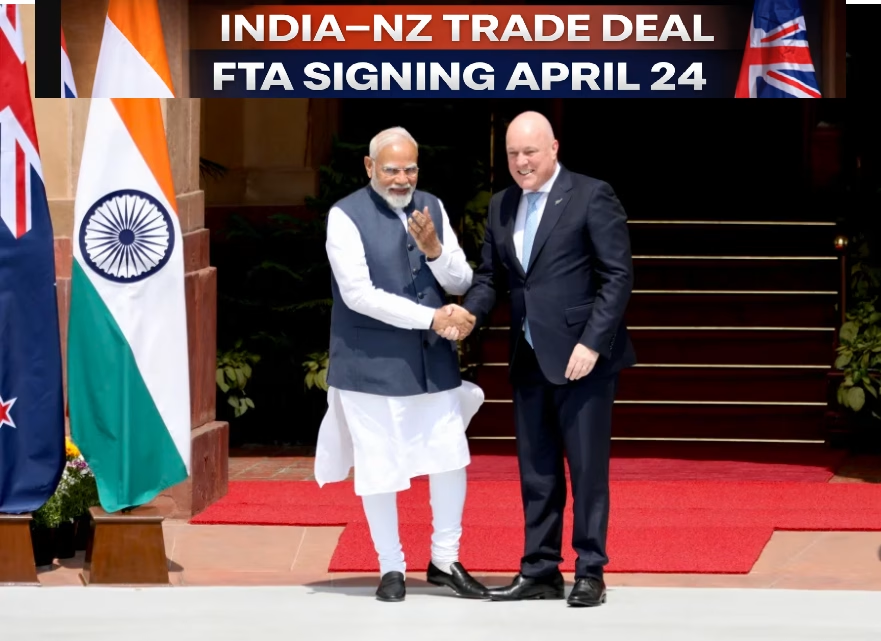
India and New Zealand are preparing to sign a landmark Free Trade Agreement (FTA) on April 27 in New Delhi, a move that could reshape economic ties between the two nations and unlock up to USD 20 billion in investment over the next 15 years.
If finalised as expected, the agreement will go far beyond tariffs. It will influence trade flows, skilled migration, business expansion, and long-term geopolitical alignment between one of the world’s fastest-growing economies and a small but strategically positioned Pacific nation.
A Deal Years in the Making
Incorporated Societies Removed After Deadline: Over 1,800 NZ Groups Face Disruption – WebfitNews
Negotiations between India and New Zealand reached a major milestone on December 22 last year when both sides announced the conclusion of talks. The upcoming signing is now seen as the formal start of a new economic chapter.
Currently, trade between the two countries remains modest:
- Goods trade: about USD 1.3 billion (2024–25)
- Total trade (goods + services): about USD 2.4 billion
- Services trade alone: USD 1.24 billion
The FTA aims to double bilateral trade to USD 5 billion within five years, signalling aggressive intent from both governments.
What Each Country Gets
India’s Advantage: Full Market Access
Under the agreement:
- Indian exports will receive zero-duty access to New Zealand
- This gives Indian businesses a competitive edge in sectors like:
- Pharmaceuticals
- Textiles
- Engineering goods
- IT and services
For Indian exporters, this is a clean entry into a stable, high-income market with relatively low regulatory friction.
New Zealand’s Gains: Selective but Strategic
In return, India will reduce or remove tariffs on around 95 percent of New Zealand exports, including:
- Wool
- Coal
- Wood and forestry products
- Wine
- Avocados and blueberries
- Sheep meat
However, India has drawn a clear line on sensitive sectors. Products like dairy, edible oils, sugar, spices, and rubber will remain protected.
That decision is not surprising. India’s domestic agriculture sector is politically sensitive and economically critical.
The $20 Billion Question: Investment Potential
The headline figure is bold. Up to USD 20 billion in investments over 15 years.
But here is the reality check.
This number is not guaranteed money. It is projected potential, based on improved trade flows, business confidence, and policy alignment.
For that figure to materialise, three things must happen:
- Ease of doing business must improve between both countries
- Private sector confidence must follow policy signals
- Logistics and supply chains must actually support scale
Without these, the number stays on paper.
A Big Shift: Skilled Migration Pathways
One of the most interesting parts of the deal is not the trade. It is people.
New Zealand will introduce a temporary visa pathway for up to 5,000 Indian professionals each year, allowing stays of up to three years.
This includes:
- IT professionals
- Engineers
- Healthcare workers
- Teachers
- Construction workers
- Yoga instructors and AYUSH practitioners
- Indian chefs and cultural professionals
This is a strategic move.
New Zealand has been facing skill shortages across multiple sectors. India has a large, young, skilled workforce. This agreement tries to bridge that gap.
What This Means for New Zealand
From a New Zealand perspective, this FTA is not just about exports. It is about survival in a competitive global trade environment.
Key implications:
- Diversification of trade partners beyond China and Australia
- Access to a massive consumer market of over 1.4 billion people
- Boost for agriculture and horticulture exports
- Addressing workforce shortages through controlled migration
But there are risks too:
- Increased competition for local industries
- Pressure on housing and infrastructure if migration scales up
- Dependency on another large external market
What This Means for India
For India, the benefits are more straightforward:
- Entry into a developed economy with minimal tariffs
- Expansion of the services sector globally
- Opportunities for skilled workers abroad
- Strategic positioning in the Pacific region
This also aligns with India’s broader global trade strategy of building multiple bilateral agreements rather than relying only on multilateral deals.
The Bigger Picture: Trade in a Changing World
This deal comes at a time when global trade is becoming more fragmented.
Countries are no longer relying only on large blocs. Instead, they are building targeted bilateral partnerships.
India–New Zealand FTA fits exactly into that pattern.
It is less about volume today and more about positioning for the next 10 to 20 years.
Webfit News Perspective
This is where things get real, and not just optimistic headlines.
At Webfit News, we see this deal as strategically important but operationally fragile.
Yes, the numbers sound big. Yes, the intent is strong. But execution is everything.
Let’s be blunt:
- Trade targets are easy to announce, hard to achieve
- Investment projections are often inflated
- Migration pathways can create pressure if not managed well
The real success of this FTA will depend on what happens after April 27, not on the signing day itself.
For New Zealand, this is a chance to step out of its comfort zone and engage deeply with a fast-growing economy.
For India, it is another step in becoming a global trade power.
For the Indian community in New Zealand, this could be a turning point. More opportunities, more visibility, and stronger economic ties.
But here is the question nobody is asking clearly:
Are both countries ready to handle the scale of change they are promising?
If the answer is yes, this deal could redefine the relationship.
If not, it risks becoming another agreement that looks impressive but delivers slowly.
Conclusion
The India–New Zealand Free Trade Agreement has the potential to reshape trade, migration, and investment between the two countries.
It is ambitious. It is strategic. And it is necessary in today’s global environment.
But ambition alone is not enough.
The next 12 to 24 months will decide whether this becomes a transformational deal or just another headline.
References
- PTI Report on India–New Zealand FTA
- Government trade data (India and New Zealand bilateral trade)
- Ministry of External Affairs and official trade statements