
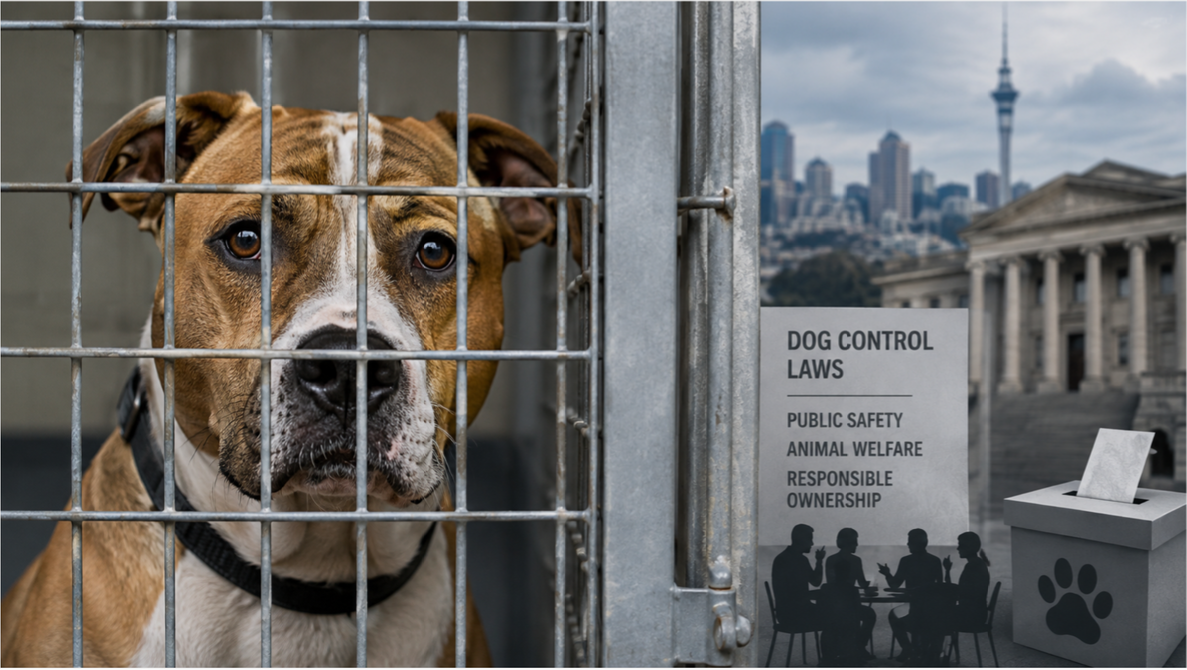
A dispute over the continued detention of a classified dangerous dog in Auckland has become part of a wider election-year argument about how New Zealand should balance public safety, animal welfare and personal responsibility.
The Animal Justice Party Aotearoa New Zealand is calling on Auckland Council to reconsider its decision not to release Hunter, a dog being held following alleged breaches of the Dog Control Act 1996.
The party says Hunter’s guardian has now paid the required registration amount and agreed to restore and maintain the approved confinement arrangement.
Auckland Council, according to the party’s release, considers there have been repeated breaches and says the conditions imposed on dangerous dogs are intended to protect the public.
The Council intends to prosecute over the latest alleged breach and has advised that its decision not to release Hunter is final. Hunter’s guardian can challenge that decision through the District Court.
The case is now becoming politically relevant for another reason. New Zealand is just over two months away from the 7 November general election, and political parties are already competing hard to define what they stand for.
Hunter case at a glance
| Issue | Detail |
|---|---|
| Dog | Hunter |
| Classification | Dangerous dog |
| Location | Auckland |
| Seized | Early August 2026 |
| Main alleged issues | Registration and secure confinement requirements |
| Council position | Repeated breaches considered serious |
| Current status | Dog remains in Council custody |
| Possible next step | Prosecution and potential District Court challenge |
| Animal Justice Party position | Hunter should be released if safe compliance can now be demonstrated |
Why Hunter could face destruction
The Animal Justice Party says the most serious issue is what could happen if Hunter’s guardian is successfully prosecuted.
Under the Dog Control Act, a court may be required to order the destruction of a dangerous dog following certain convictions unless it is satisfied exceptional circumstances exist.
That possibility is at the heart of the party’s argument.
Co-leader and General Secretary Danette Wereta said the party was not disputing that dangerous dog controls were important.
“This is not about pretending there have been no breaches or asking the Council to compromise public safety,” she said.
“The confinement requirements serve an important purpose and must be met.”
The party’s argument is instead that the legal consequences for the dog may be disproportionate if the owner’s failures can now be corrected and the animal can be safely managed.
Party says responsibility should fall on humans
Wereta said Hunter should not ultimately lose his life because of human non-compliance.
The party wants the wider law changed so enforcement focuses more directly on the person responsible.
Its position is that owners who fail to comply should face appropriate enforcement, accountability and support, but destruction of the animal should not automatically follow from the owner’s behaviour.
That argument fits closely with the Animal Justice Party’s wider 2026 election platform.
The party is campaigning on animal welfare reform and says the Hunter case is an example of why existing laws need to be reconsidered.
The case therefore gives the party a concrete example through which to promote one of its central election themes.
Council says public safety requirements matter
The other side of the argument cannot be ignored.
Dangerous dog classifications exist because authorities are required to manage risks to people and other animals.
According to the Animal Justice Party’s account of Auckland Council’s position, the Council believes there have been repeated breaches and considers them serious.
The Council has also reportedly questioned whether Hunter’s guardian will consistently comply in future.
That is significant because the debate is not simply about whether a shed can be moved back into position today.
The issue for an enforcement agency is whether it has reasonable confidence that legal requirements will continue to be followed.
The Animal Justice Party disputes the weight Council has placed on that history and says current willingness to comply should be given greater consideration.
Government already reviewing the Dog Control Act
The Hunter dispute has emerged at an especially relevant time.
Earlier this year, the Government ordered a comprehensive review of the Dog Control Act 1996 following a series of serious dog attacks.
The review has focused on public safety, owner responsibility and the effectiveness of the current law.
That creates an important political contrast.
The Government’s review has emphasised the risks posed by uncontrolled dogs.
The Animal Justice Party is now asking whether the same legal framework gives enough weight to animal welfare when an owner breaches the rules.
Both arguments begin from different concerns, but they intersect around the same central question:
What should happen to a dog when the human responsible for it fails to comply with the law?
A smaller issue inside a much bigger election campaign
The 2026 election campaign is already becoming a contest of sharply different promises.
National is campaigning on economic management, law and order, education, health and tax settings.
Labour is promoting its own package of health, public transport and cost-of-living policies.
New Zealand First is also pushing proposals around tax, apprenticeships, immigration and employment.
Against those large debates, a dispute involving one dog may appear minor.
Politically, however, it illustrates why smaller parties can matter in election campaigns.
They can force issues onto the agenda that larger parties might otherwise overlook.
Animal welfare could become a sharper election issue
The Animal Justice Party’s wider election platform calls for stronger animal welfare protections and changes to how animals are treated within New Zealand’s legal and regulatory system.
The Hunter case gives the party a simple and emotionally powerful argument: should an animal potentially die because its owner failed to meet legal requirements?
The counterargument is equally important.
Councils cannot wait until after a serious incident to enforce rules designed specifically to prevent harm.
That is why this case deserves more than an emotional response from either side.
It raises legitimate questions about proportionality, enforcement and where responsibility should sit.
The bigger question for Parliament
Hunter’s immediate future may ultimately be decided through existing legal processes.
But the wider issue belongs to Parliament.
If lawmakers believe the current Dog Control Act produces outcomes that are either too harsh on animals or too weak on public safety, then the answer is legislative reform.
With the Government already reviewing the legislation and the general election approaching, voters may hear much more about where political parties draw that line.
For the Animal Justice Party, the position is clear: enforce the law against people who fail their responsibilities, but do not make the animal automatically pay the ultimate price.
For councils and public safety advocates, the challenge is ensuring any reform does not weaken protections designed to prevent dangerous dogs from causing serious harm.
Hunter’s case may involve one dog and one family.
But in an election year increasingly dominated by competing promises, it has opened a much larger debate about who should carry the consequences when animal-control laws are broken: the animal, the owner, or both?
Sources
- Animal Justice Party Aotearoa New Zealand media release, 28 August 2026.
- Electoral Commission information on the 2026 general election.
- Government statements on the review of the Dog Control Act 1996.
- National Party 2026 campaign material.
- New Zealand Labour Party 2026 campaign material.
- New Zealand First 2026 campaign material.