WELLINGTON, 31 July 2026
The Human Rights Commission has urged the Government to abandon proposed changes to Treaty references in legislation, warning that repealing or weakening existing clauses could reduce protections for Māori, increase legal uncertainty and deepen racial division.
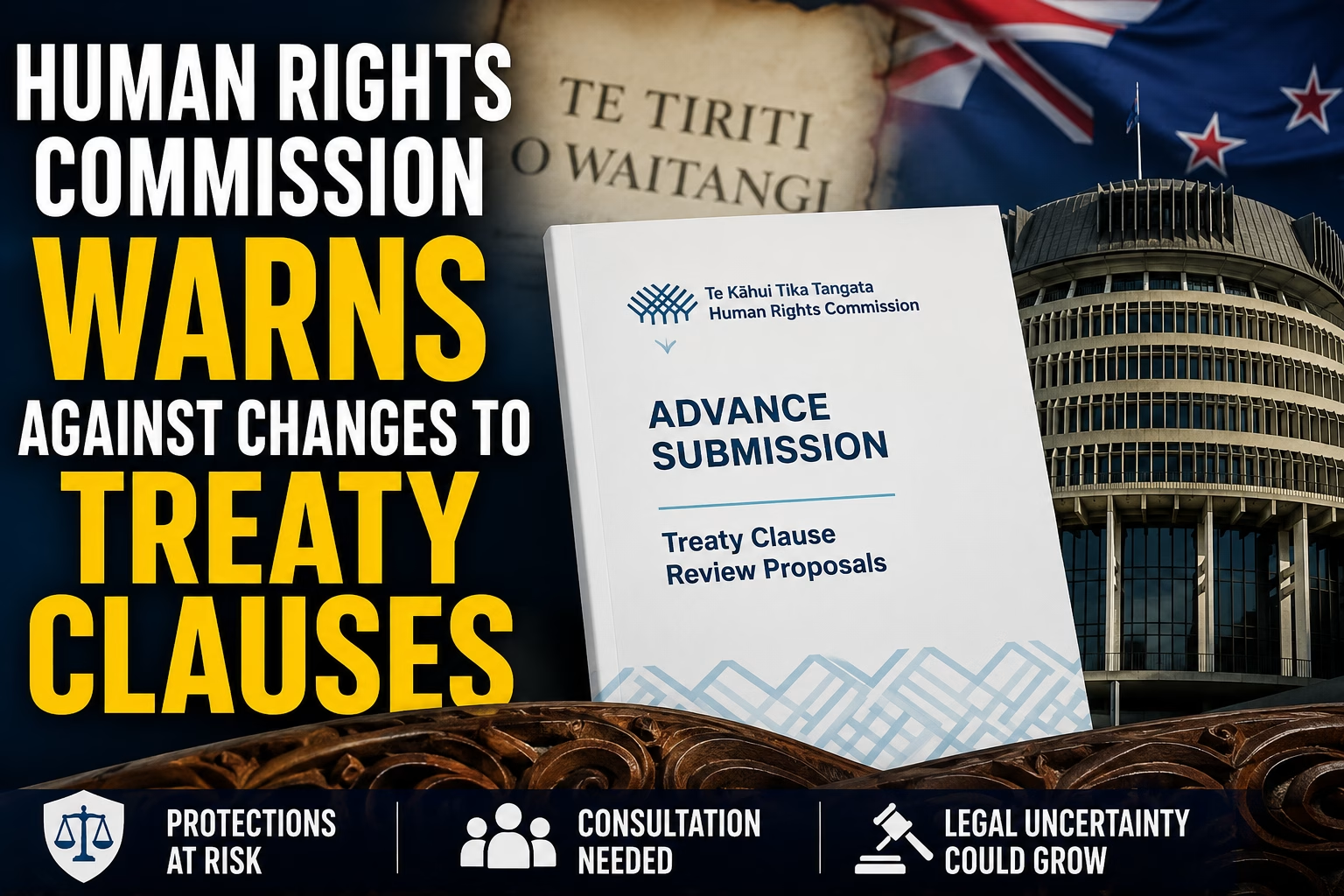
Te Kāhui Tika Tangata has released an advance submission and public information guide responding to the Government’s Treaty clause review.
The Commission argues that the reforms are constitutionally regressive, inconsistent with established Treaty jurisprudence and incompatible with New Zealand’s domestic and international human rights obligations.
It says any replacement approach should be developed through meaningful engagement and partnership with Māori rather than through unilateral Crown decision-making.
Commission challenges Government’s case for greater clarity
The Government says the review is intended to make Treaty references clearer and more consistent across legislation.
Justice Minister Paul Goldsmith announced in May that the Government had agreed to amend 19 pieces of legislation. The plan includes making two references more specific, repealing seven references and limiting provisions across 10 Acts to a standard no stronger than requiring decision-makers to “take into account” the Treaty.
Goldsmith said inconsistent wording developed over several decades had created uncertainty and made compliance more difficult.
He also said Treaty settlements would be excluded from the review and that iwi consultation and a full select committee process would follow.
The Human Rights Commission disputes the idea that clarity requires reducing the strength of Treaty obligations.
Dayle Takitimu, the Commission’s Rongomau Taketake and Indigenous Governance Partner, said certainty could be achieved without weakening legal protections.
“At its heart, this issue is simple. The Government says it wants clarity, but many Māori, legal experts, the Waitangi Tribunal, the Human Rights Commission, and international bodies say the review risks doing the opposite: weakening protections, reducing accountability, and increasing conflict,” Takitimu said.
What the Government is proposing
The Treaty clause review began as part of the coalition agreement between National and New Zealand First.
It originally covered 28 Acts containing references to the principles of the Treaty of Waitangi, before the scope was reduced to 19.
Under the decisions announced by the Government:
| Proposed action | Number or scope |
|---|---|
| Legislative references to be made more specific | 2 |
| Treaty references proposed for repeal | 7 |
| Acts where the standard would be limited to “take into account” | 10 |
| Pieces of legislation covered by the final review | 19 |
The Government has also said future legislation should refer to both the Treaty of Waitangi and te Tiriti o Waitangi where relevant.
The proposals have not yet completed the parliamentary process and could be altered following consultation and select committee scrutiny.
Human Rights Commission calls reforms constitutionally regressive
The Commission’s submission says Te Tiriti is not merely a drafting issue within individual statutes.
It describes Te Tiriti as part of the constitutional and human rights foundation of Aotearoa New Zealand.
“Te Tiriti is not a side issue or a drafting inconvenience; it is part of the constitutional and human rights foundation of Aotearoa,” Takitimu said.
The Commission argues that weakening Treaty clauses could reduce the legal accountability of public bodies and narrow the obligations decision-makers must consider when exercising statutory powers.
Treaty clauses can vary considerably between laws. Some require authorities to give effect to Treaty principles, while others require them to have regard to, recognise or take account of those principles.
Those differences can reflect the purpose of each statute and the nature of the rights or interests it protects.
The Commission warns that imposing a lower and more uniform standard may create fresh uncertainty about how existing duties should be interpreted.
Similar concerns raised by Waitangi Tribunal
The Human Rights Commission’s position closely reflects concerns previously expressed by the Waitangi Tribunal.
In its October 2025 report on the Treaty clause review, the Tribunal found that proceeding with the review in its planned form would breach Treaty principles and could prejudice Māori.
It warned of possible negative effects on Māori rights and interests, the Māori-Crown relationship and the durability of Treaty settlements.
The Tribunal did not reject the possibility of reviewing Treaty clauses altogether.
It said a review focused genuinely on clarity could benefit both Māori and the Crown, provided there was adequate time for policy analysis and full Māori participation in decision-making.
Its recommendations included removing repeals from the process, extending the consultation period and ensuring Māori views were incorporated through co-design or another meaningful partnership process.
The Tribunal also found that clarity did not necessarily require the removal of Treaty clauses.
Concerns about consultation and decision-making
The Commission has raised objections not only to the substance of the proposals but also to the process used to develop them.
It says the reforms were advanced without sufficient consideration of those most affected and without adequate regard to domestic and international accountability mechanisms.
The Commission argues that consultation after major policy decisions have already been made is not equivalent to involving Māori in the formation of those decisions.
Its submission calls for meaningful participation by Tiriti partners before replacement proposals are developed.
Takitimu said the human rights standards applying to Indigenous peoples supported partnership and participation rather than unilateral changes.
“Achieving clarity, if that is the aim of the exercise, doesn’t require watering down obligations to the bare minimum,” she said.
“Certainty and clarity are better achieved by following agreed human rights standards which support honouring treaties and respecting Indigenous peoples’ human rights.”
United Nations scrutiny adds international dimension
The debate is also being watched internationally.
The United Nations Committee on the Elimination of Racial Discrimination examined New Zealand’s compliance with its anti-discrimination obligations in late 2025.
Its concluding observations raised concerns about legislative changes affecting Māori and called for relevant reviews to be undertaken through effective consultation and partnership.
The Committee referred to the principle of free, prior and informed consent, an international human rights standard applying to decisions affecting Indigenous peoples.
The Human Rights Commission says the Government’s current approach does not adequately reflect those expectations.
International committee findings are not the same as domestic court rulings, but they are relevant to New Zealand’s obligations under treaties it has agreed to follow.
Government says public will have its say
The Government maintains that the changes are intended to make the law more predictable rather than reduce Māori rights.
Goldsmith has said consultation with iwi will continue and proposed legislation will proceed through the select committee process, allowing submissions from the public.
Supporters of the review argue that Treaty wording should be specific, understandable and connected directly to the purpose of each law.
They also contend that Parliament, rather than courts or public agencies, should determine the extent of Treaty obligations in legislation.
Critics respond that replacing stronger duties with a general requirement to take the Treaty into account could materially reduce the protection provided by some laws.
The eventual impact will depend on the exact wording of each amendment and how courts interpret the revised provisions.
Commission recommends abandoning current proposals
The Human Rights Commission is recommending that the current package be withdrawn.
It says any new process should begin with meaningful Māori involvement and should be guided by established Treaty law and international Indigenous rights standards.
The Commission has also linked the review to its earlier opposition to the Treaty Principles Bill, arguing that both initiatives reflect similar problems involving unilateral Crown action and flawed human rights reasoning.
The Treaty Principles Bill was rejected by Parliament, but debate over how Treaty obligations should appear in legislation has continued through the separate clause review.
Debate likely to remain politically significant
Treaty policy remains one of the most contested issues in New Zealand politics ahead of the 2026 General Election.
The Government is framing the review as a legal clarity and consistency exercise.
The Human Rights Commission, Waitangi Tribunal and several Māori organisations see a risk that it will weaken existing rights and Crown accountability.
The central disagreement is therefore not simply about drafting language.
It concerns how strongly legislation should require the Crown and public bodies to uphold Treaty responsibilities, how Māori should participate in decisions affecting those responsibilities and whether greater uniformity would create certainty or remove important protections.
With consultation and legislative scrutiny still to come, the dispute is likely to intensify as the proposed amendments move closer to Parliament.