
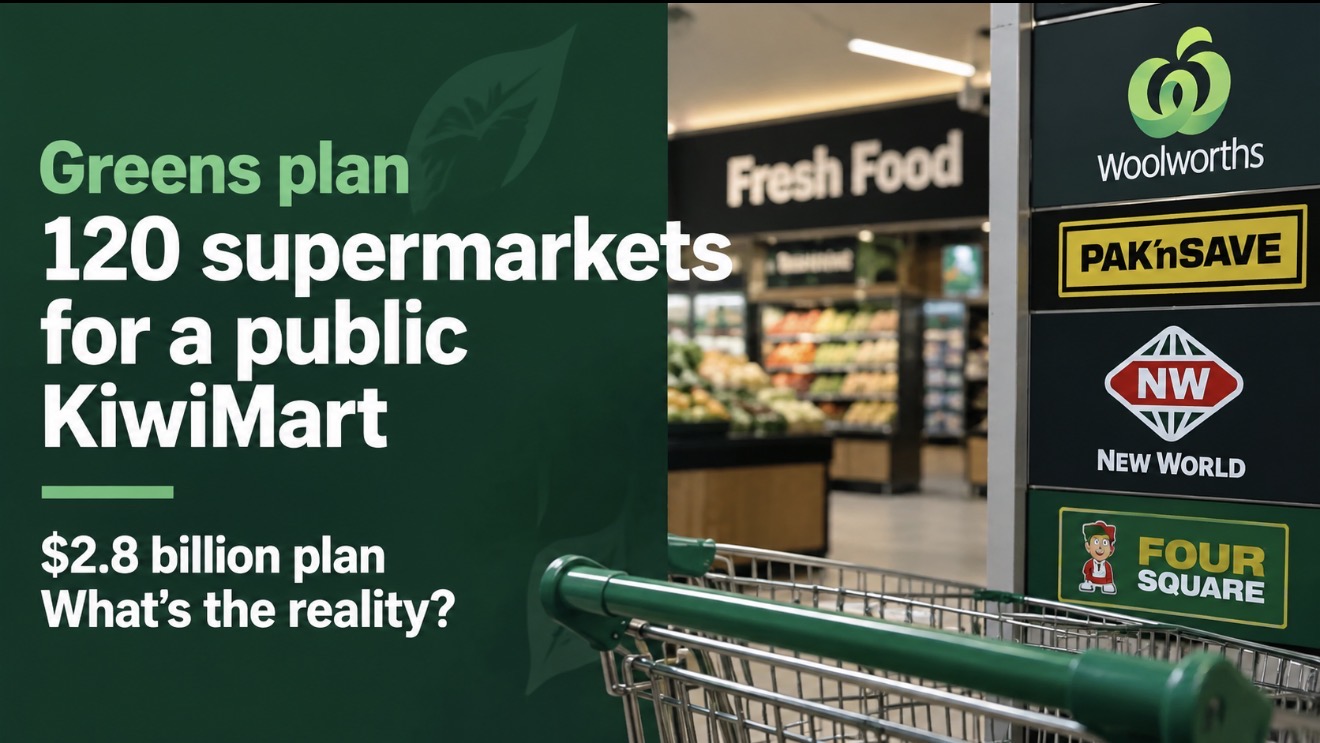
The Green Party has unveiled one of the most aggressive supermarket competition policies New Zealand has seen in decades, proposing a new publicly owned grocery chain called KiwiMart.
Under the plan, Foodstuffs and Woolworths would be required to sell 120 existing supermarkets, along with two distribution centres, into public ownership.
The Greens estimate the proposal would require about $2.8 billion in public investment and give KiwiMart roughly 15 percent of New Zealand’s grocery market from the outset.
It is a major proposal, and the obvious question is whether it is based on a real competition problem or simply election-year politics.
The answer is more complicated than either side may suggest.
What exactly are the Greens proposing?
The proposal forms part of the Green Party’s wider Affordable Kai policy.
Instead of waiting for another international supermarket company to enter New Zealand and compete with Foodstuffs and Woolworths, the Greens want the Government to create a third major player itself.
The proposed chain would be publicly owned and operate under the name KiwiMart, with affordability built into its mandate.
According to details released on Sunday:
- 120 existing supermarket stores would move into KiwiMart
- two distribution centres would support the network
- Foodstuffs and Woolworths would be required by legislation to divest the selected assets
- the estimated initial investment is about $2.8 billion
- the Greens expect KiwiMart to begin with about 15 percent national market share
The proposal is therefore very different from simply building 120 new government supermarkets.
It relies largely on taking existing retail capacity out of the two dominant supermarket groups and transferring it to a new competitor.
That distinction matters.
Is the $2.8 billion figure confirmed?
The $2.8 billion figure is an estimate, not an agreed purchase price.
Reporting on the policy says Parliamentary Library modelling was used in preparing the costing.
There is also some inconsistency in how the costing has been described publicly.
One account says about $1.3 billion would be required to acquire the stores, with a further $1.5 billion associated with the distribution infrastructure and establishment of KiwiMart.
Another describes the modelling as $1.3 billion for acquiring stores and distribution assets and another $1.5 billion for establishing the operation.
Either way, the important point for readers is this:
Nobody has negotiated the purchase of these 120 supermarkets for $2.8 billion.
The figure is policy modelling.
The actual cost could ultimately depend on which stores were selected, whether buildings were owned or leased, property values, goodwill, inventory, equipment, distribution assets, compensation requirements and the final legislation governing compulsory divestment.
So the claim that the Government could simply “buy 120 supermarkets for $2.8 billion” should not be treated as a settled commercial fact.
But the supermarket competition problem is very real
Where the Greens are on much stronger factual ground is their argument that New Zealand’s supermarket market remains highly concentrated.
The Commerce Commission’s 2025 Annual Grocery Report, released in June 2026, found that the major regulated grocery retailers continued to control 82 percent of the national grocery market.
That figure had barely moved despite several years of government intervention.
The national market shares recorded by the Commission included approximately:
Woolworths: 27 percent
Pak’nSave: 25 percent
New World: 22 percent
The remaining market is spread across Four Square and other Foodstuffs formats, smaller chains, independent operators, Costco and other retailers.
The Commerce Commission described New Zealand’s retail grocery sector as highly concentrated and said competitive pressure had not meaningfully increased.
That is not Green Party rhetoric. It is the competition regulator’s own assessment.
New Zealand is unusually concentrated compared with overseas markets
Another useful measurement is the Herfindahl-Hirschman Index, or HHI, which economists and regulators use to assess market concentration.
New Zealand’s grocery market recorded an HHI of about 3,585 in 2025.
For comparison, the Commerce Commission cited figures of approximately:
United Kingdom: 1,515
Ireland: 1,934
The higher the number, the greater the concentration.
Even Auckland, where consumers have more alternatives than most of New Zealand, recorded an HHI of around 2,635.
The Commission said Auckland was actually New Zealand’s most competitive grocery region, with the major supermarket groups holding about 71 percent of the local market.
In other regions, their combined share was substantially higher.
So the basic economic argument behind introducing a meaningful third competitor is supported by the data.
Are supermarkets really making $1 million a day in “excess profit”?
Green co-leader Chlöe Swarbrick repeated the claim that the supermarket groups take about $1 million a day in excess profits.
That number did not originate with the Green Party.
It comes from the Commerce Commission’s earlier grocery market study, which estimated excess profitability in the sector at approximately that level.
However, there is an important qualification.
The $1 million-a-day figure is based on earlier Commerce Commission economic modelling. It should not be interpreted as saying the supermarkets currently put exactly $1 million of unreasonable profit into their bank accounts every single day.
More recent Commerce Commission analysis uses broader measures including operating margins, EBIT and net profit.
Its 2026 report found that Foodstuffs remained strongly profitable, with Foodstuffs North Island and Foodstuffs South Island sitting towards the upper end of international supermarket profitability comparisons.
Woolworths New Zealand’s margins had declined during its restructuring and investment programme, although the Commission noted early signs of recovery during the 2026 financial year.
So the broader claim that profitability and weak competition remain concerns is supported.
The catchy “$1 million a day” number needs context.
Grocery competition has barely changed
This may be the strongest evidence behind the Greens’ proposal.
Despite years of political attention, regulation and supermarket reforms, the Commerce Commission found little observable change in the core competition indicators during 2025.
The major supermarket groups still controlled 82 percent of the national market.
Their market position remained broadly stable.
Margins and profitability remained broadly stable.
The Commission concluded that emerging competitors were still not large enough to materially change market shares or pricing pressure.
There have been positive changes, including removing restrictive land covenants, improving wholesale supply arrangements, changing the Grocery Supply Code and making it easier to develop new supermarkets.
But so far those measures have not created anything resembling a third nationwide supermarket group.
Why not simply bring Aldi, Lidl or another international retailer into New Zealand?
Successive governments have talked about encouraging another major supermarket operator into the country.
The difficulty is scale.
A supermarket chain cannot compete effectively just by opening several stores.
It needs distribution centres, warehouses, supplier relationships, logistics, technology, property, staff and enough purchasing volume to negotiate competitively with manufacturers.
That makes entry into a country of only around five million people expensive.
The Greens’ argument is that rather than waiting years for a foreign company to build that infrastructure, the Government could create a viable competitor immediately by transferring existing stores and distribution infrastructure.
There is some logic to that argument.
Australia provides a useful comparison.
When Aldi expanded into South Australia and Western Australia, it committed hundreds of millions of dollars to distribution centres, stores and infrastructure, with plans for as many as 120 outlets.
Retail grocery competition requires scale.
A few independent supermarkets do not automatically create competitive pressure against two enormous distribution networks.
But KiwiMart would not automatically mean cheaper groceries
This is the biggest weakness in the simplistic version of the argument.
Creating a third supermarket does not, by itself, guarantee lower prices.
KiwiMart would still have to pay for:
staff
electricity
transport
property
warehousing
technology
stock
insurance
refrigeration
waste
distribution
supplier contracts
Those costs do not disappear because the shareholder becomes the Government.
To materially lower prices, KiwiMart would need either lower operating costs, lower required profit margins, better purchasing arrangements, government support or some combination of these.
If it operates inefficiently, taxpayers could end up subsidising supermarket losses.
If it operates commercially and charges similar prices to competitors, consumers may gain another choice without receiving dramatically cheaper groceries.
That is the central economic test the Greens would ultimately need to satisfy.
Public ownership does create one major difference
A government-owned supermarket does not necessarily need to maximise shareholder returns in the same way as a privately owned company.
KiwiMart could theoretically operate on a lower required rate of return and use competition rather than maximum profitability as its objective.
That could create pricing pressure.
If KiwiMart sold a common basket of groceries significantly cheaper, Foodstuffs and Woolworths would face pressure to respond.
This is why the proposal should be judged less on whether government ownership is ideologically good or bad and more on whether KiwiMart could create sustainable price competition without requiring permanent taxpayer subsidies.
That modelling has not yet been publicly demonstrated in enough detail.
The Foodstuffs structure makes divestment especially complicated
There is another important issue often missed in the headlines.
Foodstuffs is not simply one corporation owning every New World, Pak’nSave and Four Square store.
Foodstuffs North Island and Foodstuffs South Island are separate co-operatives, and many stores are individually owned and operated by local owner-operators.
Pak’nSave itself states that its stores are locally owned and operated.
That means compulsory divestment could potentially affect individual New Zealand business owners, depending on how legislation was designed.
Woolworths has a more conventional corporate ownership structure.
This means transferring 120 supermarkets would be legally and commercially more complicated than ordering two companies to hand over 120 identical corporate assets.
The Greens acknowledge new legislation would be required.
Exactly how stores would be selected and how owners would be compensated would therefore be crucial.
What happens to the existing distribution system?
This is another unanswered practical question.
Distribution centres are central to supermarket economics.
Foodstuffs and Woolworths use vertically integrated supply chains to move enormous volumes of groceries around the country.
Removing two distribution centres from existing operators would have to be carefully managed so that the divestment created a functioning third network without damaging food supply to remaining stores.
Simply owning 120 shopfronts is not enough.
KiwiMart would need procurement systems, supplier agreements, inventory systems, freight networks, warehouses and national management capability from day one.
That transition risk deserves considerably more attention than the headline “$2.8 billion supermarket purchase”.
The Government is already pursuing a different approach
The current Government has chosen a market-based competition strategy rather than creating a state-owned supermarket.
Measures announced or underway include making supermarket developments easier to fast-track, removing barriers around suitable land, strengthening wholesale access and introducing rules aimed at stopping predatory pricing by dominant firms.
The Commerce Commission says those reforms are beginning to create a more favourable environment for new entrants.
However, its latest report also makes clear that the results have so far been limited.
That creates the political argument at the centre of this debate.
One side says reforms need more time.
The Greens say New Zealand has waited long enough.
There are genuine concerns over supplier power as well
The debate is not only about what shoppers pay at checkout.
In July, the Commerce Commission said payments, rebates and discounts demanded from suppliers by the major supermarkets could make it harder for smaller competitors to compete.
The regulator said large supermarket groups can use their scale to obtain supplier pricing unavailable to smaller retailers.
That is exactly the type of structural advantage a new supermarket chain would have to overcome.
A KiwiMart with 120 stores could potentially have enough purchasing volume to negotiate far more effectively than a small independent competitor.
That is one of the stronger economic arguments for beginning at significant scale.
The Commerce Commission is still finding competition problems
The regulatory concerns are not theoretical.
In August, the Commerce Commission announced court action against Foodstuffs South Island, alleging anti-competitive conduct relating to restrictions on discounts offered by independently operated Pak’nSave stores.
Foodstuffs South Island is contesting allegations through the legal process, so they remain allegations rather than proven breaches.
But the action reinforces the wider point that grocery competition remains under intense regulatory scrutiny.
The wider Affordable Kai package is much larger than KiwiMart
The supermarket proposal is only one component of the Greens’ food policy.
The broader package is estimated to cost more than $6 billion over four years.
It includes permanently restoring and expanding the Ka Ora, Ka Ako school lunch programme to approximately another 150,000 children.
The party also proposes increasing food-bank funding, doubling the cap on Work and Income food grants and establishing a $150 million-per-year Fair Food Fund for community-led food security projects.
It wants greater Commerce Commission powers and funding, compulsory pricing accuracy rules with compensation where shoppers are overcharged, and laws banning excessive supermarket pricing.
The Greens say these measures would be funded through their wider tax programme.
So what is actually factual?
Several parts of the Greens’ argument are backed strongly by independent evidence.
New Zealand does have an unusually concentrated supermarket market.
Confirmed.
Foodstuffs and Woolworths remain overwhelmingly dominant.
Confirmed.
The major regulated retailers hold about 82 percent of the grocery market.
Confirmed by the Commerce Commission.
Competition has improved dramatically after previous reforms.
No. The Commerce Commission says core competition indicators have changed very little.
Supermarket profitability remains a competition concern.
Yes, although profitability differs between companies and the “$1 million per day” line comes from earlier modelling rather than a live daily calculation.
KiwiMart will definitely cost $2.8 billion.
Not confirmed. That is a policy estimate based on modelling, not a negotiated acquisition price.
The Greens have already identified 120 stores that will be nationalised.
There is no evidence publicly available so far showing a final list of individual stores.
KiwiMart would definitely make food cheaper.
Unproven.
More competition would normally be expected to put downward pressure on prices, but the actual outcome would depend on KiwiMart’s efficiency, purchasing power, operating model and pricing mandate.
The reality
The Green Party has identified a genuine problem.
New Zealand’s supermarket industry is highly concentrated, meaningful competition remains weak and years of reform have not yet materially changed that structure.
Those findings come directly from the Commerce Commission.
Where the debate becomes much less certain is the proposed solution.
Turning 120 existing supermarkets and two distribution centres into a publicly owned national chain would be an enormous commercial, legal and operational exercise.
The $2.8 billion headline should therefore be treated as an estimated starting cost, not a final price tag.
And although a 15 percent third competitor could potentially change grocery competition significantly, there is currently no evidence proving that KiwiMart would automatically deliver permanently cheaper groceries.
The serious question for voters is not whether New Zealand has a supermarket competition problem.
The evidence says it does.
The question is whether spending billions to create a publicly owned competitor would fix that problem more effectively than regulation and private-sector competition.
That is the part of the KiwiMart proposal that still needs far more detailed scrutiny before anyone can confidently answer it.