
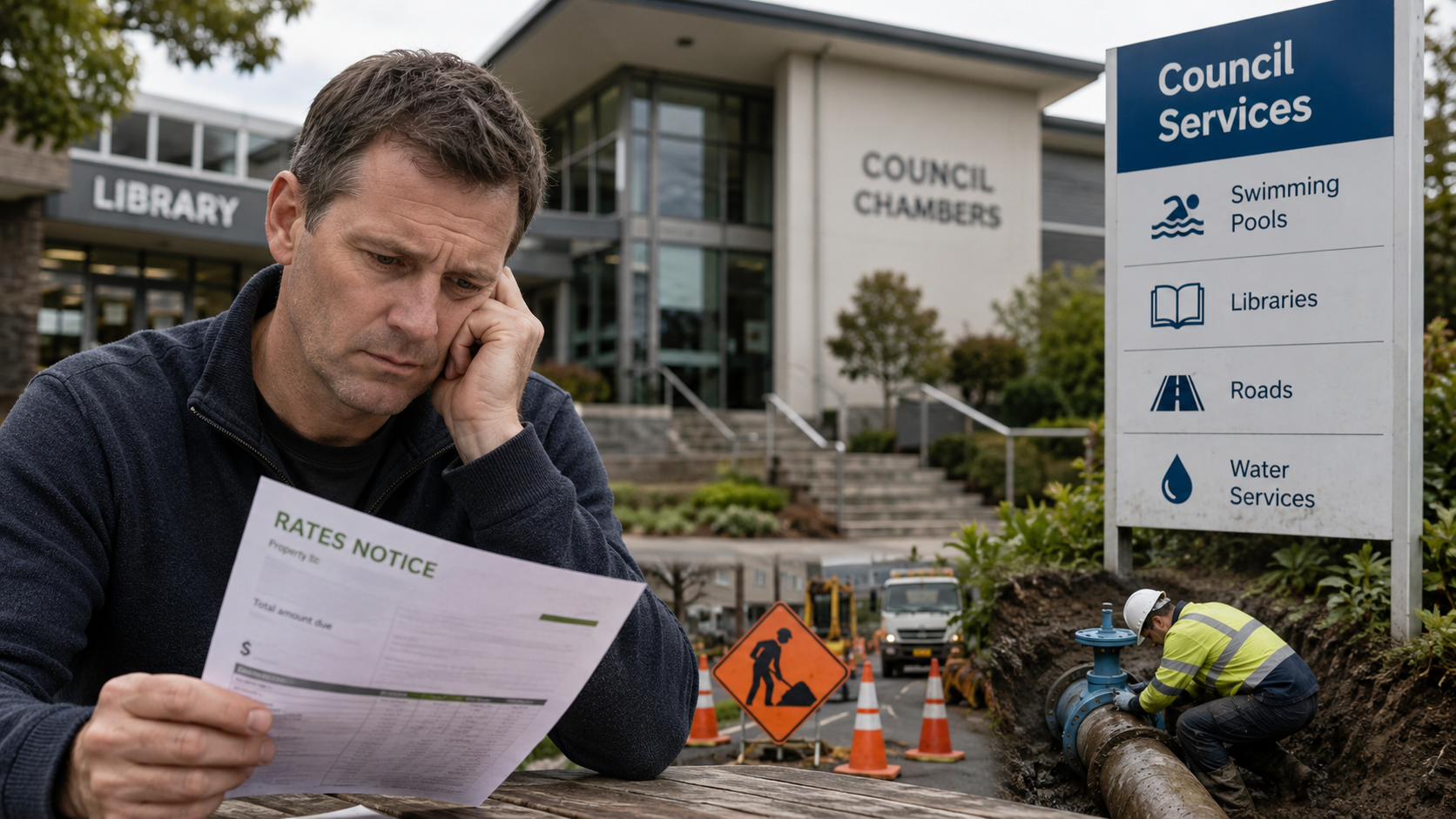
The Government’s plan to cap annual council rates increases has drawn a sharp warning from the Public Service Association, which says the policy could reduce local services, constrain infrastructure investment and increase borrowing costs for councils.
Local Government Minister Simon Watts has proposed an initial rates target of between 2 and 4 percent, arguing households and businesses need greater protection from steep annual increases.
The PSA says the policy risks creating a different financial problem for councils already dealing with ageing infrastructure, rising costs and growing demand for local services.
“The combination of no new taxes and rates caps would be extremely challenging for councils,” PSA national secretary Duane Leo said.
He said restricting councils’ ability to increase rates could force them to reduce services or delay infrastructure spending rather than solve the underlying funding pressures.
Government says ratepayers need relief
The Government says recent rates increases have been too high and councils need stronger financial discipline.
Watts said median rates increases had reached 14.2 percent and 9.2 percent over the past two years.
The proposed system would require councils to work within an initial 2 to 4 percent target range.
Councils would begin taking the target into account from 1 July 2027, with the system expected to take full effect from 1 July 2029.
The target range would be reviewed every six years.
Water services would sit outside the rates cap and continue to be regulated separately.
The proposal also includes exemptions where councils can show exceptional circumstances or demonstrate that going above the cap is necessary for prudent financial management.
An independent regulator would oversee the system, assess exemptions and advise on future target ranges.
PSA warns services could be affected
Leo said the PSA was concerned that capping revenue would eventually affect the services councils provide.
He pointed to analysis from credit-rating agency S&P Global Ratings which warned rates caps were highly likely to put pressure on council services and investment.
That could include reduced opening hours for libraries and swimming pools, as well as less money available for core infrastructure.
“One major concern we have is that ultimately rates caps would result in credit downgrades, negatively impacting on councils’ ability to borrow and driving up interest costs,” Leo said.
The PSA argues that a weaker credit position could make borrowing more expensive at the same time councils are trying to fund major infrastructure projects.
Rates cap at a glance
|
Measure |
Government proposal |
|
Initial annual rates target |
2% to 4% |
|
Councils begin considering target |
1 July 2027 |
|
Full system expected |
1 July 2029 |
|
Target review |
Every six years |
|
Water services |
Excluded |
|
Exceptional circumstances exemption |
Available |
|
Prudent financial management exemption |
Available |
|
Oversight |
Independent regulator |
|
Recent median rates increases cited by Government |
14.2% and 9.2% |
Councils already under financial pressure
The PSA’s concern comes as councils across New Zealand face competing pressures.
Ratepayers are increasingly frustrated by large annual increases.
At the same time, councils are managing expensive maintenance programmes, ageing infrastructure, transport networks, community facilities and debt.
The Government’s position is that councils should prioritise essential spending more carefully.
The PSA argues that many of the costs councils face cannot simply be removed.
Roads still need to be maintained.
Water systems still need investment.
Libraries, pools and other local facilities still need staff and operating budgets.
If rates increases are restricted without another source of revenue, councils may be forced to reduce services, delay projects or borrow more.
Credit rating concerns
The PSA has also raised concerns about the effect a cap could have on councils’ credit ratings.
A downgrade can make borrowing more expensive because lenders generally demand higher interest rates from organisations seen as carrying greater financial risk.
That matters because councils rely heavily on debt to fund long-term infrastructure.
If councils are unable to raise enough revenue while still needing to invest in infrastructure, their financial position could weaken.
Higher borrowing costs could then create further pressure on council budgets.
The PSA says this is one of the risks that needs to be considered before the Government proceeds with legislation.
Infrastructure failures remain a concern
Leo pointed to recent infrastructure failures as an example of what can happen when critical assets are not adequately maintained.
He referred to the failure at Wellington’s Moa Point Wastewater Treatment Plant, which caused major disruption and renewed attention on the condition of local infrastructure.
“We’ll not only see reduced public services but limited investment in critical maintenance,” Leo said.
He said Wellington’s experience showed the consequences of failing to invest adequately in water and other infrastructure.
The PSA argues that councils need the financial capacity to carry out preventative maintenance before problems become emergencies.
That is particularly important for water, roads and other infrastructure where failures can become far more expensive than routine maintenance.
Debate now shifts to how councils are funded
The rates cap proposal raises a wider question about how local government should be funded.
Councils depend heavily on rates, while also receiving revenue from fees, charges, grants and central government funding.
The Government says the current system has allowed rates increases to become too high and wants councils to focus more closely on core services.
The PSA says limiting rates without providing councils with alternative funding will make it harder for them to meet their responsibilities.
“Rather than treat councils as a liability, the Government, and any future government, needs to demonstrate how they plan to financially enable councils to deliver the services they’re mandated to,” Leo said.
That puts the debate between two competing pressures.
Households want relief from rapidly rising rates.
Councils need enough revenue to maintain services and infrastructure.
The Government believes a cap will improve discipline and force better prioritisation.
The PSA says that without a broader funding solution, the policy risks shifting the cost somewhere else.
That could mean fewer services, delayed maintenance, higher debt or more expensive borrowing.
The legislation will now be closely watched by councils, ratepayers, unions and credit-rating agencies as the Government develops the final framework.
Source: Public Service Association, New Zealand Government, S&P Global Ratings, Christchurch City Council and Wellington Water.