
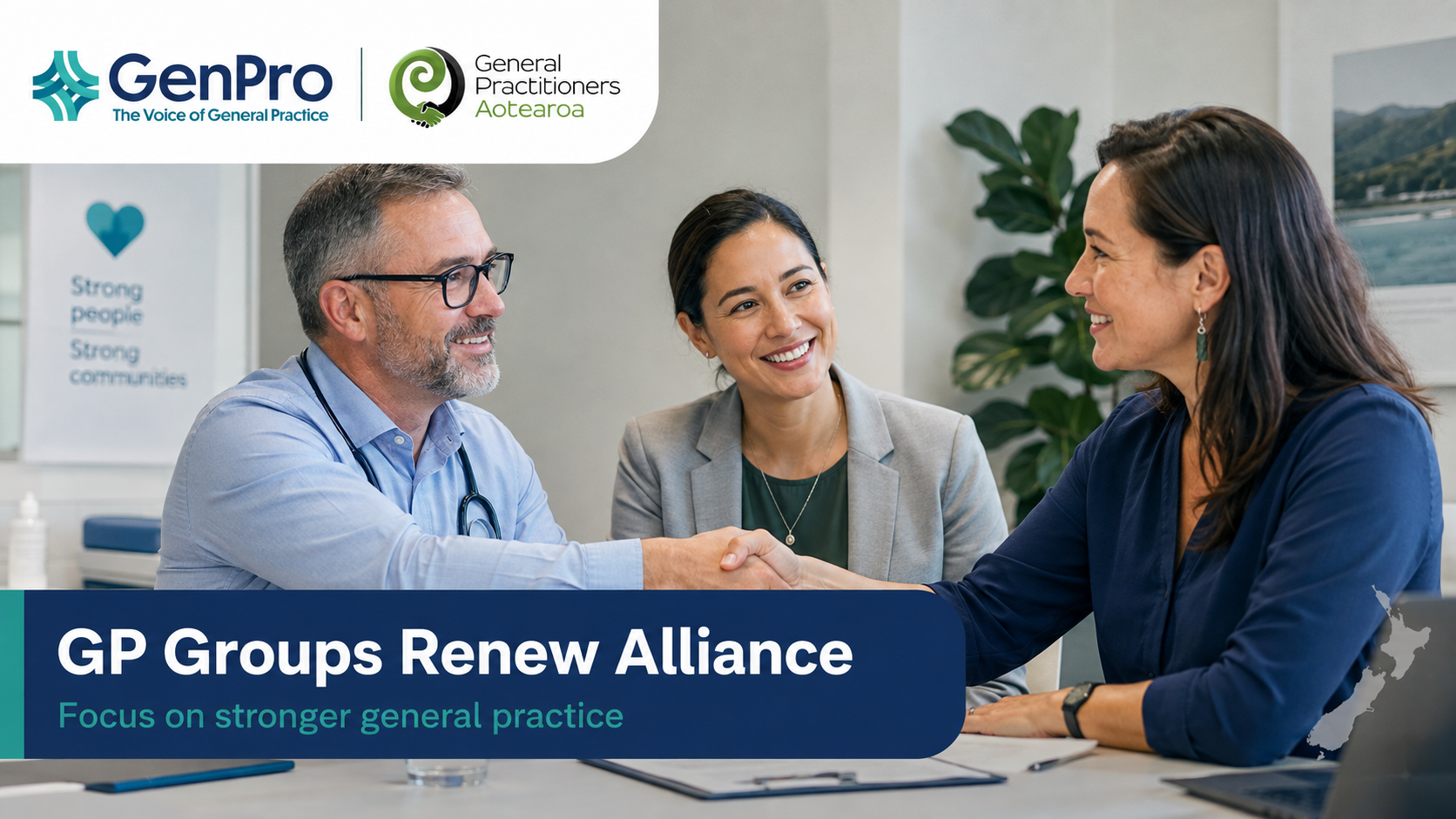
Two of New Zealand's key general practice membership organisations have renewed their formal commitment to work together, extending a partnership they say is aimed at strengthening general practice and improving access to care for patients.
GenPro and General Practitioners Aotearoa have signed a new Memorandum of Understanding, continuing an arrangement that began in 2024.
On the surface, an agreement between two professional organisations may sound administrative.
But the importance is much broader.
General practice is often the first point of contact for people who need medical care. When GP clinics are under pressure, the effects can be felt across the entire health system through longer waits, difficulty finding appointments and more people eventually seeking care elsewhere.
That is why the renewed agreement matters.
GenPro represents GP practice owners, while General Practitioners Aotearoa represents GPs whether they own a practice or not.
The two organisations have different roles, but they share a common interest in making general practice more sustainable and ensuring patients can continue to access high-quality care close to home.
What exactly has been agreed?
The two organisations have renewed a Memorandum of Understanding that provides a framework for them to collaborate on issues where their interests overlap.
Their original MoU was signed in 2024 and provided a two-year basis for cooperation.
With that agreement expiring in June this year, both organisations have agreed to continue working together where appropriate on matters important to general practice.
GenPro Chair Dr Angus Chambers said the organisations have different responsibilities but share the same broad objective.
"GenPro and General Practitioners Aotearoa have different roles, but we share a common goal: a strong, sustainable general practice sector that delivers the best possible care for patients," he said.
The new agreement allows each organisation to retain its own identity and voice while working together when there is a shared issue.
That distinction is important.
This is not a merger.
It is not one organisation taking over the other.
It is an agreement to coordinate where cooperation may produce a stronger result.
Why do two GP organisations exist?
For patients, the difference between the organisations may not immediately be obvious.
But they represent different parts of the general practice system.
GenPro members are GP practice owners.
That means its membership is closely connected to the realities of operating a general practice as a business and healthcare service.
Practice owners have to think about staffing, premises, technology, administration, patient demand and whether the practice itself remains financially sustainable.
General Practitioners Aotearoa members are GPs, whether they own a practice or not.
Its perspective therefore includes doctors working across general practice, including those who may not carry the financial responsibilities of owning a clinic.
The two viewpoints overlap, but they are not identical.
That is one reason collaboration can be useful.
A problem affecting a GP can also affect the practice employing them.
A problem affecting the financial sustainability of a practice can ultimately affect doctors and patients.
Why should ordinary patients care?
This is where the agreement becomes more relevant to the public.
Most people do not think about the organisational structure behind their GP clinic when they book an appointment.
They simply want to know:
Can I get an appointment when I need one?
Can I afford the consultation?
Is my doctor able to spend enough time with me?
Will my local practice still be there next year?
Can my family access primary healthcare close to home?
The strength of general practice directly influences those questions.
Dr Buzz Burrell, Chair of General Practitioners Aotearoa, said a strong general practice sector is essential to providing high-quality care close to home and reducing pressure on the wider health system.
That point goes beyond the interests of doctors.
If people cannot easily access a GP, healthcare problems can become more serious before they are treated.
Some patients may eventually seek care through urgent-care clinics or hospitals instead.
That can shift pressure from primary care to other parts of the health system.
General practice is more than a doctor's appointment
A GP practice is also a small healthcare organisation.
It may include doctors, nurses, reception staff, practice managers and other health professionals.
The clinic needs buildings, equipment, software, administration systems and staff.
It also has to handle increasing demand while remaining financially viable.
That means discussions about the sustainability of general practice are not simply about how much individual GPs are paid.
They are also about whether local clinics can continue operating effectively.
This is particularly relevant for practice owners, which is why GenPro's role differs from that of an organisation representing doctors more broadly.
Why collaboration could matter
When two organisations representing related parts of the same sector speak separately, they may sometimes approach an issue from different angles.
That can be useful.
But where they agree, presenting a coordinated position can potentially make their concerns clearer.
Dr Chambers said it made sense for the organisations to work together where their interests are shared.
"Where we have shared interests, it makes sense for us to work together," he said.
"Renewing the MoU provides a clear framework for that collaboration while allowing each organisation to maintain its distinct role and voice."
That approach could be important when issues affect both doctors and practice owners.
For example, any change that affects the operation of GP clinics may have consequences for both the medical workforce and the businesses delivering primary healthcare.
Dual membership encouraged for GP owners
One practical message from the announcement is directed at GPs who also own, or part-own, their practices.
Both organisations say those doctors can, and should, belong to both groups.
Their argument is that the organisations offer different perspectives and services.
A GP owner is both a doctor and a business owner.
That person may therefore benefit from representation covering both sides of the role.
Dr Chambers said there was additional value in eligible GP owners being involved with both organisations.
"GenPro and GPA provide different perspectives and services, and there is value in eligible GP owners being part of both organisations," he said.
What does this mean for the country's wider health pressures?
The media release does not set out specific Government funding commitments or new Government measures connected to this agreement.
That is important to make clear.
The renewed MoU is an agreement between GenPro and General Practitioners Aotearoa, not a new Government healthcare policy.
But the wider point raised by both organisations is highly relevant to national health planning.
Primary care acts as one of the main entry points into the health system.
When it works well, patients can often receive treatment earlier and closer to home.
When it struggles, pressure can flow elsewhere.
That makes the future of general practice important not only to GPs, but also to hospitals, urgent care, communities and patients.
The question for policymakers is therefore not simply whether individual practices are coping today.
It is whether the general practice model is sustainable enough to meet future demand.
What does "sustainable general practice" actually mean?
The word "sustainable" is often used in healthcare discussions, but it can mean several things.
For a general practice, sustainability can involve having enough staff, enough financial certainty and enough capacity to continue treating patients.
For a GP, it can mean having a workload that can be maintained over the long term.
For a patient, it can mean having reliable access to a local doctor.
For the wider health system, it can mean keeping as much appropriate care as possible within the community rather than allowing preventable demand to move into more intensive services.
That is why the two organisations repeatedly use the word "sustainable".
They are talking about whether general practice can continue performing its role effectively over time.
Cooperation does not mean the organisations will always agree
Another important part of the renewed MoU is that both organisations retain their own voices.
That matters because practice owners and employed GPs may not always view every issue in exactly the same way.
There may be areas where their priorities differ.
A healthy professional sector does not require every organisation to hold the same view on every matter.
The value of the agreement is that it creates a mechanism for cooperation where there is genuine common ground.
Dr Burrell said the relationship developed over the past two years had been constructive.
"We get on great with the folks at GenPro and there's a lot of common ground when it comes to improving things for GPs," he said.
"We are united in wanting a stronger and more sustainable future for general practice."
Why this matters now
The significance of this agreement is not in the paperwork itself.
It is in the message behind it.
Two organisations representing different parts of general practice have decided they achieve more by coordinating on shared problems than by working entirely separately.
That is particularly relevant when the issues facing general practice affect the whole system.
Practice owners need viable clinics.
GPs need workable professional conditions.
Patients need access to care.
And the wider health system needs primary care to function effectively.
Those interests are closely connected.
What happens next?
The renewed MoU gives GenPro and General Practitioners Aotearoa a continuing framework for collaboration.
The organisations say they will work together where appropriate on matters of shared interest and importance to general practice.
The practical value of that agreement will depend on what comes next.
The important questions will be whether the organisations can turn their cooperation into clearer advocacy, practical improvements for general practices and better outcomes for patients.
For the public, that is ultimately the measure that matters.
The bigger picture
This announcement may not immediately change the experience of someone trying to book a GP appointment tomorrow morning.
But it highlights a wider issue that affects almost every New Zealander at some point.
General practice is one of the foundations of the health system.
If local practices are strong, accessible and sustainable, patients can receive care earlier and closer to home.
If those practices become increasingly difficult to operate or doctors struggle to maintain their workloads, the consequences do not remain inside the clinic.
They eventually affect patients and the rest of the health system.
That is why the renewed GenPro and GPA partnership is more than an agreement between two membership bodies.
It is part of a much larger conversation about what New Zealand needs from general practice and what has to be done to make sure primary healthcare remains available when people need it.
As Dr Burrell put it, a strong general practice sector is essential not only for doctors, but for patients and the wider health system.
The agreement provides a framework for the two organisations to work together.
The next question is whether that stronger collective voice can help produce meaningful improvements on the ground.
Source: GenPro and General Practitioners Aotearoa, media release, 20 August 2026.