
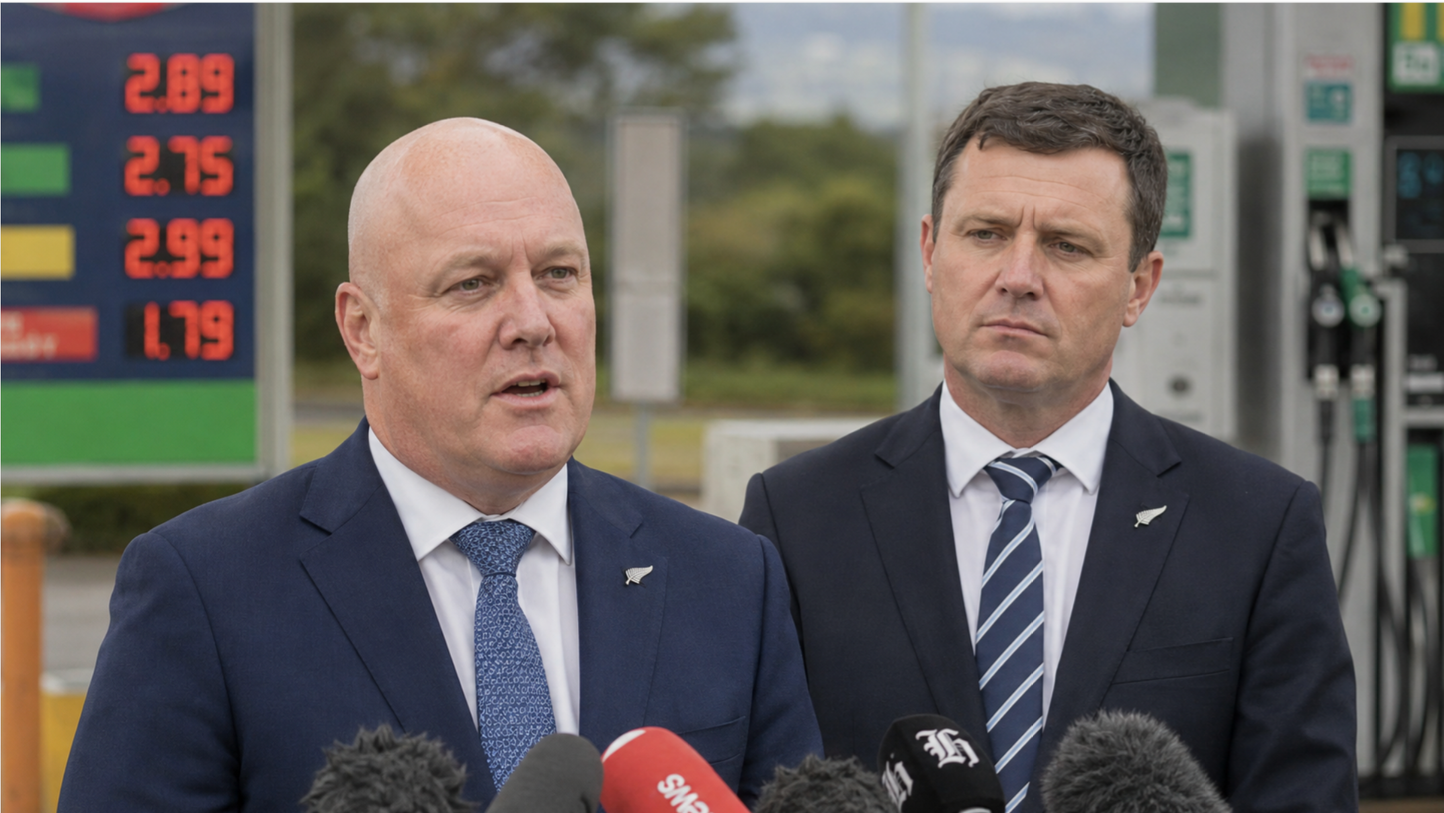
The Government’s decision to delay planned fuel tax increases by a year will give motorists some short-term relief, but it does not remove the underlying problem: New Zealand still needs billions of dollars to maintain roads, fund public transport and keep major infrastructure projects moving.
The Government announced on 31 August that fuel excise duty increases previously due to begin on 1 January 2027 will now be pushed back.
Instead of a 12-cent-per-litre rise in 2027 followed by further increases of 6 cents and 4 cents, the new plan would introduce smaller 5-cent increases every six months, beginning in 2028 and continuing through to the end of 2029.
The total increase would therefore be 20 cents per litre rather than the previously planned 22 cents.
But delaying the increase creates an immediate funding gap.
The Government says it will top up the National Land Transport Fund by an estimated $1.476 billion over the forecast period, including using money from a $450 million contingency fund established in Budget 2026.
The rest will have to come from elsewhere.
That is where the political argument becomes more complicated.
What is actually changing?
| Item | Previous plan | New Government plan |
|---|---|---|
| First increase | 12c per litre from January 2027 | No increase in 2027 |
| Later increases | 6c, then 4c annually | 5c every six months |
| Start of increases | January 2027 | January 2028 |
| Total planned rise | 22c per litre | 20c per litre |
| Transport funding shortfall | Lower under original plan | About $1.476 billion to be filled |
| Funding source | Fuel excise and other transport revenue | Rainy-day fund plus additional government funding |
Fuel excise duty has not increased since 2020.
For motorists, the immediate effect is easy to understand.
There will be no extra fuel tax from January 2027.
For the Government, however, that lost revenue still has to be replaced if planned road maintenance, public transport services and infrastructure spending are to continue.
Government reaches into its fuel crisis reserve
A key part of the announcement is the use of the Government’s $450 million fuel crisis contingency fund.
That fund was created in Budget 2026 as a reserve for what the Government described at the time as potential temporary and targeted responses to fuel crises.
Now, part of it will be used to support transport funding while fuel tax increases are delayed.
Transport Minister Chris Bishop said the alternative would be significant cuts.
Without the additional funding, he said, New Zealand would face reductions in road maintenance, public transport and infrastructure investment.
The Government’s argument is therefore that it is trying to achieve two competing objectives at once.
Give motorists relief now.
Keep the transport programme funded.
That balance comes at a fiscal cost.
Why this matters beyond the petrol station
Fuel tax debates are often treated as a simple question of how much motorists pay at the pump.
In reality, the money helps finance a much broader transport system.
The National Land Transport Fund supports road maintenance, state highways, local roads, public transport and other transport investment.
If one of its major revenue streams is delayed, another source has to replace it.
That replacement can come from general taxation, borrowing, spending cuts elsewhere, new charges or future tax increases.
None of those options is cost-free.
This is the central issue behind the announcement.
The tax increase may have been delayed.
The transport cost has not disappeared.
Luxon says election timing is not behind the decision
Prime Minister Christopher Luxon rejected suggestions that the decision was driven by the approaching election.
He said the Government had already been signalling that a January 2027 increase was becoming unlikely because of changing international fuel conditions and geopolitical uncertainty.
The Government has pointed to recent fuel-market instability as a reason to avoid adding another cost to household budgets at the beginning of next year.
That argument will likely appeal to motorists who have watched fuel prices move unpredictably in response to global events.
But the timing will inevitably attract political scrutiny.
Fuel taxes are highly visible.
Few taxes are noticed as quickly by households as an extra few cents appearing on petrol station price boards.
With a national election approaching, both major parties are now offering voters some form of protection from an immediate fuel tax rise.
Their approaches, however, are different.
National and Labour are now fighting over who has the more credible freeze
Labour announced last week that it would freeze fuel excise duty and road user charges for the next three years.
The Government says that proposal would create a much larger hole in transport funding.
Bishop described Labour’s approach as effectively hoping for the best, saying a three-year freeze would leave the National Land Transport Fund short by about $4.6 billion.
Labour disputes that figure.
Labour leader Chris Hipkins said the Government itself had previously campaigned against large fuel tax increases and accused National of now planning to raise petrol taxes by 20 cents per litre during a cost-of-living crisis.
His argument is straightforward.
Households are already under financial pressure, and this is not the time to add more to the price of petrol.
But Labour has its own unanswered question.
How would it replace the revenue?
When asked how Labour would fund its three-year freeze, Hipkins said the party’s full fiscal plan had not yet been released.
He also did not rule out borrowing.
That leaves voters with two incomplete but competing propositions.
National has explained more clearly when fuel taxes would eventually increase, but has still not fully detailed where all of the replacement funding will come from.
Labour promises a longer freeze but has not yet explained how the resulting transport funding gap would be financed.
The $1 billion still to be found
Of the Government’s projected $1.476 billion funding requirement, $450 million can potentially come from the fuel crisis contingency.
That still leaves roughly another $1 billion.
Bishop said the additional funding will be shown in the upcoming Pre-election Economic and Fiscal Update, or PREFU.
That document will therefore be important.
It should reveal whether the balance comes from reprioritised spending, additional Crown funding, borrowing or another mechanism.
Until then, the public knows the size of much of the problem but not the complete solution.
For a government presenting the decision as fiscally responsible, that missing detail matters.
Labour attacks the rainy-day fund
Hipkins has accused the Government of turning the fuel contingency into what he called a “slush fund”.
His criticism is that the reserve was originally presented as a response to temporary and targeted fuel-market pressures, rather than as a source of broader transport funding.
The Government’s defence is likely to be that fuel prices and cost-of-living pressure are precisely the circumstances the contingency was intended to address.
Both positions deserve scrutiny.
Using contingency funding may be reasonable during unusual conditions.
But reserves are finite.
Once money has been used, it is no longer available for another crisis.
That creates a legitimate question about what would happen if another significant international fuel shock occurred after part of the fund had already been committed.
The road freight sector is already warning about the other side of the equation
The political debate is mostly focused on motorists.
The freight industry is looking at the problem differently.
Ia Ara Aotearoa Transporting New Zealand has warned that continually deferring transport revenue increases can eventually create higher costs elsewhere.
Its argument is that poorly maintained roads increase journey times, fuel consumption and vehicle maintenance costs.
Freight companies then pass those additional costs through the supply chain.
Ultimately, consumers can end up paying more for groceries, building materials and other goods.
That creates an uncomfortable contradiction in the cost-of-living debate.
Keeping fuel tax lower helps households directly.
Allowing transport infrastructure to deteriorate can hurt households indirectly.
The difficult job for any government is finding the point between the two.
Why transport funding keeps becoming politically difficult
New Zealand’s road funding model faces a structural problem.
Fuel excise duty depends heavily on petrol consumption.
Road user charges largely cover diesel vehicles and other road users outside the petrol excise system.
But the transport network itself is becoming more expensive to maintain and build.
Construction costs have risen.
Major infrastructure projects have become more expensive.
There are also increasing demands for public transport, resilience upgrades, bridge renewals and safety improvements.
At the same time, improvements in vehicle efficiency and the gradual transition towards electric vehicles raise long-term questions about whether traditional fuel taxes remain the best way to fund roads.
The Government has previously signalled interest in moving towards broader road-user charging.
That debate is likely to become more important because the current system increasingly asks fewer litres of petrol to support a transport network with growing costs.
What motorists should understand
For an average driver, the headline is positive in the short term.
The 12-cent increase that had been due in January 2027 is not going ahead.
But motorists should not interpret the announcement as the cancellation of future increases.
Under the new plan, fuel tax will still rise.
It will simply begin later and increase in smaller steps.
Starting in January 2028, the tax is proposed to rise by 5 cents per litre every six months until the end of 2029.
That is a more gradual path, but it still represents a substantial increase over time.
The election question is now about credibility, not just cents per litre
Both National and Labour know that fuel prices are politically sensitive.
Neither wants to be seen adding pressure to household budgets during a cost-of-living squeeze.
But the serious policy question is not simply which party promises the lowest fuel tax.
It is which party can explain how New Zealand will pay for its transport system.
Roads still need resurfacing.
Bridges still need repairing.
Public transport still needs funding.
Major projects still have contracts and construction costs attached to them.
Someone eventually pays.
That payment can appear at the petrol pump, through road user charges, through general taxation, through borrowing or through reduced spending elsewhere.
The political temptation is to focus on the first of those because it is the most visible.
The responsible debate needs to include all of them.
For voters, the most useful question may therefore be less about who delays the fuel tax the longest and more about this:
If the money does not come from fuel taxes, exactly where will it come from?
That is the question both major parties will need to answer before election day.
Reporting basis: This article draws on original reporting by RNZ political reporter Tuwhenuaroa Natanahira on the Government’s 31 August fuel-tax announcement, with additional context and analysis by Webfit News.