
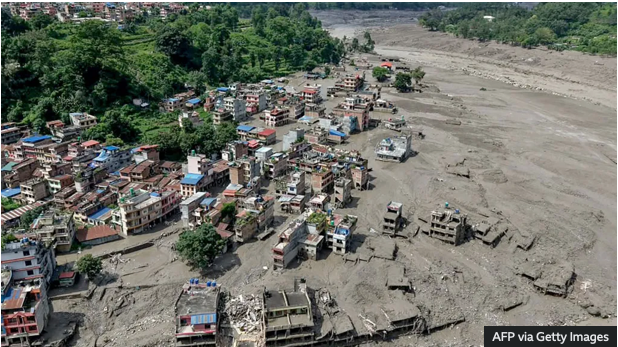
At least five New Zealanders have reportedly been listed as missing after a catastrophic flash flood and landslide struck the Nepal-Tibet border, killing at least 160 people and leaving hundreds more unaccounted for.
RNZ first reported the New Zealand connection, citing former Honorary Consul of Nepal to Auckland Dinesh Khadka, who said Nepal Police had provided him with the names of five New Zealanders still unaccounted for.
New Zealand’s Ministry of Foreign Affairs and Trade had not confirmed the number at the time of reporting and was seeking further information.
The disaster struck on Wednesday after a massive collapse of ice, rock and debris in the Himalayan border region sent a violent surge of mud and water through valleys and settlements on both sides of the Nepal-China border.
Nepal Police said at least 157 bodies had been recovered, while Chinese authorities reported three deaths and 265 people missing in Tibet’s Gyirong County.
The overall death toll is expected to rise.
Hundreds of tourists still missing
Nepalese officials reported 403 tourists missing, including 341 foreign nationals.
Among those unaccounted for were tourists and pilgrims from India, the United States, Australia, the United Kingdom, Canada and other countries.
Reported figures included 133 Indian nationals, 47 Americans, 34 Australians, 33 British nationals and 24 Canadians.
Nine South Korean workers involved in a hydropower project were also reported missing.
The region is an important route for people travelling towards Mount Kailash and Manasarovar in Tibet, particularly during the pilgrimage season.
That has made the disaster unusually international in its impact.
What happened
Early reports suggested a magnitude 4.4 earthquake may have triggered the disaster.
But subsequent scientific assessment changed that picture.
The US Geological Survey later indicated that seismic activity recorded in the region was likely caused by the enormous landslide itself rather than an earthquake triggering the collapse.
Satellite imagery reviewed by disaster authorities and international experts showed that part of a glacier had broken away and fallen into the valley below.
The collapse carried ice, rock and sediment into the river system, producing an enormous debris-filled flood.
The Nepal National Disaster Risk Reduction and Management Authority said the event originated around 20 kilometres northeast of the Rasuwagadhi border crossing.
Experts have described it as an ice-rock avalanche.
The flood then travelled rapidly through the Lhende Khola and into the Bhote Koshi and Trishuli river systems.
Water levels downstream reportedly rose by as much as nine metres within half an hour.
Disaster at a glance
| Indicator | Latest reported figure |
|---|---|
| Confirmed deaths in Nepal | 157 |
| Confirmed deaths in Tibet | 3 |
| Tourists reported missing | 403 |
| Foreign tourists among missing | 341 |
| New Zealanders reportedly missing | 5 |
| Australians reported missing | 34 |
| British nationals reported missing | 33 |
| Americans reported missing | 47 |
| Canadians reported missing | 24 |
| Indian nationals reported missing | 133 |
| Missing in Tibet’s Gyirong County | 265 |
Figures remain subject to change as rescue teams reach affected areas.
Entire settlements swept away
The scale of destruction has made rescue work extremely difficult.
Roads, bridges, homes and hydropower infrastructure have been damaged or destroyed.
At least 19 bridges and almost 40 kilometres of road were reported to have been swept away or badly damaged.
In some locations, helicopters have struggled to land because of high water levels, mud and destroyed access routes.
Residents described entire settlements being washed away.
The Himalayan Trust said the scale of the loss was “heartbreaking” and said the flood had affected the Bhote Koshi valley in the Langtang region.
Nepalese police, military personnel and emergency teams continued rescue operations through difficult conditions, while international assistance was being mobilised.
The United Nations said it was preparing supplies and personnel to assist affected communities.
Why this disaster is raising wider concern
This event is not being viewed as an isolated flood.
Scientists have been warning for years that the Himalayan region is becoming increasingly vulnerable to glacier collapse, flash flooding, landslides and extreme weather.
The Hindu Kush Himalaya has experienced accelerating ice loss, while warmer temperatures can destabilise glaciers and increase the risk of sudden collapses and glacial flooding.
Experts say the exact trigger for Wednesday’s disaster still needs further investigation.
But the mechanism itself is increasingly familiar.
Ice breaks away.
Rock and sediment are dragged with it.
The mass crashes into a valley or river.
Water, mud and debris then move downstream at enormous speed.
In steep Himalayan terrain, communities can have very little warning.
The same wider region has already experienced serious glacial and flash-flood disasters in recent years.
That adds another dimension to the tragedy.
The question is no longer only how rescue teams respond after a disaster.
It is whether high-risk regions need much stronger monitoring, early warning systems and restrictions on where critical infrastructure and settlements are developed.
New Zealand families waiting for answers
For New Zealand, the immediate focus is on establishing whether the five people reportedly missing are safe.
MFAT has urged New Zealanders in Nepal to follow the advice of local authorities and contact friends and family when they are able to do so.
New Zealanders requiring urgent consular assistance can contact MFAT’s emergency consular service.
Families with relatives travelling in Nepal or the Tibet border region may face delays in receiving information because communications and transport links have been badly disrupted.
That uncertainty is likely to continue while rescue teams work through remote and heavily damaged areas.
Video and image verification remains important
Videos circulating on social media appear to show people running from a huge wall of debris and water before buildings and vehicles are struck.
Some footage has been verified by international news agencies.
However, not every image or video circulating online has been independently verified.
Webfit News is therefore treating unverified social media material with caution.
Any images or videos published alongside this report should be credited to the original source where known, and clearly marked where independent verification has not been possible.
That distinction matters during fast-moving disasters, when old or unrelated footage can easily be recirculated as new.
For now, the confirmed picture is already devastating enough.
At least 160 people are dead.
Hundreds remain missing.
Entire communities have been damaged or destroyed.
And at least five New Zealanders are reportedly among those still unaccounted for.
The next 24 to 48 hours will be critical as rescue teams try to reach isolated areas and authorities work to identify the dead and locate those still missing.
Source credit: RNZ first reported the New Zealand connection. Additional reporting and verification from AFP, Reuters, Associated Press, Nepalese authorities, Chinese state media and the Himalayan Trust.