Federated Farmers is calling for a more coordinated national approach to water storage, arguing New Zealand could learn from Tasmania rather than forcing individual communities to repeatedly navigate funding, engineering and consenting challenges on their own.
NEW ZEALAND: New Zealand has plenty of ideas for storing more water, but lacks an effective system for turning the strongest proposals into completed infrastructure, according to Federated Farmers.
The farming organisation wants the next Government to provide seed funding for new water-storage projects, speed up approvals and create a more coordinated development model inspired by Tasmania.
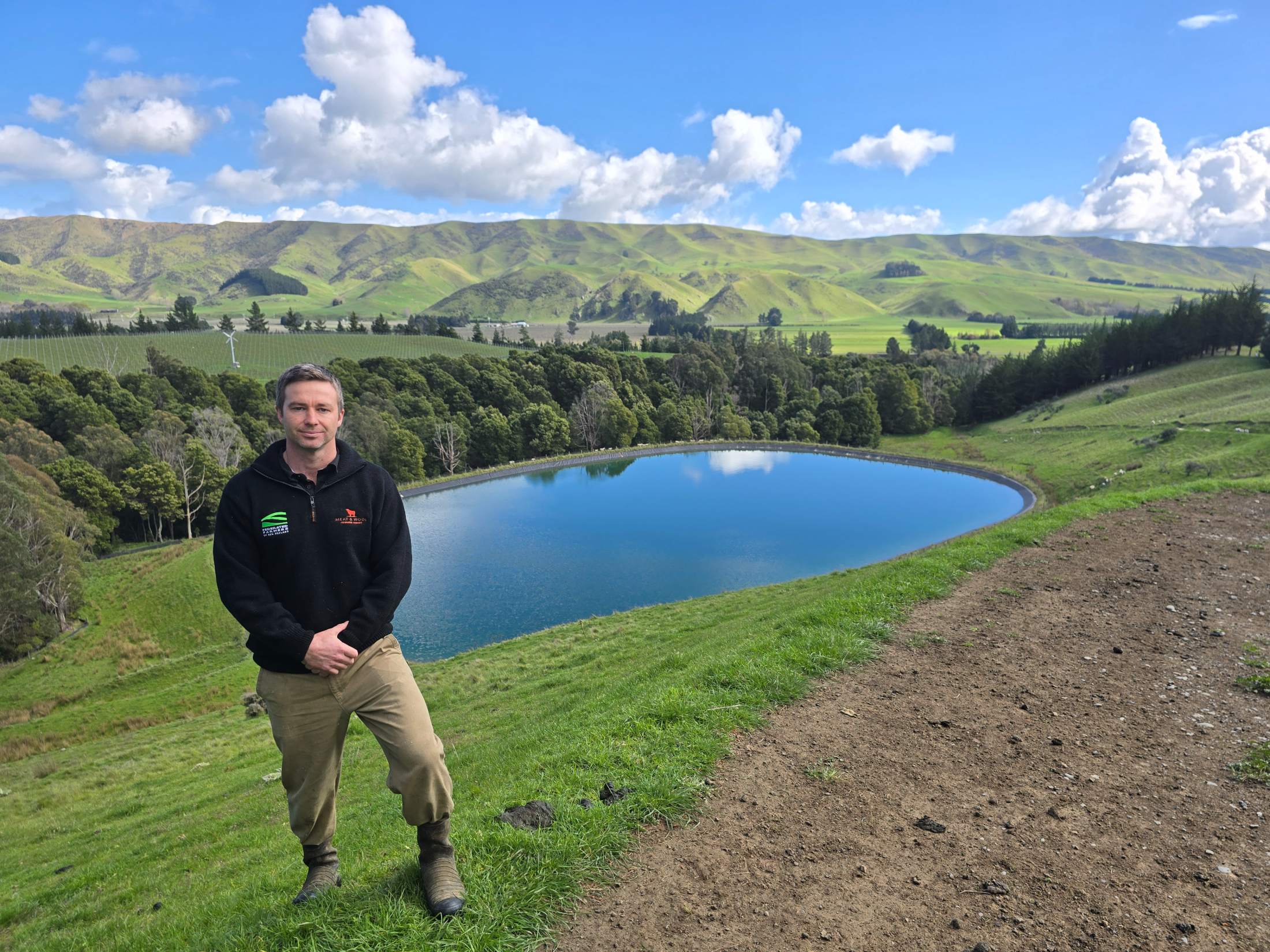
Federated Farmers water storage spokesperson Richard Dawkins says potential projects already exist across New Zealand, from Northland to Central Otago, but communities frequently have to build their own teams and work through complex development processes from scratch.
“New Zealand doesn’t have a shortage of water storage ideas. What we lack is a system for turning the best of those ideas into reality,” Dawkins said.
Why Federated Farmers is looking to Tasmania
Dawkins points to Tasmania as an example New Zealand could learn from.
Instead of expecting each community to independently develop a water scheme, Tasmania has developed specialist capability to assess projects and work with communities to determine whether proposals are viable.
According to Dawkins, projects that do not stack up can be identified earlier, while viable schemes can draw on established engineering, commercial and project-development expertise to become investment-ready.
Crucially, knowledge gained developing one project is retained and applied to the next.
Dawkins said New Zealand did not necessarily need to reproduce Tasmania's system exactly.
“I’m not saying New Zealand needs to copy Tasmania line for line, but there’s plenty we could learn from the model,” he said.
He said IrrigationNZ had also been examining the Tasmanian approach and advocating for greater coordination in New Zealand.
More than irrigation
Federated Farmers argues the debate around water storage should not be limited to irrigation.
Well-designed storage infrastructure can potentially support multiple purposes, including:
maintaining environmental river flows;
drinking and stock water supplies;
irrigation and productive land use;
recreation;
groundwater recharge;
electricity generation in some schemes; and
improving resilience during drought and periods of increasingly variable rainfall.
Dawkins points to Opuha Dam in South Canterbury as an example of a multipurpose water-storage scheme.
He says releases from the dam have historically prioritised environmental river flows, followed by domestic and stock water, before irrigation and electricity generation.
The resulting lake has also developed into a recreational asset.
“It’s a useful reminder that water storage is about so much more than just putting more water on farmland,” Dawkins said.
Could reliable water encourage more investment?
Federated Farmers also argues that greater water security can influence investment decisions.
When farmers and growers have greater confidence that water will be available during dry periods, Dawkins says they may be more willing to invest in their operations, adopt more efficient water technology or move into different and potentially higher-value crops.
The organisation argues those investments can subsequently flow into processing businesses, employment and services in surrounding communities.
As an example, Federated Farmers' 2026 election platform attributes around $400 million of Canterbury's GDP in 2025 and more than 2,200 full-time jobs to the Central Plains irrigation scheme.
Those figures are Federated Farmers' estimates and form part of the organisation's case for further investment in water infrastructure.
Farmers should still pay for private benefits
Federated Farmers is not arguing that every proposed dam or storage scheme should proceed.
Dawkins says projects still need to demonstrate that they make sense commercially and environmentally.
He also says water users should pay for the private benefits they receive.
“None of this means every proposed dam should be built, or that taxpayers should be writing blank cheques,” he said.
Instead, Federated Farmers sees a role for government in helping potentially viable projects survive the expensive and complicated early development stages.
What Federated Farmers wants from the next Government
Water infrastructure forms part of Federated Farmers' policy agenda ahead of New Zealand's 2026 general election. The organisation has already released a five-point election platform setting out priorities it wants political parties to consider.
Its water-storage proposals include government seed funding for new projects, faster approvals, resource-management settings that better enable community water storage and managed aquifer recharge, and a national standard designed to make sensible on-farm storage easier to develop.
Fast-track consenting could assist some major projects, Dawkins says, but he argues consenting addresses only one part of a much larger challenge.
Before construction can begin, somebody still has to identify suitable opportunities, undertake engineering and economic assessments, develop community support, secure financing and ultimately produce a project investors are prepared to back.
The argument for a permanent pipeline
This is where the Tasmanian concept becomes central to Federated Farmers' proposal.
Rather than treating every dam or water-storage proposal as an isolated project, Dawkins wants New Zealand to develop a system capable of moving promising schemes through a repeatable development pipeline.
That could also prevent specialist knowledge disappearing once individual projects are completed.
The debate comes as water resilience continues to attract attention in farming regions. Federated Farmers' Wairarapa branch, for example, held public discussions this year specifically examining water storage and distribution for agricultural, industrial, environmental and wider public benefits.
Finding the balance
Any significant expansion of water storage would still involve difficult questions around cost, environmental effects, land use, water allocation and who ultimately pays.
The Federated Farmers proposal does not remove those questions.
Its argument is that New Zealand should become better at answering them early and consistently, rather than requiring individual communities to repeatedly create the expertise and processes needed to determine whether a project is worth pursuing.
For Dawkins, New Zealand already has examples demonstrating what water infrastructure can deliver.
The next step, he argues, is creating a system capable of identifying the strongest opportunities and actually getting them built.
“We already have the projects, the expertise, and the successful examples showing what water storage can deliver,” Dawkins said.
“Now we need to build a system that turns our best water storage opportunities into reality.”
Source: Federated Farmers. Original commentary by Richard Dawkins, Federated Farmers water storage spokesperson. Reporting and additional context by Webfit News.