
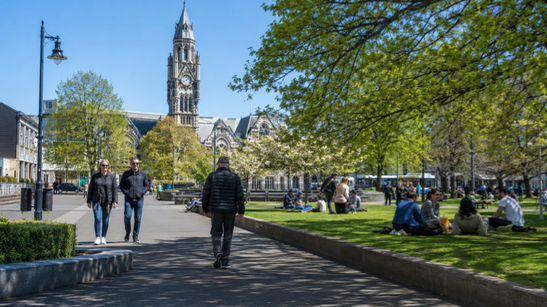
Ōtepoti Dunedin has once again come out on top in a major quality-of-life survey, with 83 percent of local participants rating their overall quality of life positively.
The result places Dunedin first among seven participating New Zealand centres for the second survey in a row, reinforcing the city’s reputation as a place where residents value their surroundings, neighbourhoods and access to green space.
But the picture is not entirely comfortable.
While most respondents reported a positive quality of life, the 2026 Rangahau te Korou o te Ora/Quality of Life Survey also identified familiar pressure points including the cost of living, housing affordability, traffic congestion, dangerous driving, rubbish and litter.
That combination makes the result more meaningful than a simple “best city” headline.
Dunedin residents appear broadly satisfied with where they live, but they are not blind to the problems around them.
Dunedin leads the seven-city survey
The survey included 5,725 people across Auckland, Hamilton, Tauranga, Wellington, Porirua, Hutt City and Dunedin.
Of those, 579 participants were from Dunedin.
The headline result was strong:
83 percent of Dunedin respondents rated their overall quality of life positively.
That was enough to give the city the highest result among the seven participating centres.
Mayor of Dunedin Sophie Barker said the result reflected what many locals already value about the city.
“It will come as no surprise to the people of Ōtepoti Dunedin, but it’s still hugely satisfying to see the positives of life in the South recognised in this way,” she said.
Barker pointed to Dunedin’s mix of history, culture, urban life, scenery and wildlife as part of what makes the city distinctive.
Key findings at a glance
| Measure | Dunedin result |
|---|---|
| Overall quality of life rated positively | 83% |
| Quality of life stayed the same over past 12 months | 49% |
| Quality of life improved | 24% |
| Quality of life declined | 27% |
| Local area has a positive look and feel | 62% |
| Green and open spaces are easy to access | 90% |
| Green spaces support wellbeing | 84% |
| Feel safe in the city centre during the day | 92% |
The figures show that Dunedin’s strongest advantage may not be one single service or amenity.
It is the overall package.
Residents are reporting high satisfaction with everyday life while also placing significant value on local surroundings and access to open space.
Green space appears to be one of Dunedin’s strongest assets
One of the clearest results was around access to nature.
Ninety percent of respondents said green and open spaces were easy to get to.
Another 84 percent said those spaces supported their wellbeing.
For a city surrounded by coastline, hills, reserves and natural landscapes, that is not especially surprising.
But it is still significant.
Access to parks, beaches, walking areas and open space increasingly matters in discussions about urban wellbeing.
It affects physical activity, stress, mental health, family life and whether people feel connected to where they live.
For Dunedin, the survey suggests this is one area where the city is performing particularly well.
Most residents feel safe in the CBD during the day
Another strong result was perceptions of daytime safety.
Ninety-two percent of respondents said they felt safe in the city centre during the day.
That is a useful measure because perceptions of safety strongly influence whether people use central-city businesses, public spaces and services.
A city centre can have good infrastructure and strong retail offerings, but if people do not feel comfortable spending time there, the wider urban experience suffers.
On this measure, Dunedin appears to be doing well.
But not everyone thinks life is getting better
The overall quality-of-life result is positive, but the year-on-year sentiment is more mixed.
Almost half of respondents, 49 percent, said their quality of life had stayed about the same over the previous 12 months.
Twenty-four percent said it had improved.
But 27 percent said it had declined.
That last figure matters.
A city can rank highly overall and still have a significant share of residents feeling that life is becoming harder.
The survey also highlighted housing affordability and the cost of living as factors affecting quality of life.
That reflects a broader national problem.
Even in places where people are happy with their environment, neighbourhood and community, household finances can still drag down their sense of security and wellbeing.
Everyday frustrations are still very visible
Residents also identified a number of common problems.
The most frequently cited issues included:
| Problem identified by residents | Percentage |
|---|---|
| Rubbish and litter | 76% |
| Dangerous driving | 74% |
| Vandalism | 64% |
| Traffic congestion | 62% |
| Theft and burglary | 54% |
These results provide an important counterbalance to the overall positive ranking.
They suggest people can like living in Dunedin while still being frustrated by what they see around them.
Rubbish and litter, in particular, stood out as the most frequently identified issue.
Dangerous driving was close behind.
Those are not abstract policy concerns.
They are highly visible parts of daily life and can shape how residents feel about neighbourhoods, roads and public spaces.
Traffic congestion remains a concern despite Dunedin’s size
It may seem surprising that 62 percent of respondents identified traffic congestion as a problem in a city much smaller than Auckland or Wellington.
But congestion is not only about population size.
It is also about road design, bottlenecks, construction, commuting patterns, school traffic and where jobs and services are concentrated.
For Dunedin, the result suggests residents are noticing pressure on parts of the network even though the city does not face the same scale of congestion as New Zealand’s largest centres.
That is exactly the kind of issue local government should be watching before it becomes more difficult to manage.
The result is good news, but not a free pass for council
Dunedin City Council is entitled to view the overall result positively.
Being ranked first for quality of life across participating centres for the second consecutive survey is a meaningful achievement.
But the survey also gives the council a practical to-do list.
The high-level result says residents like living in Dunedin.
The problem indicators say they still expect improvement.
That means maintaining quality of life cannot be treated as a finished job.
The city still has to deal with:
cost-of-living pressure
housing affordability
litter and rubbish
dangerous driving
vandalism
theft and burglary
traffic congestion
The challenge is preserving what residents already value while addressing the issues that could slowly undermine that satisfaction.
What makes Dunedin stand out
Dunedin’s strength appears to come from a combination of factors.
Residents have relatively easy access to green space.
They feel safe during the day in the central city.
Many people are satisfied with the look and feel of their local area.
The city has a strong sense of place, a visible heritage identity and close access to beaches, wildlife and natural environments.
It also has a large student population, established cultural institutions and a compact urban form.
Those qualities can create a lifestyle that feels different from larger metropolitan centres.
The survey suggests residents recognise that.
The next report will reveal who is benefiting most
A second, more detailed Dunedin report is expected in October 2026.
That will be important because citywide averages can hide substantial differences between groups.
The follow-up report is expected to break results down by:
age
ethnicity
gender
broad geographic area
That should provide a much clearer picture of whether Dunedin’s high overall quality-of-life rating is being experienced evenly.
For example, younger residents may feel differently about housing affordability.
Older residents may place more emphasis on accessibility and healthcare.
Different parts of the city may have different concerns around transport, safety or public spaces.
Those details will matter if the council wants to move beyond celebrating the headline figure and use the survey as a policy tool.
A strong result with a clear warning underneath
Dunedin has reason to be pleased with the 2026 result.
Eighty-three percent positive quality-of-life ratings, strong access to green space and high daytime safety perceptions are all substantial positives.
But the survey also shows that good quality of life is not permanent.
It can be eroded by housing costs, household pressure, poor urban maintenance and everyday frustrations if they are left unresolved.
The strongest message from the survey may therefore be this:
Dunedin residents still value their city highly.
They want to keep it that way.
And that means the council’s job is not only to celebrate what is working, but to make sure the problems residents are already identifying do not become the reasons future surveys tell a different story.
Source: Dunedin City Council and the 2026 Rangahau te Korou o te Ora/Quality of Life Survey.