New Zealand’s Emissions Trading Scheme is unlikely to deliver the country’s climate goals in its current form and could instead drive a much larger forestry estate that future generations will be required to maintain, the Parliamentary Commissioner for the Environment has warned.
Simon Upton released a new report on Wednesday examining the long-term future of the NZ ETS, one of the country’s central climate policy tools.
The report, Adrift: What future does the Emissions Trading Scheme have?, argues the scheme has reached a critical turning point and needs major reform, particularly in the way forestry is treated.
Upton said the issue was no longer whether reform would happen, but when.
“The NZ ETS is in need of major reform. It is a question of ‘when’, not ‘if’ reform happens,” he said.
“The role of forestry in particular needs a fundamental rethink if New Zealand is to have any hope of achieving its climate commitments and reducing the risks that the inclusion of forestry in the ETS has created.”
Current settings favour planting over cutting emissions
The report’s central concern is that the ETS is not generating carbon prices high enough to force major reductions in gross emissions.
Instead, the current design continues to encourage businesses and landowners to offset emissions by planting forests.
That may help New Zealand meet net emissions targets on paper, but the Commissioner says it also creates a long-term liability.
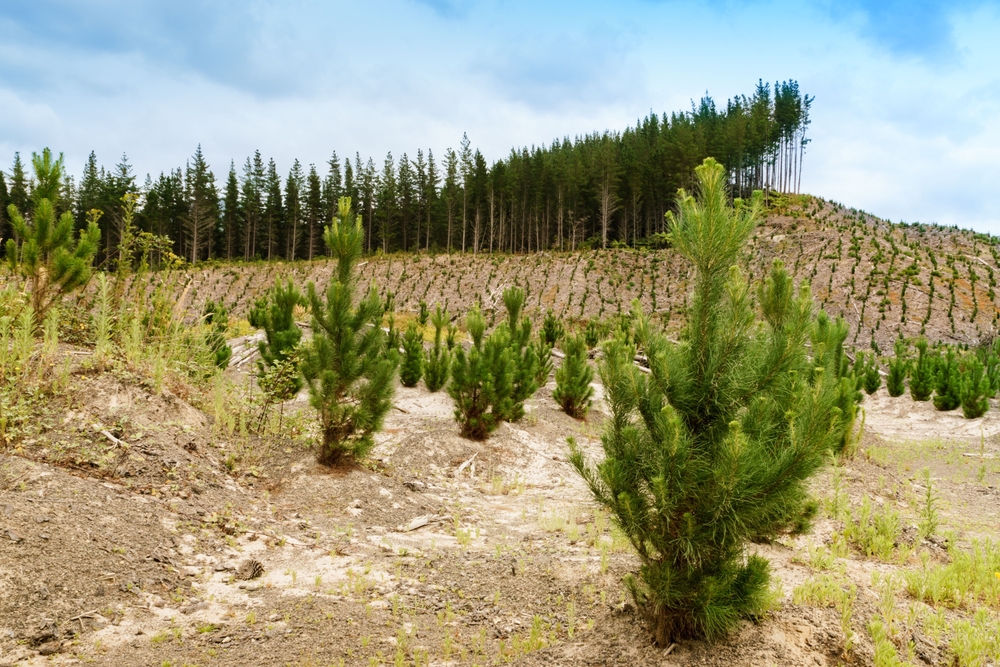
A much larger forestry estate would need to remain standing for decades and potentially generations.
Those forests would also be exposed to increasing risks from fire, disease, storms and other extreme weather events.
The concern is not that forestry has no role in climate policy.
Upton is clear that it does.
The question is whether forestry should continue to play such a dominant role inside the ETS itself.
“Forestry still has an important role to play in New Zealand’s climate policy,” he said.
“The question is not whether forestry has a role, it is whether that role should continue to be delivered through the NZ ETS.”
Why the distinction matters
The ETS is designed to put a price on greenhouse gas emissions.
Businesses covered by the scheme must surrender emissions units for the pollution they create.
Those units can come from several sources, including forestry.
When new forests absorb carbon dioxide, they can earn units that can then be sold to emitters.
The problem identified by the Commissioner is that if forestry credits remain plentiful and relatively cheap, companies may have less incentive to make deeper changes to reduce emissions directly.
That creates a tension between two climate goals.
One is reducing gross emissions, meaning the actual amount of greenhouse gases released.
The other is reducing net emissions, which allows emissions to be offset by carbon absorbed elsewhere, largely through forestry.
The Commissioner wants a much clearer national discussion about how those two objectives should be balanced.
What the Commissioner is recommending
The report does not prescribe a single replacement model.
Instead, Upton is calling for a comprehensive review of the ETS and a wider political and public discussion about what the scheme is actually expected to achieve.
His recommendations include three main areas.
| Recommendation | What it means |
|---|---|
| National discussion on ETS purpose | Clarify what outcomes New Zealand expects from the scheme and how gross and net emissions targets should relate |
| Full review of forestry’s role | Examine whether forestry should remain inside the ETS in its current form and consider incentives outside the scheme |
| Immediate rule changes | Make short-term changes to stop the current forestry problem from worsening while longer-term reform is developed |
The Commissioner argues those short-term changes are important because once more land moves into forestry under current incentives, reversing the consequences becomes more difficult.
Farmers, foresters and Māori landowners all affected
Any major reform would have consequences far beyond climate policy specialists.
The Commissioner specifically identifies farmers, foresters, Māori landowners, rural communities, businesses and consumers as groups likely to be affected.
Landowners have made investment decisions based on existing policy settings.
Forestry companies have responded to the value of carbon credits.
Farmers have had to consider whether converting land to forestry may deliver better returns.
Māori landowners may have long-term interests tied to both forestry and carbon income.
That means reform cannot simply ignore investments made under the current rules.
Upton says scheme participants are responding rationally to the incentives Government has created.
The challenge is therefore to redesign those incentives without creating unnecessary disruption or unfairly penalising people who acted under existing policy.
A risk for rural communities
The report also highlights the wider consequences of continued large-scale forestry conversion.
If more productive land is converted into permanent or long-term forestry, rural communities can change significantly.
Farming supports workers, contractors, rural schools, local shops and service businesses.
Forestry can also create jobs and investment, but its employment patterns and local economic effects can be very different.
That is why the ETS debate is not simply about carbon accounting.
It is also about land use, regional economies and what parts of rural New Zealand may look like several decades from now.
Climate policy needs a clearer long-term direction
One of the strongest messages in the report is that New Zealand needs to decide what it wants the ETS to do.
At present, the scheme is being asked to help deliver climate targets while also allowing large-scale forestry offsets.
The Commissioner believes that model risks avoiding the harder task of reducing emissions at source.
If businesses can continue buying relatively affordable forestry-backed units, major investments in low-emissions technology may be delayed.
The concern is that New Zealand could become increasingly dependent on forests to balance its carbon accounts rather than transforming the sectors responsible for emissions.
That dependence also creates future risk.
If forests are damaged by fire, disease or extreme weather, the carbon stored in them can be released again.
Maintaining a very large forestry estate therefore becomes a long-term national obligation.
Upton warns against waiting
The Commissioner’s strongest warning is about delay.
He says the longer the Government waits, particularly on forestry settings, the more difficult and expensive reform becomes.
“Waiting longer to address the issues, especially around forestry, will only make them harder and more expensive to solve,” Upton said.
“Reform is, in my view, inevitable. We cannot let the problem get worse in the meantime.”
The report now puts pressure on the Government to decide whether it will open a comprehensive review of the ETS.
It also raises a broader political question ahead of future climate policy decisions.
Should New Zealand continue relying heavily on forestry offsets, or should the ETS be redesigned to put much stronger pressure on businesses and sectors to cut actual emissions?
The Commissioner’s answer is clear.
Forestry should remain part of climate policy, but the current system is no longer sustainable enough to leave untouched.
Source: Parliamentary Commissioner for the Environment, Adrift: What future does the Emissions Trading Scheme have?, released 26 August 2026.