
Auckland’s City Rail Link is about to face one final emergency test before passengers start using the new underground network on 13 September.
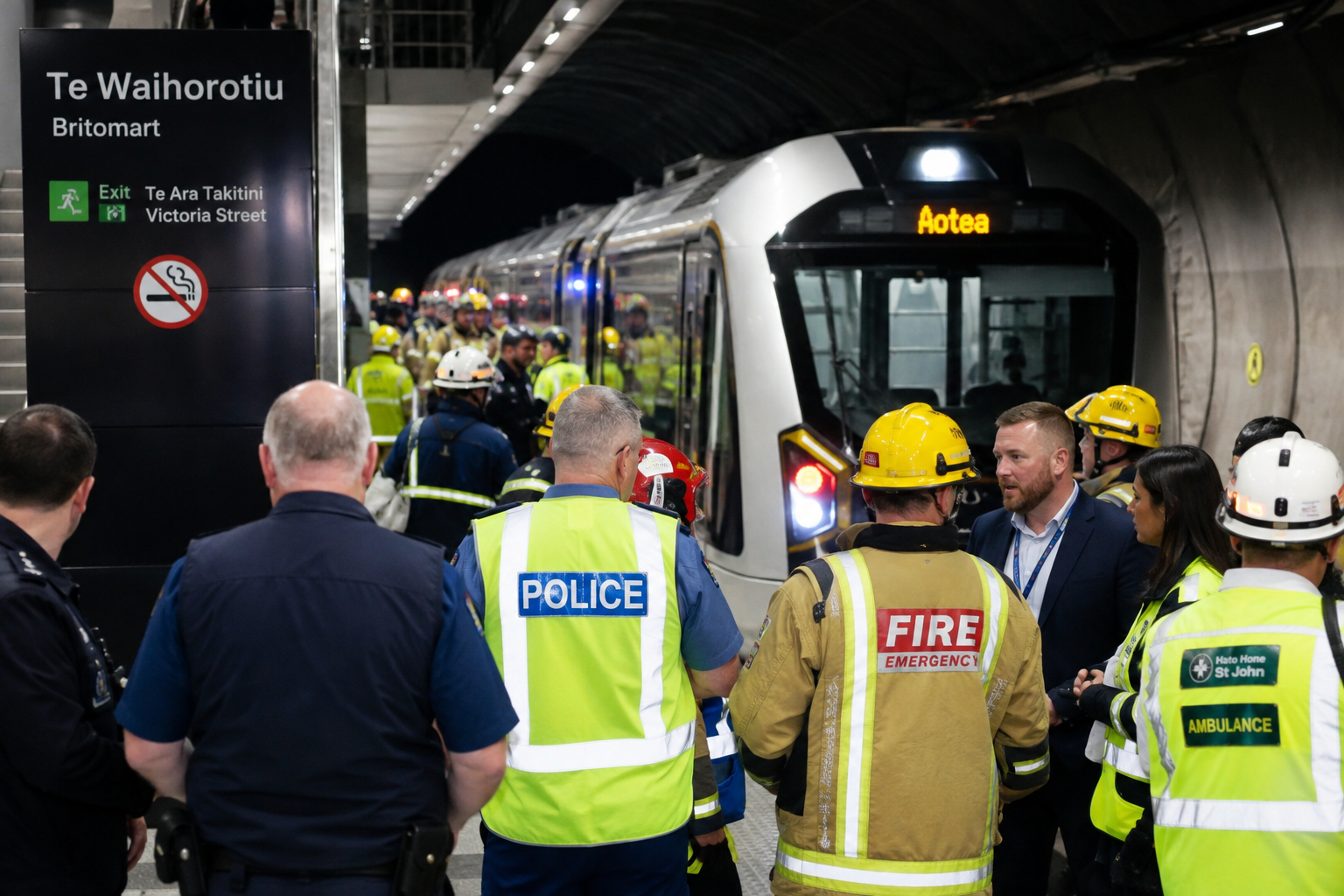
Emergency services and rail staff will carry out a major multi-agency exercise this week, simulating a fire on a train near Te Waihorotiu Station.
Fire and Emergency New Zealand, New Zealand Police and Hato Hone St John will work alongside train and station staff during the exercise.
The aim is simple: make sure everyone knows exactly what to do if something goes wrong underground.
Why this matters
The City Rail Link is unlike anything currently operating on New Zealand’s rail network.
Parts of the tunnels sit more than 40 metres below ground.
That creates very different challenges from responding to an incident on an ordinary above-ground train line.
Emergency crews may have to deal with:
limited access points
smoke in enclosed tunnels
large numbers of passengers
people with mobility or health needs
low lighting
communication difficulties underground
evacuation across multiple stations
train failures or derailments inside tunnels
This week’s exercise is not a formal requirement, but it is intended to give emergency responders another chance to practise working together before the network opens to the public.
What will happen in the final exercise?
The scenario will involve a simulated fire on a train near Te Waihorotiu Station.
Emergency responders will have to assess the incident, enter the underground environment, coordinate with rail staff, manage passengers and test communication between agencies.
Hato Hone St John Area Operations Manager Kim Moser said the exercises have been particularly useful for ambulance personnel.
“For Hato Hone St John, this testing has been an important opportunity for our ambulance personnel to build familiarity with the CRL’s new underground environment and practise coordinated responses alongside our emergency service and transport partners.”
That familiarity matters because in a real emergency, responders may have only minutes to make decisions.
This is not the first test
The final exercise comes after a much larger emergency testing programme completed last month.
More than 1,400 volunteer passengers took part.
Around 200 personnel and more than 50 emergency service vehicles were involved across the programme.
A total of 15 live exercises were carried out.
Some were relatively small drills.
Others involved more than 300 participants at once.
What scenarios have already been tested?
Emergency teams have already practised responses to a wide range of situations.
| Scenario | What was tested |
|---|---|
| Station fire | Evacuation, smoke control and emergency response |
| Train failure in tunnel | Passenger management and access for crews |
| Derailment | Multi-agency response and tunnel evacuation |
| Medical emergency | Ambulance access and patient treatment |
| Mass evacuation | Crowd movement across stations and tunnels |
| Low-light conditions | Safety and navigation during reduced visibility |
| Smoke-filled carriage | Real-time decision-making and passenger removal |
| Multiple stations involved | Coordination between different teams and control rooms |
The testing went beyond what passengers would see.
Behind-the-scenes systems were also checked, including ventilation, smoke extraction, alarms, CCTV, communications, lighting and control room operations.
Who is responsible during a real emergency?
The City Rail Link will involve several different organisations.
KiwiRail will lead and coordinate emergency responses in the tunnels through its Auckland Rail Operations Centre.
Auckland One Rail will respond to unplanned events on trains and inside CRL stations.
Emergency services will then provide specialist support depending on the incident.
This division of responsibility is important because underground emergencies can quickly become complex.
A train operator may be first to identify the problem.
Station staff may need to move passengers.
Control rooms may need to manage power, ventilation and train movements.
Police, Fire and Emergency New Zealand or Hato Hone St John may then need to enter the site.
All of those groups have to work from the same plan.
Why volunteers were part of the testing
One of the strongest parts of the programme was the effort to make the exercises feel realistic.
Volunteer passengers reflected Auckland’s actual commuter population.
That included:
older people
people with health conditions
people with limited English
people with hearing difficulties
people with visual impairments
people with mobility needs
More than 75 actors were also used to simulate situations that could not easily be recreated naturally.
Some participants were given little or no warning about what was going to happen.
That allowed organisers to observe how people actually reacted to smoke, simulated injuries, low lighting and crowd movement.
This is important because emergency plans that work perfectly on paper may behave very differently when hundreds of real people are involved.
Fire crews are still training
Fire and Emergency New Zealand has continued carrying out site visits in the weeks before opening.
Region Manager Ron Devlin said Aucklanders may have noticed fire trucks parked outside the new stations.
“There’s no need for concern, we’re simply giving as many crews as possible the opportunity to familiarise themselves with the new environment.”
Any fire crew across Tāmaki Makaurau could potentially be called to a CRL emergency.
That means familiarity cannot be limited to a small specialist team.
What Auckland Transport says
Auckland Transport General Manager Rail Services Mark Lambert said the testing programme has helped build confidence that the system is ready.
“The City Rail Link is unlike anything else in New Zealand's rail network, so it has been vital for everyone involved to practise how we would respond in a range of different situations.”
The point is not to pretend emergencies will never happen.
It is to make sure that if they do, the response is fast, coordinated and familiar.
The challenge of being 40 metres underground
City Rail Link Ltd Chief Executive Patrick Brockie said the depth of the tunnels creates unique emergency challenges.
Access can take longer.
Evacuation routes are different.
Radio and mobile communication may be more complicated.
Passengers may need to move long distances underground before reaching a safe exit.
Smoke can also behave differently inside enclosed spaces.
That is why the CRL has been tested as a complete system rather than simply as a railway.
The safety of passengers depends on trains, stations, ventilation, emergency services, communications and staff all working together.
Key numbers before opening
| Measure | Figure |
|---|---|
| Passenger opening date | 13 September 2026 |
| Volunteer passengers in testing | More than 1,400 |
| Live exercises completed | 15 |
| Emergency and rail personnel involved | Around 200 |
| Emergency service vehicles involved | More than 50 |
| Actors used | More than 75 |
| Largest exercise size | More than 300 participants |
| Tunnel depth in some areas | More than 40 metres |
What commuters should know
Passengers do not need to do anything special before the CRL opens.
But the emergency testing is a useful reminder that underground rail behaves differently from ordinary commuter trains.
If an emergency ever occurs, passengers should follow instructions from train staff, station staff and emergency responders rather than trying to leave independently.
Emergency exits, station announcements, lighting and ventilation systems have all been designed as part of the wider safety system.
The bottom line
The City Rail Link opening on 13 September will be a major change for Auckland public transport.
Much of the public attention will naturally focus on faster journeys, new stations and the transformation of the rail network.
But beneath that sits another question that matters just as much:
What happens when something goes wrong?
The final emergency exercise this week is designed to test exactly that.
After 15 live drills, more than 1,400 volunteer passengers and months of emergency service familiarisation, Auckland’s rail agencies say they are confident the system is ready.
The real measure of that preparation will hopefully never be needed.
But with trains soon carrying thousands of passengers through tunnels more than 40 metres below the city, being ready for the unexpected is not optional.
Source: City Rail Link emergency preparedness announcement, 25 August 2026.