By Webfit News
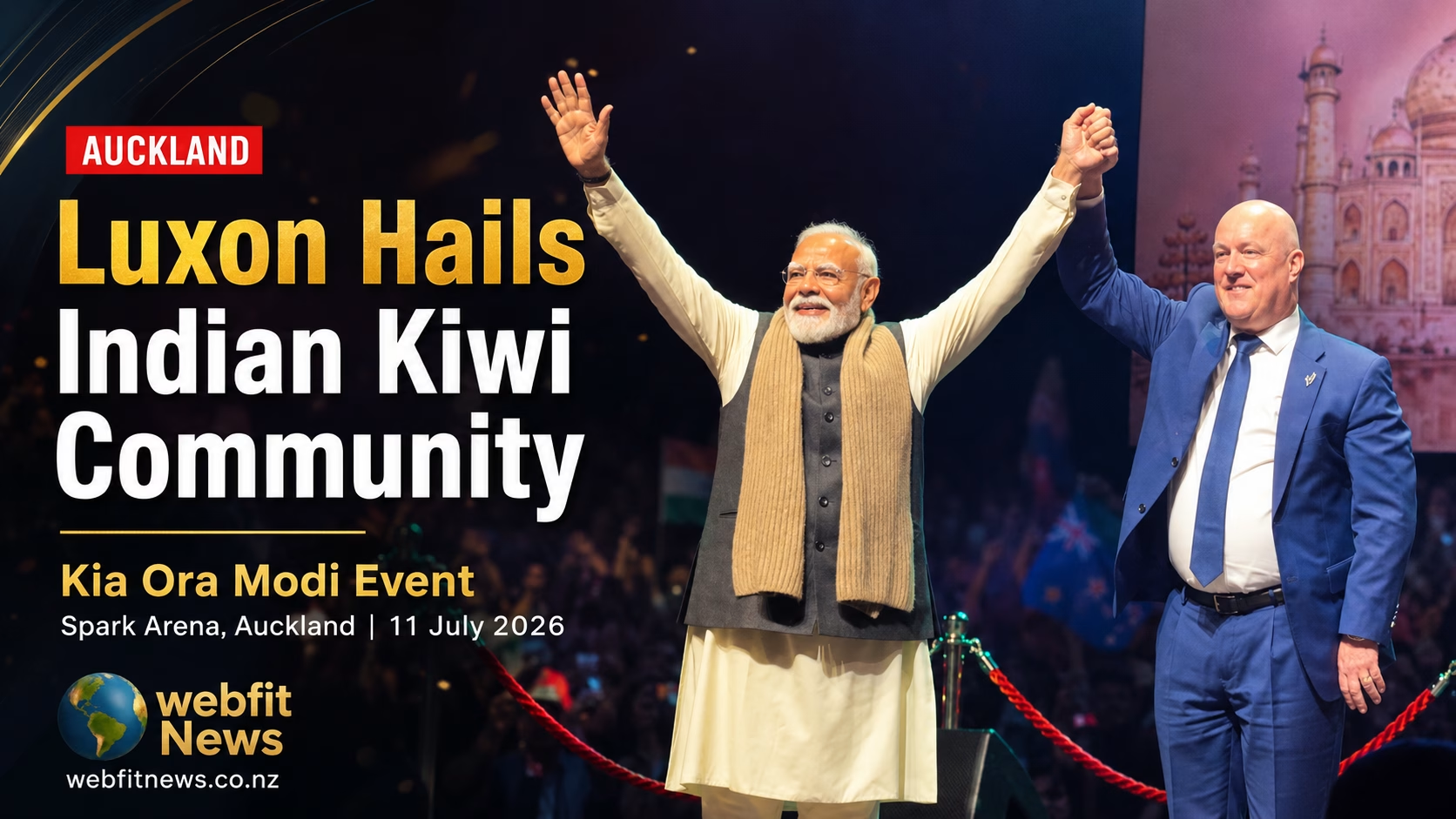
Prime Minister Christopher Luxon delivered an energetic and strongly pro-India address at the Kia Ora Modi event at Spark Arena in Auckland on 11 July 2026, welcoming Indian Prime Minister Narendra Modi and paying tribute to New Zealand’s growing Indian community.
Speaking before a crowd of more than 10,000 people, Luxon described the atmosphere inside Spark Arena as unlike anything he had previously experienced at the venue.
“What an amazing crowd. What incredible energy we have here in this room,” Luxon told the audience.
The Prime Minister said the night marked a significant moment in New Zealand’s relationship with India, highlighting that it was the first visit by an Indian Prime Minister to New Zealand in 40 years.
“Tonight, New Zealand makes history,” Luxon said.
“That is far too long between visits from family.”
Police Flood Auckland’s Karangahape Road After Bar Brawl and Crowd Dispersal – WebfitNews
Addressing Modi directly, Luxon added that, on behalf of New Zealanders, the Indian Prime Minister had been “worth the wait”.
Spark Arena Becomes a Symbol of India-New Zealand Friendship
Luxon repeatedly returned to the idea of the Indian diaspora acting as a bridge between India and New Zealand.
He recalled his visit to Delhi and said Modi had described the Indian community in New Zealand as a “living bridge” between the two nations.
“Tonight, standing in this room, we see that bridge in full,” Luxon said.
The speech was delivered before a highly enthusiastic audience, with many attendees travelling from different parts of New Zealand to attend the event.
Luxon described the gathering not simply as a large crowd, but as a family reunion that had been waiting four decades.
He said the friendship between India and New Zealand had never been stronger.
Luxon Reflects on His First Experience of India
The Prime Minister also shared a personal story about his first visit to India long before entering politics.
Luxon said he was in his mid-20s and working as a young executive with Hindustan Lever, part of the Unilever business, when he first travelled to India.
He recalled seeing workers being paid at the end of the day, often receiving wages in coins.
According to Luxon, the India he first experienced was a country full of energy, talent and potential, but still a low-income nation.
He then contrasted that memory with the India he sees today.
“Look at India today,” Luxon told the audience.
He said every visit to India had left him impressed by the country’s energy, dynamism and innovation.
Luxon gave significant credit to Modi’s leadership for India’s economic and infrastructure transformation.
“It is the transformation that Prime Minister Modi has led that takes my breath away,” he said.
Luxon Praises India’s Economic Transformation
During his speech, Luxon pointed to India’s expanding middle class and rising living standards.
He said India now had a middle class of around 445 million people and argued that greater incomes had allowed families to improve their quality of life.
Luxon spoke about families being able to afford better food, travel, education for their children and savings for retirement.
“That is not a small thing,” he said.
“That is one of the greatest advances in human dignity the world has ever seen.”
Luxon also referred to major developments in poverty reduction, aviation, road infrastructure and space exploration.
Citing figures during his speech, he said around 250 million Indians had been lifted out of poverty over the past decade.
He said the number of airports in India had more than doubled to 157 and around 95,000 kilometres of new highways had been built.
Using a distinctly New Zealand-style comparison, Luxon joked that the length of those highways would be enough to drive from New Zealand to India and back several times.
The Prime Minister also highlighted India’s Chandrayaan-3 mission, which achieved a landing near the Moon’s south polar region.
Luxon said India’s growing economic influence meant the country would play a defining role in the future.
“The 21st century will be shaped by India, and New Zealand wants to help build that future,” he said.
Free Trade Agreement Takes Centre Stage
A major part of Luxon’s speech focused on trade and the economic relationship between New Zealand and India.
Luxon referred to the New Zealand-India Free Trade Agreement as a historic achievement between the two governments.
He said many people had previously believed a free trade agreement between India and New Zealand was not possible.
“Prime Minister Modi and I did it,” Luxon told the audience.
“We got that deal done in record time.”
Luxon said the agreement would create opportunities for New Zealand exporters and Indian businesses operating in New Zealand.
“India is not just a country we trade with. It is a country that we grow with, and most importantly, it is a country we trust,” he said.
The Prime Minister argued that stronger economic ties between the two nations could lead to more jobs, higher incomes and better opportunities.
His comments reflected the wider theme of the evening, with both leaders presenting the Indian diaspora as a central part of the future New Zealand-India relationship.
Strong Tribute to New Zealand’s Indian Community
One of the strongest parts of Luxon’s speech was his tribute to New Zealand’s Indian community.
He told the audience that Indian New Zealanders had enriched the country economically, socially and culturally.
“Without you, we simply wouldn’t be the New Zealand we are today,” Luxon said.
He described New Zealand as a multicultural country built by hopeful and hardworking people determined to create better lives for themselves, their families and their communities.
Luxon said he had personally witnessed the work ethic of Indian migrants.
He spoke about people working long hours, sometimes holding two or three jobs, to save for a first home, launch a business or give their children opportunities they themselves had not enjoyed.
According to figures cited by Luxon in the speech, New Zealand’s Indian community of around 330,000 people contributes approximately $37 billion to the economy annually and supports about 220,000 jobs.
Luxon said the community’s economic impact extended across multiple sectors and professions.
However, he deliberately moved beyond financial statistics to describe the Indian community’s contribution through everyday New Zealand life.
‘This Community Is Already Part of Your Story’
Luxon used a series of personal examples to illustrate how Indian New Zealanders had become part of the country’s social and economic fabric.
He spoke about the nurse holding a patient’s mother’s hand during a night shift when family could not be present.
He mentioned doctors working in emergency departments in the early hours of the morning and GPs caring for children.
He spoke about dairy owners who know their customers, families who take risks to start businesses and employ others, accountants helping people manage their finances and engineers designing the roads New Zealanders use.
Luxon also recognised IT professionals supporting banks and hospitals, as well as teachers standing in front of New Zealand children every day.
“In a thousand quiet ways, most of us barely stop to see, this community, the Indian Kiwi community, is helping hold up the New Zealand that all of us call home,” Luxon said.
He described that as the “real contribution” of the Indian community.
“You are a great example and an inspiration to every New Zealander,” he said.
On behalf of himself, his government and the country, Luxon thanked Indian New Zealanders for their contribution.
A Warm Introduction for Narendra Modi
Luxon concluded his speech with a highly personal and enthusiastic introduction for Prime Minister Narendra Modi.
He described Modi as a leader who had risen from humble beginnings to lead the world’s largest democracy.
Luxon praised Modi’s role in India’s transformation and called him one of the most important leaders of the modern era and a true friend of New Zealand.
“Prime Minister, thank you for making this historic journey,” Luxon said.
“Thank you for seeing what we have always known, that this community and this friendship is something truly extraordinary.”
Luxon then called on the Spark Arena crowd to welcome Modi, prompting loud applause and cheers across the venue.
A Speech Built Around Community, Trade and Trust
Christopher Luxon’s Kia Ora Modi speech was more than a formal diplomatic welcome.
It was a clear statement about how his government views India, the Indian diaspora and the future of the bilateral relationship.
The speech connected India’s economic rise with New Zealand’s own opportunities, while placing Indian New Zealanders at the centre of the relationship between the two countries.
Luxon’s message was direct: India is becoming increasingly important to New Zealand, not only as a trading partner, but as a country with which New Zealand wants to build a deeper and more trusted long-term relationship.
At the same time, his strongest praise was reserved for the Indian Kiwi community.
For the thousands gathered inside Spark Arena, the message was unmistakable.
The New Zealand Prime Minister was telling them that their contribution was seen, recognised and valued.
And on a night designed to celebrate the arrival of Narendra Modi in Auckland, Christopher Luxon used the stage to make an equally important point about the people connecting India and New Zealand every day.
Video coverage: Webfit News
References
Christopher Luxon speech at the Kia Ora Modi event, Spark Arena, Auckland, 11 July 2026.
Webfit News video coverage of the Kia Ora Modi event.