
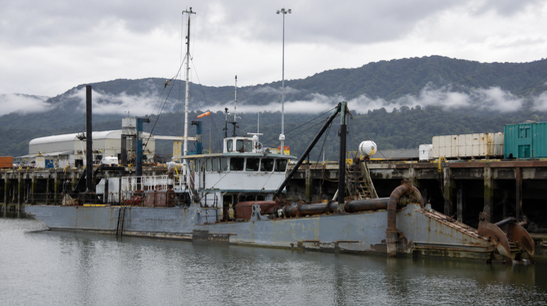
Buller District Council has completed the sale of the Kawatiri dredge, ending years of uncertainty over the ageing vessel and removing a substantial stream of ongoing costs and financial risk for ratepayers.
The dredge has been sold for $50,000, but the total financial recovery linked to the disposal is about $347,279 once the insurance settlement, remaining diesel and spare parts are included.
The decision does not erase the Council’s existing dredge-related debt, which remains at approximately $3.37 million. What it does remove is the need to keep paying to maintain, preserve, insure and potentially repair a vessel that Council says no longer had enough work to justify its cost.
For Buller ratepayers, that distinction matters.
The debt stays.
The exposure does not.
A vessel that had become increasingly difficult to justify
The Kawatiri has been part of Westport Harbour since the 1980s, where it played an important role in keeping the harbour navigable while Holcim operated its cement business from Westport.
That changed after Holcim closed its Westport operation in 2016.
Council records show the dredge then went for 12 months without work, and in August 2017 Council resolved to sell it because the loss of purpose and financial strain made continued ownership difficult to justify.
No buyer was found at the time, so the dredge remained in Council ownership.
Nine years later, the same economic problem had not gone away.
Mayor Chris Russell said there was still no level of demand capable of economically supporting the vessel.
“Council decided to sell the Kawatiri in 2017, but no buyer was found and the dredge remained in Council ownership,” he said.
“Nine years later, there was still no level of demand that could economically justify the continuing costs and risks.”
The real cost was not the $50,000 sale price
On the surface, selling a major piece of marine equipment for $50,000 may look modest.
But the Council’s decision was driven less by the sale price and more by the costs it was avoiding.
The financial recovery comprised:
| Component | Approximate value |
|---|---|
| Sale of Kawatiri | $50,000 |
| Insurance settlement | $212,445.93 |
| Remaining diesel | $80,833 |
| Spare parts | $4,000 |
| Total recovery | $347,279 |
Council’s internal review identified significant annual and potential costs if the vessel remained in its ownership.
Annual maintenance and compliance costs were estimated at between $100,000 and $200,000.
Engine and system preservation was estimated at about $25,000 a year.
Lay-up costs were estimated at approximately $299,812 annually.
Potential repairs needed to return the dredge to operational service were estimated at between $165,550 and $400,000.
That meant the financial question was not simply whether Council could achieve a better sale price.
It was whether holding out for one would expose ratepayers to even more cost.
Insurance was becoming another major risk
Time was also working against the Council.
The Council had been advised that insurance was unlikely to be renewed after 1 November 2026 if the Kawatiri remained laid up and not operating.
Its internal review also identified the possibility that Buller District Council could be left carrying the full liability if an accident occurred while the vessel was uninsured.
The dredge was also continuing to deteriorate while laid up, potentially reducing its future value and making eventual disposal more difficult.
For Council, continuing to wait therefore carried several risks at once:
more maintenance spending
continued preservation and compliance costs
deteriorating asset condition
potentially losing insurance cover
further reduction in resale value
the possibility of eventually having to scrap the vessel at additional cost
That calculation eventually pushed disposal to the top of the list.
Council tested several options before selling
The decision followed an extensive review rather than an immediate disposal.
Council considered continuing to operate the vessel, chartering it, retaining it for future work, selling it through a broker, stripping and scrapping it, or disposing of it through other means.
A broker marketed the Kawatiri with a guide price of $1.5 million, based on its insurance value, but interest was limited and no enquiries developed into a viable sale.
Council staff concluded the prospects of selling the dredge for continued operation were low because of its age and condition.
A direct offer was eventually received from Australian operator Little Big Ships Pty Ltd for an “as is” purchase at $50,000, with negotiations also covering the diesel remaining on board.
The internal report described the offer as serious and capable of being completed quickly.
That speed mattered because each additional month of ownership carried more cost and risk.
Why Council did not wait for a higher offer
One option was to leave the dredge on the market with a broker for another six months.
That might have produced a higher sale price.
But it also came with a fixed broker fee of $65,000 if a sale was achieved, together with continued maintenance, compliance and insurance uncertainty.
There was also no guarantee another buyer would emerge.
Council staff considered the $50,000 offer likely to be the best realistic option given the vessel’s age, condition and low market interest.
That makes the transaction less about extracting the maximum possible sale value and more about stopping further losses.
Scrapping or scuttling was considered, then rejected
Council also examined whether it could strip, scrap or scuttle the Kawatiri.
That option was judged impractical.
The internal report identified specialist disposal costs, hazardous material removal, landfill expenses and regulatory requirements.
Intentionally sinking a vessel would also be treated as marine dumping and require consent, environmental preparation and removal of fuels, oils, plastics and other contaminants.
Council concluded that those options could easily cost more than any value recovered from the vessel.
In one section of the report, staff listed no identifiable advantages to the strip, scrap and scuttle option.
The $3.37 million question
The most important figure in the story may not be the sale price at all.
It is the approximately $3.37 million of dredge-related debt that remains.
The sale does not extinguish that liability.
That means ratepayers are still carrying the financial legacy of the vessel.
Council’s argument is that continuing to own it would have made that position worse by adding new operating and preservation costs to an already substantial debt burden.
Russell acknowledged that reality directly.
“The existing debt remains, but what we have stopped is ratepayers continuing to carry the substantial ongoing costs and risks of retaining the dredge,” he said.
That is an important distinction in judging the sale.
The transaction is not a financial windfall.
It is a damage-limitation decision.
Westport will still be able to dredge
One of the obvious questions is whether selling the Kawatiri leaves Westport without the ability to maintain its harbour.
Council says it does not.
The Bell Pump, which is used for dredging work, has been retained by Buller District Council and was not included in the sale.
Council staff have identified vessels capable of carrying and operating the pump when dredging is required.
One option identified in the internal review is the Patiki, operated by Nautilus Pacific in the Marlborough Sounds.
Council says vessels of this type can be hired when required at a lower cost than retaining the Kawatiri permanently.
The Bell Pump is also expected to be available for future harbour maintenance work.
Moving from ownership to contracting
That represents a change in operating model.
Instead of owning and maintaining a specialised dredging vessel year-round, Council can contract a suitable vessel when dredging is actually needed.
For a harbour with intermittent dredging requirements, that may prove substantially more economical.
Russell said this was a key part of the decision.
“Westport’s future dredging requirements can still be met,” he said.
“We have retained the Bell Pump and can contract suitable vessels when the work is needed.”
“It is a more practical approach. We retain the capability we need without ratepayers carrying the continuing cost and risk of owning the Kawatiri.”
The decline in demand began years ago
The Kawatiri’s financial problem was closely linked to changes in Westport Harbour activity.
Holcim’s closure removed a major source of regular work.
There were later expectations that Westland Mineral Sands could generate activity through the transport of mineral sands from Westport.
But the grounding of the Manahau barge in August 2024 created uncertainty over when that service would return.
The dredge did undertake some work linked to the Roll-on Roll-off project and some out-of-port activity.
However, the additional work Council had hoped for did not materialise at a level sufficient to support the economics of continued ownership.
Not considered a strategic asset
Council’s internal assessment also made a broader point about what role a district council should play.
It stated that dredging is not a core Council function, that Buller District Council did not have dedicated internal expertise to manage the dredge, and that the Kawatiri was not classified as a strategic asset.
Selling it therefore allows port staff to focus on port activities rather than managing a specialist vessel with high technical and compliance demands.
That may ultimately prove as important as the direct financial savings.
A difficult ending for a vessel with a long history
The decision is not without sentiment.
The Kawatiri served Westport Harbour for decades and was closely associated with a period when the port supported substantial commercial activity.
Council has acknowledged the vessel’s role and the contribution of the people who operated and maintained it throughout its service life.
But infrastructure can reach a point where history and economics pull in different directions.
For Buller District Council, that point appears to have arrived.
What ratepayers should take from the sale
The sale does not solve every financial issue surrounding the Kawatiri.
The $3.37 million debt remains.
The $50,000 sale price is modest.
And future harbour dredging will still cost money.
But the Council has removed a vessel that could have continued costing hundreds of thousands of dollars each year while declining in value and potentially becoming uninsurable.
The practical calculation is straightforward.
Buller has chosen to retain the dredging capability it actually needs while giving up ownership of the expensive vessel that carried it.
After nearly a decade of trying to find a sustainable future for the Kawatiri, Council has finally closed that chapter.
For ratepayers, the real test will be whether the new contracted approach keeps Westport Harbour functioning while preventing the next round of avoidable costs.
Source: Buller District Council media release and Council report on disposal options for the Kawatiri dredge, 2026.