
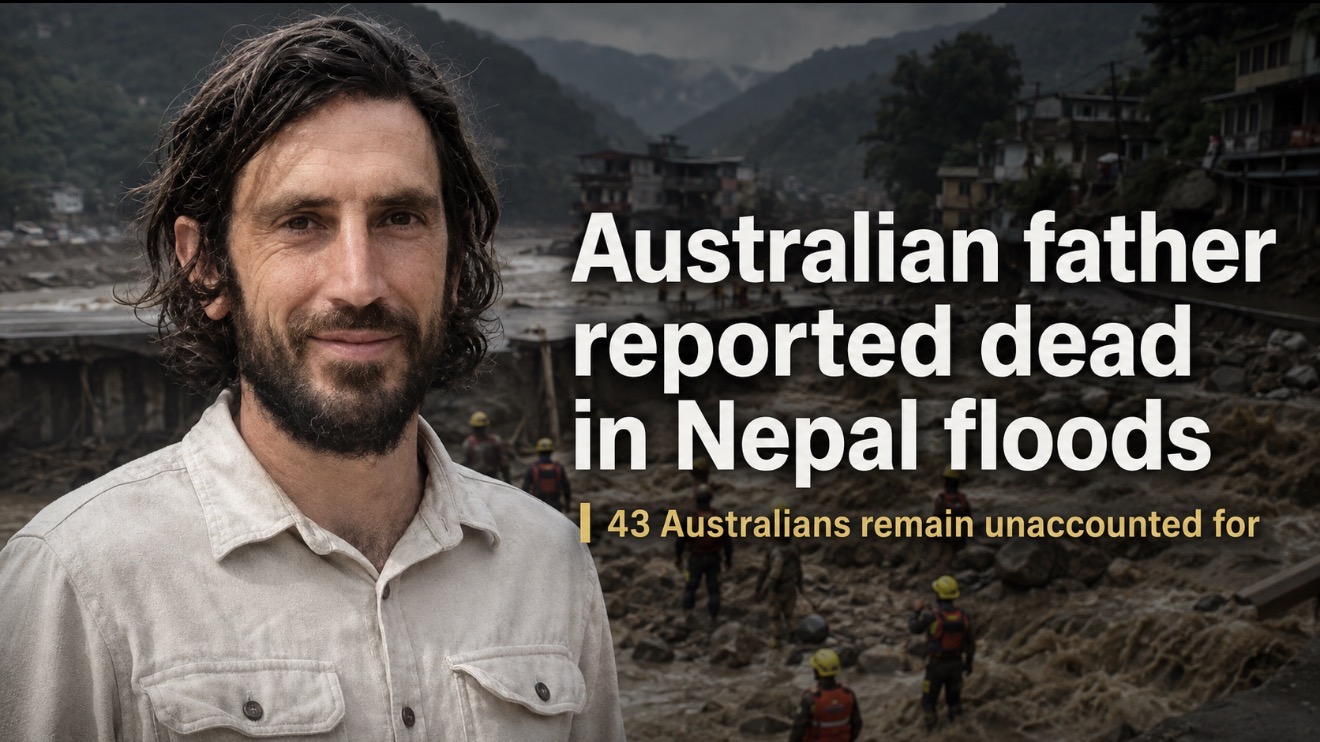
The scale of Nepal’s devastating flash flood disaster is becoming clearer by the day, with families across Australia and New Zealand waiting desperately for news of loved ones while rescuers race to reach hundreds of workers feared trapped inside damaged hydropower tunnels.
Michael Keats, a 37-year-old father from Mollymook on the New South Wales South Coast, has become the first Australian reported by his family to have died in the disaster.
Keats had been travelling through the Himalayan region after taking part in a pilgrimage to Mount Kailash and was expected to continue to India for a spiritual retreat.
His partner and family have publicly spoken about his death, although Australian Foreign Minister Penny Wong said on Tuesday that the Australian Government had not yet received official confirmation.
“Our thoughts are with Mr Keats’ family and the families of all Australians who remain unaccounted for,” Wong said.
She confirmed that 43 Australians were still unaccounted for as search operations continued across Nepal and areas near the Nepal-China border.
Families waiting for answers
For the families of those still missing, the disaster has become an agonising wait.
Many of the foreign travellers caught in the floods had been visiting the Himalayan region for trekking, tourism or spiritual pilgrimages, including journeys connected with Mount Kailash.
Australian authorities say concern is growing as time passes without confirmed information about the missing.
Wong said every hour and every day without news increased fears for those who remained unaccounted for.
The situation is also deeply relevant to New Zealand.
Five New Zealanders remain missing following the floods, according to information reported from New Zealand’s Ministry of Foreign Affairs and Trade.
Among those publicly identified are Hamilton couple Mihir and Kinnari Patel, Aucklander Dejan Kuzmic and Suhasini Reddy, whose family travelled to Kathmandu seeking answers.
MFAT has said there was still no verified information confirming the whereabouts of the missing New Zealanders and described conditions on the ground as bleak.
Fifteen New Zealanders registered on SafeTravel in Nepal had been contacted and confirmed safe.
Community Relief Appeal
Webfit News, through Good Cause, has launched the Nepal Flash Flood Relief Appeal 2026 to support people and communities affected by the disaster.
Those who wish to contribute can donate any amount that feels right. Even a small contribution can help when many people come together.
Donate here:
https://goodcause.webfitnews.co.nz/campaigns/nepal-flash-flood-relief-2026
If you are not in a position to contribute, sharing the appeal may help it reach someone who can.
Hundreds feared trapped in hydropower tunnels
Away from the search for tourists, one of the most difficult rescue operations is taking place underground.
Around 933 workers and employees connected with hydropower projects have been reported missing or unaccounted for across some of the worst affected parts of Nepal.
Authorities believe hundreds may be trapped inside tunnels that were filled or blocked by mud, rocks and flood debris.
The Upper Trishuli-1 hydropower project has become one of the main focuses of the rescue effort.
Hundreds of people working at the site were initially reported missing, although more than 250 workers have since been rescued.
At other projects, rescuers have been forced to use heavy machinery, specialist tunnelling equipment and controlled blasting to try to reopen entrances buried by debris.
International teams, including specialists from India and China, have joined Nepalese rescuers as the operation becomes increasingly technical and dangerous.
The rescue effort is complicated by unstable terrain, damaged roads, continuing weather concerns and the sheer volume of mud and rock deposited through the river corridor.
At some locations, authorities have been unable to enter tunnels because they are completely filled with debris.
Disaster has affected Nepal and Tibet
The flash floods struck on 26 August along the Nepal-China border region.
The disaster followed a major collapse involving ice, rock and glacial material in the Himalayas, which sent an enormous volume of water and debris into river systems below.
Entire sections of roads, villages, hotels, bridges and hydropower infrastructure were destroyed or buried.
More than 900 deaths have been reported across Nepal and Tibet, with thousands of people still missing.
Because rescue and recovery operations remain active, casualty figures are continuing to change.
The disaster has also affected large numbers of international visitors who were travelling through the region at the time.
New Zealand upgrades travel warning
New Zealand’s SafeTravel service has upgraded its advisory for the Nepal-Tibet border area to Level 4: Do Not Travel.
New Zealanders in affected areas have been advised to move away from rivers and low-lying land, follow local evacuation instructions and avoid travelling into flood-damaged regions.
SafeTravel has specifically warned against travel through several affected routes while authorities continue rescue and recovery work.
Anyone concerned about a New Zealander in the affected region can contact New Zealand’s 24-hour consular emergency line on +64 99 20 20 20.
New Zealand commits humanitarian assistance
New Zealand has also committed NZ$2 million in humanitarian assistance following the disaster.
According to information reported from MFAT, $1 million will go to the Nepal Red Cross Society to provide emergency shelter, water, sanitation and assistance reconnecting families separated by the disaster.
A further $1 million has been allocated for international humanitarian organisations supporting relief and early recovery efforts.
New Zealand officials have also been deployed in Kathmandu and are working with hospitals, police, emergency authorities and local tour operators.
A rescue operation where time matters
The search has now entered an increasingly difficult stage.
For tourists missing along destroyed roads and border areas, rescuers are searching through vast deposits of mud, damaged buildings and inaccessible terrain.
For workers trapped at hydropower sites, teams are attempting to reach spaces deep inside blocked tunnels without causing further collapses.
And for families in Australia, New Zealand, Nepal and many other countries, every new rescue brings hope while every passing day without information makes the situation harder.
Michael Keats’ family is now among those grieving while many others continue waiting for confirmation about loved ones who have not returned.
The full human cost of the disaster may not be known for some time.
For now, rescue teams from Nepal and supporting countries continue working through some of the most difficult conditions imaginable, while families thousands of kilometres away wait for the phone call that could change everything.
References
Australian Minister for Foreign Affairs, Penny Wong, interviews regarding Australians missing following the Nepal flood disaster, 1 September 2026.
New Zealand SafeTravel, Nepal Flash Flooding advisory, updated 29 August 2026.
New Zealand Ministry of Foreign Affairs and Trade information regarding missing New Zealanders and humanitarian assistance.
Reuters reporting on rescue operations at Nepal hydropower sites.
Associated Press reporting on the Nepal and Tibet flood disaster.
Al Jazeera reporting on Nepal hydropower workers and international rescue operations.