By Webfit News Desk
In a world already on edge, the latest high-level defence talks between Australia and New Zealand are raising serious questions about the region’s future role in global conflicts. A recent meeting between top ministers from both countries signals a stronger military alignment with the United States, particularly as tensions with China continue to grow.
This development is not just a routine diplomatic update. It reflects a deeper strategic shift that could reshape security, politics, and public debate across the Indo-Pacific.
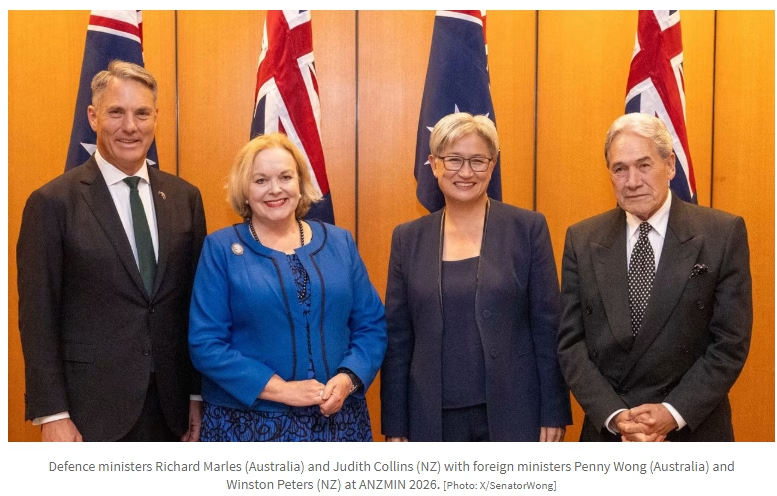
What Happened at the ANZMIN Meeting
Workers Across Asia-Pacific Rise: What Global Labour Protests Mean for New Zealand – WebfitNews
The annual ANZMIN meeting, held in Canberra, brought together foreign and defence ministers from both Australia and New Zealand. The key outcome was clear: both nations are committing to closer military cooperation under existing alliances like ANZUS, AUKUS, and the Quad.
Officials discussed improving coordination, joint training, and shared defence systems. The long-term goal is to build a more integrated “Anzac force” that can operate seamlessly together by 2035.
On paper, the messaging focused on “peace, stability, and prosperity” in the Indo-Pacific. But if you read between the lines, this is really about preparing for potential conflict, especially involving China.
Why This Matters Right Now
Timing is everything. This meeting comes during a period of global instability, including ongoing conflict involving Iran and broader geopolitical friction between major powers.
The Indo-Pacific region is becoming the central stage for global power competition. The United States sees China as its main strategic rival, and allies like Australia and New Zealand are increasingly being pulled into that orbit.
That creates a hard question:
Are these countries strengthening security, or stepping closer to future conflict?
Military Integration Is Accelerating
One of the most significant outcomes is the push for deeper “interoperability” between the two militaries. That means:
- Shared systems and equipment
- Joint procurement strategies
- More combined military exercises
- Exchange of senior defence personnel
Officials even described the two forces as becoming “force multipliers” for each other.
Translation in plain English:
They want to operate almost like one combined military when needed.
Rising Defence Spending
This alignment is not just talk. It is backed by serious money.
- Australia is investing tens of billions into long-range weapons and naval capabilities
- New Zealand plans to double defence spending to around 2 percent of GDP
That is a big shift for New Zealand, which traditionally maintained a more moderate military posture.
The focus is also changing. Instead of purely defensive capabilities, both countries are moving toward more combat-ready and globally deployable forces.
The China Factor
China sits at the centre of this entire strategy.
Both countries raised concerns about China’s actions in the South China Sea and broader regional influence. They also echoed familiar Western positions on Taiwan and human rights issues.
However, China responded strongly, accusing the alliance of bias and “colonial-style arrogance.”
This kind of back-and-forth is not new. But the tone is getting sharper, and that usually signals rising tension, not easing it.
The Pacific Region Is Becoming a Strategic Battleground
Another key focus is the Pacific.
Australia and New Zealand are increasing their military and diplomatic presence across Pacific Island nations. This includes:
- Expanding joint deployments
- Strengthening regional defence groups
- Increasing influence in smaller island nations
On the surface, this is framed as support for regional stability. But realistically, it is also about countering China’s growing influence in the Pacific.
This is where things get tricky. Smaller nations often become the middle ground in big power competition.
The Bigger Economic and Social Trade-Off
Here is where you need to pause and think.
While defence spending is increasing, both Australia and New Zealand are also facing:
- Cost of living pressures
- Strain on healthcare systems
- Housing affordability challenges
So the real question becomes:
Where should national priorities sit?
The report highlights that billions are being directed toward military capability, while public services continue to face funding challenges.
That tension is going to become more visible in public debate.
Political Consensus Is Strong
Interestingly, there is very little political disagreement on this issue.
Across both countries, major political parties broadly support closer ties with the United States and stronger defence alignment.
That means this direction is unlikely to change anytime soon, regardless of election outcomes.
Webfit News Perspective
Let’s be direct.
This is not just about defence cooperation. It is about positioning Australia and New Zealand within a global power structure that is becoming more divided.
The language used publicly talks about stability and security. But the actions point toward preparation and alignment for potential conflict scenarios.
New Zealand, in particular, is at a crossroads. It has long promoted an independent foreign policy. Now it is moving closer to a more traditional alliance-based approach.
The risk is not immediate war. The risk is a gradual escalation. Step by step, decision by decision, until involvement becomes inevitable.
And once you are in, there is no easy exit.
Conclusion
The ANZMIN meeting marks a clear shift in regional defence strategy. Australia and New Zealand are strengthening military ties, increasing spending, and aligning more closely with US-led initiatives.
For policymakers, this may be seen as necessary in a changing world.
For citizens, it raises important questions:
- What role should New Zealand play globally?
- How much defence spending is too much?
- And at what point does security planning become participation in conflict?
These are not abstract questions anymore. They are becoming real, and they deserve serious attention.
Source & Credit
Original reporting and analysis sourced from:
World Socialist Web Site (WSWS)
https://www.wsws.org/