
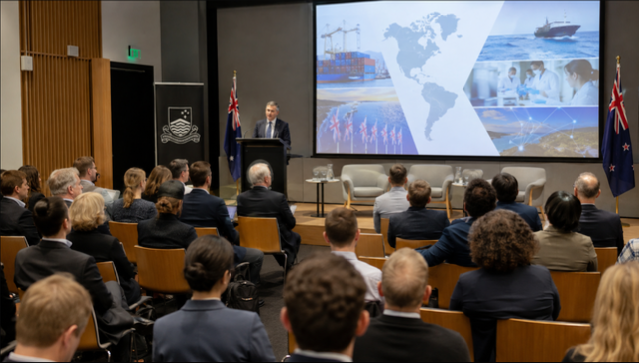
A series of major events at The Australian National University over the coming weeks will bring together researchers, policymakers, historians and industry experts to examine some of the biggest issues shaping the Asia-Pacific region.
From Vietnam’s economic rise and Australia-Japan relations to marine science, public health, war and the legacy of 9/11, the programme reflects how closely economic, environmental and security questions are now connected.
For New Zealand, many of the discussions are directly relevant.
Aotearoa faces the same strategic region, shares many of Australia’s economic and security concerns, depends heavily on Asia-Pacific trade and is grappling with similar questions around climate change, ocean protection, public health preparedness and regional stability.
The events form part of The Australian National University’s latest public programme in Canberra.
What is coming up at ANU
| Event | Date | Main focus |
|---|---|---|
| AMSA 2026 | 31 August to 3 September | Marine science and ocean policy |
| Meet the Author: Dr Joshua Black | 3 September | Political storytelling and political legacies |
| Vietnam Update 2026 | 4 September | 40 years of economic reform and Vietnam’s regional rise |
| World Field Epidemiology Day 2026 | 7 September | Outbreak response and global health security |
| Japan Update 2026 | 10 September | Japan’s economy, politics, foreign policy and Australia relationship |
| Meet the Author: James Curran | 10 September | Paul Keating’s global vision for Australia |
| 9/11 at 25 | 11 September | Security, war and democracy since 2001 |
| Robert O’Neill War Studies Lecture | 28 October | Australia’s transformation during the Second World War |
Taken separately, the events cover very different fields.
Taken together, they tell a broader story about the pressures facing countries such as Australia and New Zealand.
Vietnam at 40 years of Đổi Mới
One of the most relevant events for New Zealand will be the 2026 Vietnam Update Conference on 4 September.
The conference marks 40 years since Vietnam began the economic reform programme known as Đổi Mới.
Those reforms helped move Vietnam away from a highly centralised economic model towards a more market-oriented system and eventually transformed the country into one of Asia’s significant manufacturing and export economies.
The ANU conference will examine not only Vietnam’s economic achievements but also the social, environmental and geopolitical challenges accompanying that transformation.
For New Zealand, Vietnam is no longer a peripheral Southeast Asian market.
It is an increasingly important economic partner.
New Zealand and Vietnam elevated their relationship to a Comprehensive Strategic Partnership in 2025.
The two countries are also connected through several major regional trade frameworks, including the Comprehensive and Progressive Agreement for Trans-Pacific Partnership, the ASEAN-Australia-New Zealand Free Trade Area and the Regional Comprehensive Economic Partnership.
New Zealand Government reporting has identified Vietnam as one of the country’s strongest prospective export growth markets.
Two-way trade was worth more than NZ$3 billion in the year ended March 2025, with New Zealand exporting products including dairy, fruit, nuts and wood while importing machinery, electrical products and footwear.
Both countries have also stated an ambition to grow bilateral trade further.
So when ANU experts discuss Vietnam’s next economic phase, New Zealand businesses should be listening too.
Vietnam’s growth brings opportunity, but competition as well
Vietnam’s rise presents New Zealand with opportunity, but it also creates competition.
Its growing middle class could provide additional demand for New Zealand food, education, healthcare, technology and professional services.
But Vietnamese businesses are becoming more sophisticated themselves.
The country has become deeply integrated into international manufacturing supply chains and is increasingly attractive to companies looking to diversify production away from excessive dependence on individual markets.
For New Zealand businesses, that means Vietnam should not simply be viewed as somewhere to sell products.
It is increasingly a market in which long-term partnerships, investment, supply chains and regional strategy matter.
That is why understanding how Vietnam intends to manage its next stage of reform is important.
More than 600 experts discussing the future of the ocean
Another major event is AMSA 2026, bringing together more than 600 marine scientists, Indigenous knowledge holders and national science leaders.
The conference is one of the largest marine-science gatherings in the Southern Hemisphere.
Discussions will examine new developments in marine research and how scientific findings can inform government policy.
That has obvious relevance to New Zealand.
New Zealand is surrounded by ocean and has one of the world’s largest exclusive economic zones relative to its land area.
Its economy, biodiversity and national identity are closely connected to marine environments.
Fisheries, aquaculture, coastal tourism, shipping and offshore ecosystems all depend on effective management of the ocean.
Climate change is also placing increasing pressure on marine ecosystems through warming waters, changing species distribution, acidification and extreme weather.
For New Zealand, marine research is therefore not simply an environmental issue.
It is an economic and food-security issue as well.
Indigenous knowledge is becoming part of serious science discussions
The inclusion of Indigenous knowledge holders in AMSA 2026 is also significant.
Across Australia and New Zealand there is growing recognition that Indigenous knowledge systems can contribute meaningfully to environmental management.
In New Zealand, mātauranga Māori has long informed understanding of ecosystems, species and the relationships between communities and the natural environment.
There are legitimate debates about how different knowledge systems should interact with scientific methodology.
But the more constructive question is often where each can contribute.
Marine management is one area where that discussion will continue to matter for both countries.
Epidemiologists and the next health emergency
World Field Epidemiology Day at ANU will focus on the people who investigate disease outbreaks on the ground.
Field epidemiologists are often among the first specialists trying to answer critical questions during an emerging health crisis.
Where did an outbreak begin?
How quickly is it spreading?
Who is most vulnerable?
What interventions are working?
What should governments do next?
The COVID-19 pandemic demonstrated why these capabilities matter.
Countries can have excellent hospitals and still be badly exposed if they cannot quickly identify, track and contain new infectious threats.
New Zealand learned that lesson directly.
Its geographic isolation can provide some protection, but international travel means outbreaks can move across borders rapidly.
Pandemic preparedness therefore requires investment long before the next emergency begins.
Japan’s future matters to New Zealand too
Japan Update 2026 will examine Japan’s economy, domestic politics, foreign policy and its evolving relationship with Australia.
Although the event is framed through the Australia-Japan relationship, much of the discussion will also matter in Wellington.
Japan is one of New Zealand’s oldest and most important partners in Asia.
The countries cooperate across trade, diplomacy, security, the Pacific, energy and regional institutions.
Both are also members of the CPTPP.
Japan remains an important destination for New Zealand exports and a significant source of investment, tourism and commercial relationships.
Beyond economics, both countries have strong interests in a stable Indo-Pacific.
That includes freedom of navigation, resilient supply chains, regional security and a functioning international rules-based system.
Those concerns have become more important as strategic competition in the region intensifies.
New Zealand cannot treat regional security as somebody else’s problem
One lesson running through several of the ANU events is that smaller countries cannot isolate themselves from geopolitical change.
New Zealand is geographically distant from many of the world’s conflicts.
Economically, however, it is deeply connected to them.
Much of New Zealand’s trade moves through Asian maritime routes.
Energy supplies, manufactured goods, technology and critical components depend on international shipping.
Any serious regional disruption can therefore quickly become a New Zealand economic problem.
The New Zealand Government and ASEAN reaffirmed this point in July, stressing the importance of keeping land routes, airports and seaports open to support resilient supply chains and maritime trade.
That is why discussions about Japan, Southeast Asia and regional security should matter to ordinary New Zealand businesses as well as defence specialists.
Twenty-five years since 9/11
On 11 September, ANU’s Strategic and Defence Studies Centre will mark 25 years since the terrorist attacks of 11 September 2001.
The panel will examine the attacks’ impact on security, war and democracy.
That anniversary is likely to provoke difficult questions.
The attacks led to wars in Afghanistan and Iraq, dramatic expansion of counter-terrorism powers, increased surveillance and decades of debate over the balance between security and civil liberties.
Australia became closely involved in those conflicts.
New Zealand’s experience was different, but it was not untouched.
New Zealand deployed personnel to Afghanistan and strengthened domestic counter-terrorism systems.
The wider global security environment changed permanently.
Twenty-five years later, the important question is no longer simply what happened after 9/11.
It is what countries learned from it.
Democracies still face the security-versus-freedom problem
Every democracy faces a difficult balance.
Governments have a responsibility to protect the public.
But governments also have a responsibility to protect rights.
Security legislation introduced during emergencies can remain long after the original threat changes.
Technology has made that debate even more complicated.
Mass digital communication, artificial intelligence, facial recognition and modern surveillance systems provide governments with capabilities that would have seemed impossible in 2001.
For New Zealand, a country that places considerable value on democratic institutions and civil liberties, the lessons of the post-9/11 era remain relevant.
Political storytelling is not a trivial issue
Two ANU author events will focus on political identity and national direction.
Historian Dr Joshua Black will discuss his book Performance Politics, examining how Australian politicians use memoir, storytelling and public identity to shape their political legacies.
Historian James Curran will discuss Grand Ambition: Paul Keating’s Global Vision for Australia.
These topics may appear less urgent than war or economic reform, but they address something fundamental about democracy.
Politics is partly about policy.
It is also about storytelling.
Leaders tell voters who the country is, where it has come from and where it should go.
New Zealand politics works the same way.
Debates about immigration, Māori-Crown relations, economic reform, national identity, foreign policy and the Pacific are all influenced by competing stories about what New Zealand is supposed to be.
Understanding how political narratives are constructed therefore matters, particularly during an election period.
Australia’s wartime transformation offers another lesson
The Robert O’Neill War Studies Lecture in October will examine how the Second World War transformed Australia.
Professor Joan Beaumont will consider wartime economic mobilisation, industrial production and Australia's evolving relationship with the United States.
Again, the subject is historical, but the modern relevance is obvious.
Governments around the world are once more talking about economic resilience, defence production, strategic industries and secure supply chains.
The idea that countries can simply purchase whatever they need from the cheapest global supplier has been challenged by pandemics, wars and geopolitical competition.
New Zealand faces the same issue.
As a small and geographically isolated economy, it cannot manufacture everything.
But recent international disruptions have raised difficult questions about which supplies are too important to leave entirely exposed to global disruption.
Fuel, medicines, food inputs and critical technology all sit somewhere in that discussion.
What New Zealand should take from this programme
The ANU events are based in Canberra, but many of the questions being asked are genuinely trans-Tasman.
For New Zealand, several stand out.
Vietnam and Southeast Asia
New Zealand needs deeper economic engagement with Southeast Asia.
Vietnam’s growth offers real opportunity, particularly as New Zealand seeks greater diversification of export markets.
The ASEAN-New Zealand Comprehensive Strategic Partnership now provides a wider framework for that engagement through the themes of peace, prosperity, people and planet.
Japan
Japan remains both an important economic partner and an increasingly significant security partner in the Indo-Pacific.
New Zealand has strong reasons to deepen that relationship.
Oceans
Marine science will become more important as climate change, fisheries management and biodiversity pressures intensify.
For an ocean nation, this cannot be treated as a specialist environmental issue.
Health security
COVID-19 demonstrated that infectious disease can become an economic and social crisis almost overnight.
Public-health surveillance and field epidemiology deserve continuing investment even when no major outbreak is dominating headlines.
Security and democracy
Countries need security institutions capable of responding to genuine threats without gradually normalising unnecessary restrictions on democratic freedoms.
That balance will become more difficult as surveillance technology develops.
Supply-chain resilience
New Zealand remains highly exposed to international disruption.
Building resilience does not necessarily mean attempting to manufacture everything domestically.
It means understanding where the country's vulnerabilities lie and building reliable partnerships before a crisis begins.
Why Australian academic debates matter in New Zealand
New Zealanders sometimes look across the Tasman and assume Australia's policy debates belong to Australia.
Increasingly, that distinction is artificial.
The two countries share defence relationships, trade agreements, migration flows, environmental systems and overlapping strategic interests.
They operate in the same Indo-Pacific region.
They face many of the same external risks.
And because Australia is substantially larger, policy discussions often develop there earlier or at greater scale.
That does not mean New Zealand should simply copy Australian policy.
It means New Zealand should pay attention.
Universities such as ANU bring together people who can examine issues before they become immediate political crises.
That is valuable.
The bigger message
Perhaps the strongest theme connecting the ANU programme is that the major issues confronting countries today no longer fit neatly into separate boxes.
Trade is connected to security.
Security is connected to supply chains.
Climate change is connected to food systems and oceans.
Public health is connected to national resilience.
Technology is connected to democracy.
Regional partnerships influence all of them.
For New Zealand, which depends heavily on international trade and stable relationships but has limited ability to shape global events alone, that interconnectedness matters enormously.
The strategic advantage of a smaller country comes partly from recognising change early and building strong relationships before circumstances force it to react.
The conversations taking place at ANU over the coming weeks may be Australian in location.
Many of the questions are just as much New Zealand’s.
Sources: The Australian National University; New Zealand Ministry of Foreign Affairs and Trade; New Zealand Government information on ASEAN, Vietnam, Japan and the CPTPP.