
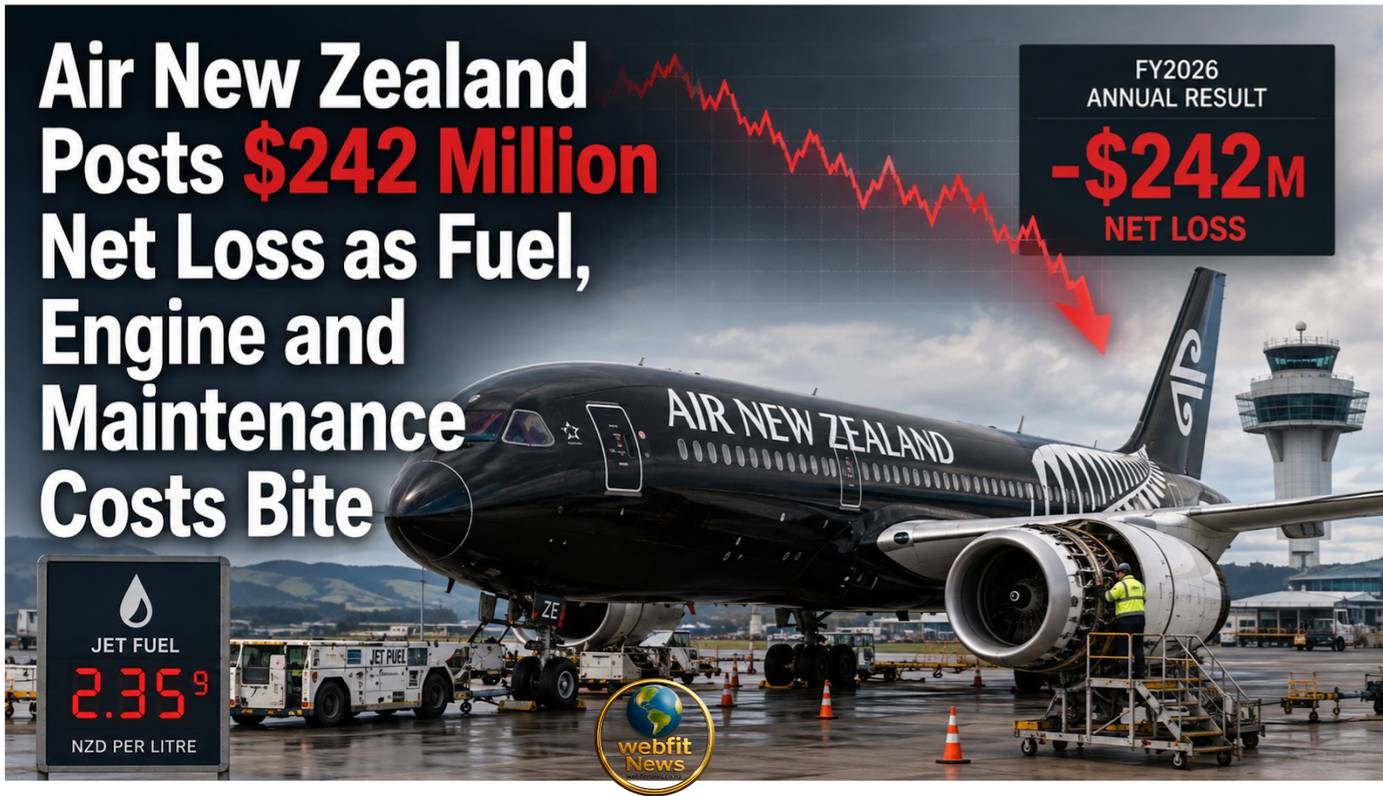
Air New Zealand has reported a net loss after tax of $242 million for the 2026 financial year, as soaring fuel prices, engine availability problems, rising aviation system charges and heavy maintenance costs weighed on the national carrier.
The airline recorded a loss before tax of $336 million, compared with earnings before tax of $164 million in the previous year.
Despite the loss, total revenue rose 3.9 percent to $7.0 billion, while passenger revenue increased 4.8 percent to $6.1 billion.
Operating cash flow fell to $819 million, down from $940 million in 2025.
No final dividend has been declared.
Four major pressures drove the result
Air New Zealand said the 2026 result was largely shaped by four significant cost pressures.
Fuel prices
The Middle East conflict pushed jet fuel costs sharply higher in the second half of the year.
Air New Zealand estimates fuel costs were $328 million higher than expected going into the second half.
After hedging, the increase was around $205 million, while the estimated impact on the pre-tax result was about $135 million after fare changes and capacity reductions were taken into account.
Jet fuel averaged US$111 per barrel during the financial year, compared with US$88 in 2025.
Fuel prices were actually four percent lower in the first half of the year compared with the same period in 2025, but that improvement was overwhelmed by a 58 percent increase in the second half.
Engine availability
Ongoing issues involving Rolls-Royce Trent 1000 and Pratt & Whitney PW1100 engines cost the airline an estimated $190 million.
The impact came through lost capacity, additional aircraft leasing and engine costs, lower fleet utilisation and wider operating inefficiencies.
However, Air New Zealand says the engine problems that have constrained the network for several years are now substantially behind it.
More aircraft had returned to service by the end of the financial year, leaving the airline in what chief executive Nikhil Ravishankar described as a considerably more reliable fleet position heading into 2027.
Aviation system costs
The airline said aviation system charges have become another major pressure.
Air New Zealand and its customers faced around $1.2 billion in aviation system charges across New Zealand and overseas ports in 2026, up $142 million from 2025.
Of that, approximately $720 million was recognised as a cost in Air New Zealand's financial statements, around $83 million more than the previous year.
The airline said New Zealand aviation costs have risen at more than twice the rate of inflation since 2019.
Maintenance
Aircraft maintenance was another major hit.
Air New Zealand described 2026 as a peak maintenance year, with costs rising by $139 million, excluding foreign exchange effects.
That increase was driven by lifecycle maintenance and additional maintenance work on leased engines.
Passenger revenue rises despite pressure
While the airline moved into loss, passenger revenue continued to grow.
Passenger revenue reached $6.1 billion, up 4.8 percent from 2025.
Network capacity increased 1.3 percent, helped by previously grounded aircraft returning to service. That increase was partly offset by capacity reductions introduced in response to high fuel prices.
Group Revenue per Available Seat Kilometre rose 3.4 percent, reflecting fare adjustments and capacity management.
Cargo revenue fell slightly, declining 0.6 percent to $484 million as higher fuel costs affected freight demand.
Total operating costs increased 11.8 percent, while non-fuel operating costs rose 10 percent, or $438 million.
Airline says reliability is improving
Ravishankar said the financial result reflected a difficult aviation environment, but argued the airline had made progress in areas it could control.
On-time performance improved from 77.5 percent in 2025 to 84 percent in the second half of 2026.
The airline said customer satisfaction also improved.
Air New Zealand has been working through a broader operational review, including new digital tools to improve communication and decision-making.
The airline says its goal is to become one of the world's top five airlines for reliable and punctual operations.
It has also completed upgrades on 9 of its 14 Boeing 787 aircraft, with the remaining aircraft due to be completed by November.
Cost-cutting continues
The airline said it delivered $94 million in incremental transformation benefits during 2026.
It has also identified another $135 million in annualised savings expected to flow from the 2027 financial year.
Those savings include the $100 million previously announced in May.
The cost programme includes restructuring across parts of the organisation, reducing duplication, sharpening accountability and improving productivity.
New strategy focuses on growth and resilience
In June, Air New Zealand launched its new strategy, Te Pae Hou - Our Future.
The strategy is built around three priorities:
- Customer First, focusing on reliability, service, products and smarter customer offers
- Targeted Growth, including profitable network expansion, loyalty programme changes and new revenue streams
- Resilient and Future Fit, including cost reduction, regional network sustainability and tighter capital management
Chair Dame Therese Walsh said the airline's long-term strength was closely linked to New Zealand's broader economic performance.
She said a stronger Air New Zealand would support tourism, exports and long-term national prosperity.
2027 expected to be a transition year
Air New Zealand is not providing earnings guidance for the 2027 financial year because of continued uncertainty around the Middle East conflict and fuel prices.
Jet fuel is currently around US$150 per barrel.
The airline said that before the conflict it would have expected, in its central case, to return to profitability in 2027.
Engine-related disruption is expected to reduce substantially, although the airline still expects a financial impact of around $70 million to $90 million next year.
Aircraft maintenance costs are forecast to be $50 million to $100 million lower than in 2026.
However, aviation system charges are expected to keep rising, with airport charges at some ports likely to increase by more than 10 percent during the year.
Air New Zealand expects 2027 to be both a transition and recovery year.
Ravishankar said strong forward bookings into New Zealand were an encouraging sign for tourism and the wider economy.
The airline plans to provide a more detailed update on its strategy and medium-term financial objectives at an Investor Day later this year.