
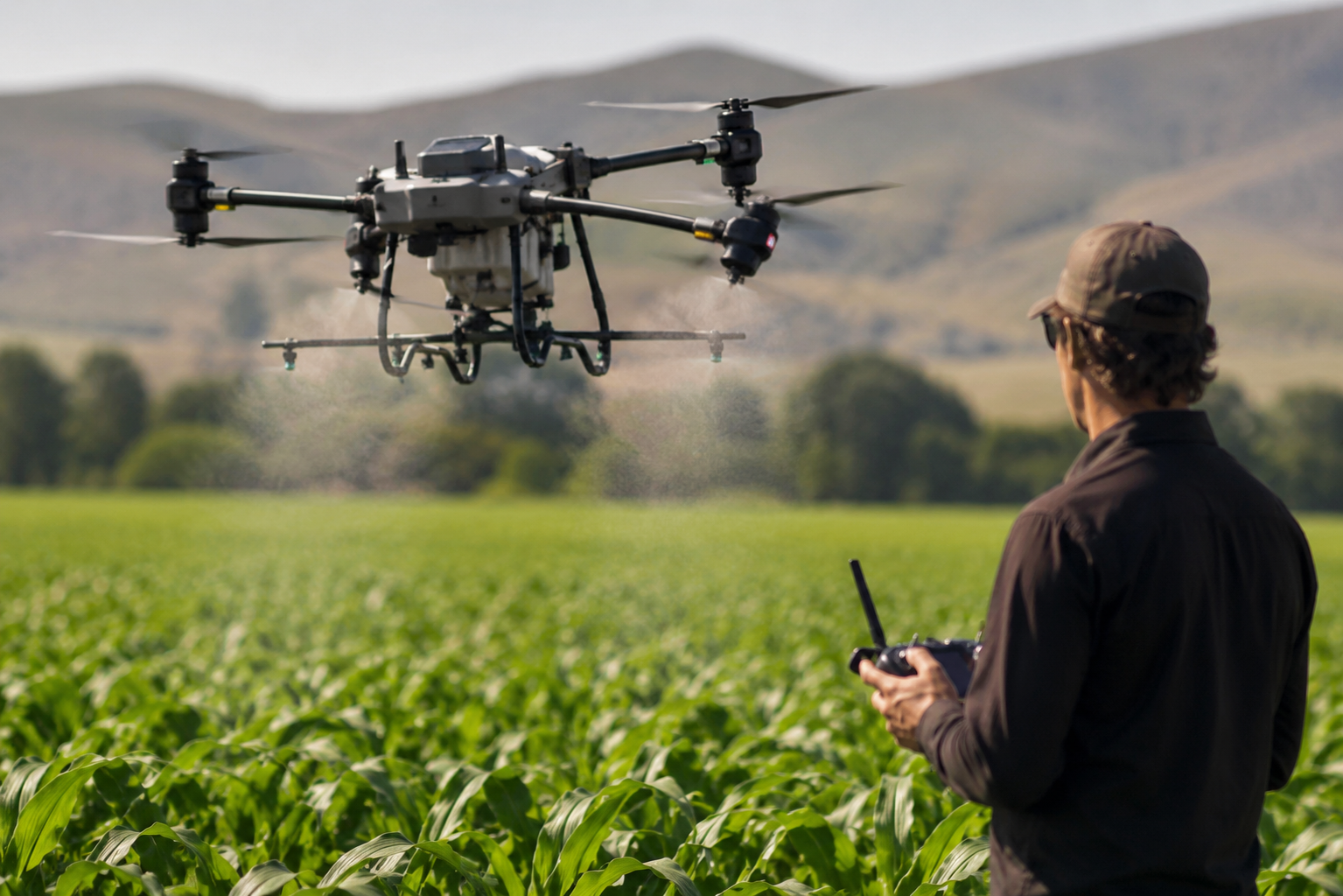
Agricultural drones are already becoming part of everyday life on some New Zealand farms.
Farmers use them to check stock, inspect crops, assess flood damage, map paddocks and monitor difficult terrain.
But using a drone to actually spray fertiliser or agrichemicals has been a very different story.
Federated Farmers says the current rules have made that much harder, with some farmers facing the prospect of applying for a Part 102 certificate and potentially waiting years to find out whether they will get one.
For many, the process has simply not been worth the effort.
Now the Government is moving to cut that red tape.
The changes are expected to come into effect in mid-2027 and are intended to make agricultural drone use more accessible while still keeping appropriate safety protections in place.
For farmers, this could be an important practical change.
Not because drones are new.
Because the rules may finally become more workable for the kind of jobs farmers actually want to use them for.
What is the problem with the current system?
New Zealand currently regulates most drone operations under two main sets of aviation rules.
Part 101
Part 101 covers lower-risk drone operations.
Most ordinary drone users operate under this system.
A farmer can generally use a small drone for activities such as:
- checking stock
- inspecting fences
- surveying land
- mapping paddocks
- checking crops
- photographing flood damage
- monitoring farm infrastructure
If the operation stays within the conditions of Part 101, no Part 102 certificate is required.
That is one reason small drones have already become common on farms.
They are relatively easy to use for routine observation, checking and monitoring work.
Part 102
Part 102 is different.
It is a risk-based certification framework for operations that sit outside the simpler Part 101 rules.
Agricultural spraying and topdressing currently fall into this higher-risk category.
That means a farmer wanting to use a drone to apply fertiliser or agrichemicals can face a much more involved process.
Federated Farmers says this is where frustration has built up.
Transport spokesperson Chris Dillon says farmers have been telling the organisation for some time that the rules around agricultural drone use were getting in the way of innovation.
He says that under the current system, farmers wanting to use drones for applications such as spraying fertiliser or agrichemicals have faced the prospect of applying for a Part 102 certificate and potentially waiting years for an outcome.
"For many farmers, that simply wasn't worth the hassle, so they haven't even bothered," Dillon says.
That is the barrier the Government is now trying to reduce.
Why is spraying treated differently?
At first glance, it may seem strange that a farmer can fly a drone over a paddock to take photographs, but faces much more regulation when the same technology is used to spray fertiliser or agrichemicals.
There is a reason.
Once a drone starts carrying and releasing material, the risks become more complicated.
Regulators have to consider issues such as:
- aircraft weight
- chemical handling
- pilot competency
- drift onto neighbouring properties
- people or livestock below the flight path
- proximity to roads or buildings
- other aircraft operating nearby
- loss of control while carrying a chemical payload
- environmental and health risks
- emergency procedures
So the existing rules are not simply bureaucracy for the sake of bureaucracy.
Spraying is genuinely different from taking aerial photographs.
The real question is whether the current certification system is proportionate to the actual risk involved in routine agricultural drone use.
That is the issue the Government is now trying to address.
Why does this matter to farmers?
The biggest potential advantage is precision.
Drones can potentially apply fertiliser or agrichemicals exactly where they are needed rather than treating larger areas unnecessarily.
That matters because fertiliser and agrichemicals cost money.
If a farmer can use less product and still treat the right area effectively, that can improve efficiency and reduce waste.
Dillon says this is one of the main reasons Federated Farmers supports the change.
"Drones can apply fertiliser and agrichemicals with incredible precision, targeting exactly where they're needed rather than treating areas unnecessarily," he says.
"That means less product being used, which is good for farmers' bottom lines and good for the environment."
What could a drone actually do on a farm?
Federated Farmers says drone use is already high for routine jobs such as mustering, checking crops and doing flood assessments.
That gives a useful indication of where the technology is heading.
A farmer may already be using a drone to inspect a paddock from the air.
The next step is being able to use that same technology as an actual working tool.
For example, drones could be useful for:
- targeting small weed infestations
- applying agrichemicals to difficult areas
- spreading fertiliser more precisely
- checking and treating areas that are hard to reach
- working across steep or wet ground
- reducing the need to cover an entire paddock
- reaching places where conventional machinery may not be practical
The value will vary from farm to farm.
But the principle is simple.
A drone can go where it is needed and treat only the area that actually requires attention.
Why are more farmers interested in drones?
One reason is accessibility.
Dillon says more farmers are starting to use drones after seeing them demonstrated at farm discussion groups.
He also says smaller drones do not cost a lot to buy.
That matters because technology only becomes useful when it is practical enough for farmers to adopt.
A machine can be impressive, but if it is too expensive, too complicated or tied up in regulation, most farmers will not bother.
The same applies to certification.
If a farmer can use a drone easily for checking stock but faces years of uncertainty before being allowed to use it for spraying, the incentive quickly disappears.
That is exactly the problem Federated Farmers says the new rules should fix.
Could this reduce fertiliser and chemical use?
Potentially, yes.
That is one of the strongest arguments in favour of agricultural drones.
Traditional application methods can sometimes result in larger areas being treated than necessary.
A drone can potentially focus on a specific section of land.
For example, if weeds are concentrated in one part of a paddock, a farmer may be able to treat that area rather than applying product across the whole block.
That does not mean drones will always use less product in every situation.
But more accurate application gives farmers the opportunity to reduce unnecessary use.
That can save money and may also reduce environmental impact.
The safety rules will still matter
Cutting red tape should not mean abandoning aviation or chemical safety.
Federated Farmers itself says the final rules need to provide flexibility while maintaining appropriate safety protections.
That balance will be important.
Agricultural drones may still need requirements around:
- operator training
- aircraft maintenance
- chemical-use competency
- record keeping
- safe distances
- operating conditions
- emergency procedures
- airspace awareness
New Zealand's aviation framework already recognises that agricultural aviation requires specific competency.
Aerial spraying and topdressing are more complex than simply flying a camera drone.
Once chemicals, fertiliser or other products are being applied, operators have additional responsibilities.
Those responsibilities can involve the people below, nearby properties, livestock, the environment and other aircraft.
So the aim should not be to remove safety rules.
It should be to make them proportionate and practical.
Why practical rules matter
Farm environments are not the same as suburban streets or urban construction sites.
Farmers can be dealing with:
- large properties
- steep terrain
- isolated paddocks
- changing weather
- livestock
- mud
- flood damage
- difficult access
Rules written without understanding those conditions can quickly become impractical.
That is why Federated Farmers says it will work with Government and officials to make sure the final rules reflect real-world agricultural conditions.
The organisation wants farmers to have enough flexibility to actually use the technology, while maintaining sensible protections.
Does this mean farmers will be able to spray anything anywhere?
No.
The changes should not be interpreted as permission to use agricultural drones without controls.
The new rules are still being worked through.
Federated Farmers has made it clear that safety remains part of the discussion.
There may still be requirements around competency, operation, record keeping and the safe use of products.
The difference is that the process should become more accessible and less burdensome than the current system.
Could drones replace helicopters?
Probably not in every situation.
Helicopters and other aircraft can cover large areas quickly and carry much bigger loads.
For major topdressing or spraying jobs, they may remain the best option.
Drones are likely to be more useful where precision matters more than sheer scale.
That may include smaller treatment areas, difficult terrain, steep land and locations where farmers do not need to treat an entire block.
So this is not really about replacing agricultural aviation.
It is about giving farmers another tool.
Could drones replace tractors and ground spraying?
Again, not completely.
Ground-based machinery will remain useful for many jobs.
But tractors and sprayers have their own limitations.
They can struggle on steep or wet land.
They can damage soft ground.
They take time to move around large properties.
And they may treat more area than is necessary in some situations.
A drone can potentially avoid some of those problems.
The best option will depend on the job.
What is the real meaning of this policy change?
The importance of the Government's decision is not simply that drones will become easier to fly.
Farmers are already flying them.
The important change is that drones may become easier to use as genuine agricultural equipment.
That is a much bigger step.
A drone that only looks at a problem is useful.
A drone that can also help treat the problem is potentially much more valuable.
That is why the agricultural sector is paying attention.
What could farmers gain?
If the final rules are practical, the benefits could include:
- more precise fertiliser use
- more targeted agrichemical application
- less wasted product
- lower operating costs in some situations
- easier access to difficult terrain
- faster response to problem areas
- less reliance on heavy machinery in some cases
- improved environmental performance through more precise application
The size of those benefits will depend on the farm and the type of operation.
But the potential is clear.
What are the risks?
There are also risks that should not be ignored.
More drones operating on farms could increase the need for good training and responsible operation.
Possible concerns include:
- chemical drift
- aircraft failure
- poor maintenance
- inexperienced operators
- unsafe flying near roads or buildings
- interaction with helicopters or other aircraft
- loss of control
- inappropriate use of agrichemicals
That is why safety still needs to remain part of the final framework.
The challenge is finding the right balance.
Too much regulation can stop farmers using useful technology.
Too little regulation can create unnecessary risk.
What happens next?
Federated Farmers says it will now work with Government and officials to help make sure the final rules are practical for farmers operating in real agricultural environments.
The changes are due to come into effect in mid-2027.
Between now and then, the detail will matter.
Farmers will want a system that is simple enough to use.
Officials will want to make sure safety is protected.
The final rules will need to do both.
The bottom line
The Government's decision is about removing a regulatory barrier that Federated Farmers says has discouraged farmers from using drones for spraying and other agricultural applications.
The potential benefits are not theoretical.
They are practical.
More precise use of fertiliser.
More targeted spraying.
Less unnecessary product.
Lower costs in some situations.
Easier access to difficult areas.
And the possibility of turning drones from simple observation tools into genuine pieces of farm equipment.
But this is not about removing all rules.
The strongest version of the reform will be one that makes agricultural drone use easier while still requiring sensible standards around safety, training and responsible chemical application.
If that balance is achieved, the changes expected in mid-2027 could make drones a much more useful part of everyday farming in New Zealand.
Source: Federated Farmers